You’ve just unboxed your new handheld gaming beast. The screen is gorgeous, promising an epic visual feast. You fire up your favourite AAA title, crank every setting to Ultra, and… the framerate chugs. It’s a classic story for many South African gamers. The dream of high-resolution mobile gaming often collides with the reality of performance limits. But what if you could have both? What if sharpness and smooth gameplay weren't mutually exclusive? Let's dive in. 🚀
What is High-Resolution Mobile Gaming, Really?
When we talk about achieving sharp visuals on the go, we're discussing more than just 1080p or 1440p. On the compact screen of a handheld console or a high-end smartphone, what truly matters is pixel density (PPI)—how many pixels are packed into each inch. A higher PPI means a sharper, more detailed image where you can't distinguish individual pixels, creating a super-immersive experience.
This is a massive leap from the mobile games of a few years ago. Today, we're playing fully-fledged PC titles on the move, and our expectations for visual quality have skyrocketed. This new era of portable power is driven by a fantastic range of handheld gaming consoles that bring desktop-level experiences right into your hands.
The Great Balancing Act: Frames vs. Visual Fidelity
Here's the fundamental trade-off: every pixel on your screen demands power from the device's graphics processing unit (GPU). A QHD+ screen (2560x1600) has nearly three times as many pixels as a standard Full HD screen (1920x1080). Rendering a game at that native resolution requires immense graphical horsepower.
Pushing all those pixels can cause your frame rate (FPS) to drop. For most gamers, a smooth 60 FPS is the gold standard. Anything less can feel sluggish or choppy, especially in fast-paced action or competitive games. So, do you choose breathtaking sharpness or buttery-smooth performance? The ASUS ROG Ally, for instance, tackles this by pairing a high-refresh-rate 1080p screen with a powerful AMD Z1 Extreme chip, aiming for a perfect blend of clarity and speed right out of the box.
The Smart Solution: Upscaling Magic ✨
Thankfully, you don't always have to choose. The secret weapon in the world of high-resolution mobile gaming is upscaling technology. Technologies like AMD's FidelityFX™ Super Resolution (FSR) and Intel's Xe Super Sampling (XeSS) are brilliant solutions to the performance problem.
Here’s how they work in simple terms:
- The game is rendered internally at a lower, less demanding resolution (like 720p).
- A sophisticated algorithm then intelligently upscales the image to fit your screen's native resolution (like 1080p or 1440p).
- The result? You get a sharp, clean image that looks close to native resolution, but with a massive FPS boost.
This technology is a core feature in modern devices. New contenders like the MSI Claw, powered by Intel's new Core Ultra processors, are built to take full advantage of AI-driven upscaling with XeSS, promising excellent performance and image quality.
Check Your Game Settings 🔧
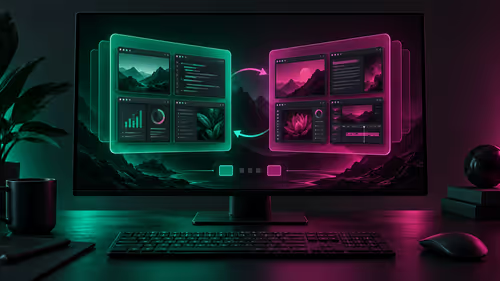
Most modern PC games ported to handhelds now include dedicated upscaling options like FSR or XeSS. Before lowering your resolution manually, always check the graphics settings for an "Upscaling" or "Resolution Scaling" option. Setting this to "Performance" or "Balanced" can give you the best of both worlds without much effort!
Optimising Your Handheld for Peak Performance
Getting the most out of your device isn't just about what's under the hood; it's about how you tune it. Achieving the perfect balance for sharp mobile gaming often comes down to a few smart tweaks.
Find Your Sweet Spot
Don't be afraid to experiment. Start with the game at your screen's native resolution and medium settings. See what frame rate you get. If it's below your target (e.g., 60 FPS), try enabling FSR or XeSS on a "Quality" or "Balanced" preset. If that's not enough, then consider lowering the in-game resolution. Devices with unique, high-resolution displays like the QHD+ screen on the Lenovo Legion Go truly shine when you find that perfect combination of upscaling and native settings.
Use Built-in Software
Most handhelds come with specialised software (like Armoury Crate SE or Legion Space) that lets you control the device's power profile (TDP). For a demanding game, switching to a "Performance" or "Turbo" mode can provide the extra juice needed to maintain smooth frame rates at higher resolutions.
The era of compromise is ending. With powerful hardware and intelligent software, achieving crisp, smooth, high-resolution mobile gaming is more accessible than ever. It's about understanding the tools at your disposal and finding the perfect setup for the games you love to play.
Ready to Experience Gaming on the Go?
The world of handheld PC gaming offers incredible power and flexibility. For the ultimate combination of performance, sharp displays, and value in South Africa, a modern handheld is hard to beat. Explore our massive range of handheld gaming consoles and find the perfect device to conquer your world.