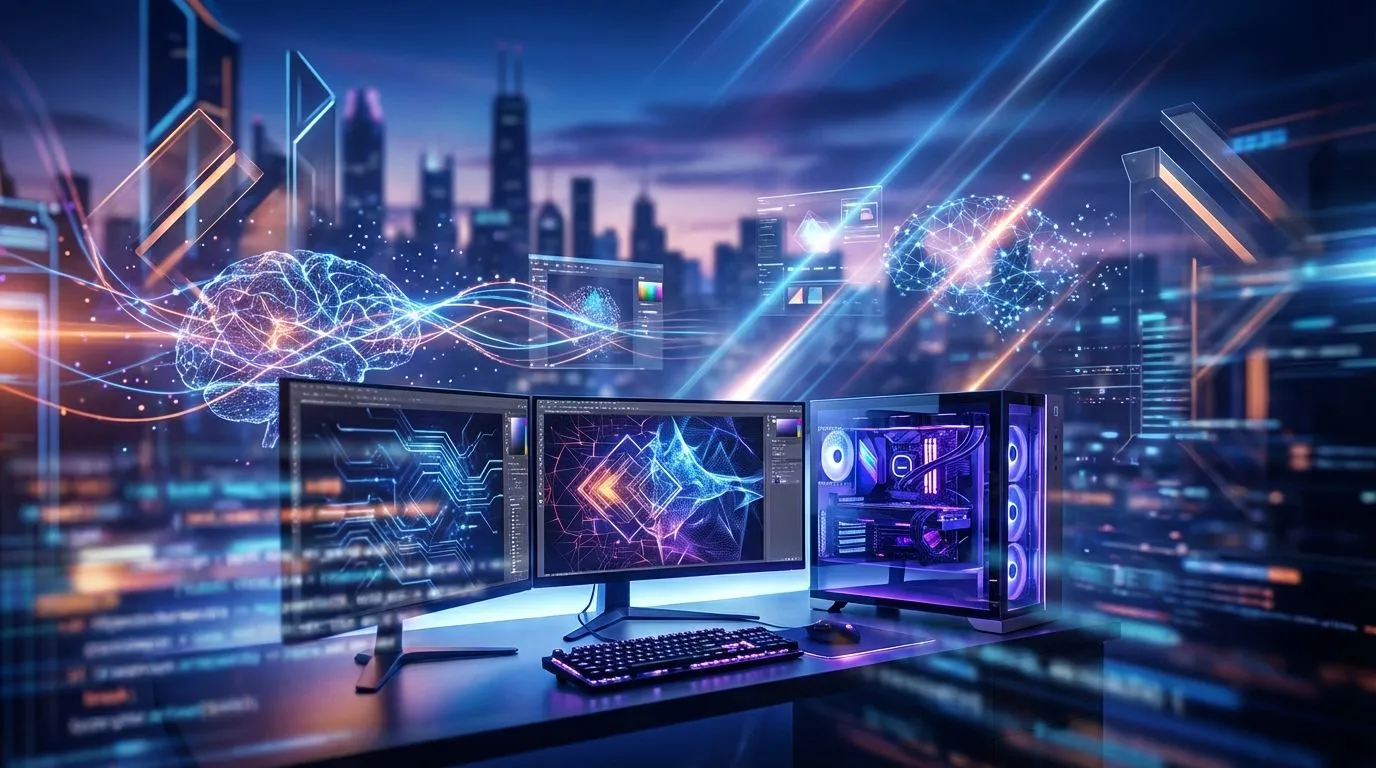
Juggling clients, deadlines, and a lagging PC? For South African freelance designers, the dream of creative freedom can quickly turn into a nightmare of render queues and crashing software. You know a high-spec workstation could solve it, but that price tag… yoh! Is the massive Rand investment really worth it for your freelance ROI?
Let’s break down the numbers and see if that beastly machine will actually make you money, or just look pretty on your desk. ✨
The Real Cost of a Slow PC: More Than Just Rands
Before we talk about spending money, let's talk about what your current setup is costing you. It’s not just the frustration. Every spinning wheel and "Not Responding" message is a direct hit to your bottom line.
Think about it:
- Lost Billable Hours: Time spent waiting is time you can't bill. A 15-minute render delay, four times a day, is an hour lost. Over a month, that's serious cash left on the table.
- Creative Friction: When your tools can't keep up with your ideas, your creativity suffers. You start avoiding complex effects or larger files, limiting the quality of your work.
- Missed Deadlines: In the fast-paced world of freelance, a reputation for being late is a death sentence. A powerful PC is your insurance policy for delivering on time, every time.
A slow machine isn't a quirk; it's a bottleneck that actively shrinks your earning potential.
Breaking Down the ROI on a High-Spec Workstation
So, how does a powerful rig translate into a return on investment (ROI)? Let's do some quick "back-of-the-napkin" maths.
Imagine a new high-spec workstation for designers saves you just 5 hours per week. If your billable rate is a modest R450/hour, that’s R2,250 saved per week. That's R9,000 per month. Suddenly, even looking at powerful machines over R20,000 seems less like an expense and more like a strategic investment that could pay for itself in just a few months.
This calculation doesn't even include the ability to take on more complex, higher-paying projects that your old machine couldn't handle. The ROI isn't just about saving time; it's about unlocking new revenue streams.
What Specs Actually Matter for Your Design Workflow? ⚙️
Not all components are created equal, and what a gamer needs isn't always what a designer needs. Here’s a quick guide to building a smart workstation for designers.
CPU: The Brain of Your Operation
The Central Processing Unit (CPU) is your workhorse. For design, you need a balance of:
- High Core Count: Essential for 3D rendering (like in Blender or Cinema 4D) and video encoding, where the workload can be split across many cores.
- Fast Clock Speed: Crucial for tasks that rely on a single core's performance, like navigating the interface in Photoshop or Illustrator.
RAM: Your Creative Multitasking Fuel
Random Access Memory (RAM) is your short-term workspace. Running multiple Adobe apps, a browser with 50 tabs, and Spotify all at once? That's all RAM. 16GB is the absolute minimum today, but 32GB is the sweet spot for serious creative work, preventing slowdowns when working with large files. For video editors and 3D artists, 64GB is the new standard.
Productivity Pro Tip ⚡
When choosing RAM, look for two sticks (e.g., 2x16GB) instead of one (1x32GB). This allows your system to run in "dual-channel" mode, significantly increasing memory bandwidth and giving you a noticeable performance boost in memory-intensive applications like Adobe After Effects.
GPU: The Visual Powerhouse
Your Graphics Processing Unit (GPU) handles everything you see on screen. For designers, it accelerates tasks in programs like Photoshop, Premiere Pro, and DaVinci Resolve. While specialised Quadro cards are an option, many of the best gaming PC deals feature NVIDIA GeForce RTX cards that offer incredible performance for creative work, especially with their powerful CUDA cores for rendering.
Storage: Speed is Everything
Forget old-school hard drives for your main OS and applications. An NVMe SSD (Non-Volatile Memory Express Solid-State Drive) is non-negotiable. It drastically cuts down on boot times, application loading, and file-saving speeds. You can always add a larger, cheaper hard drive for long-term storage and archives. Even a PC with solid options under R20,000 should be built around a fast NVMe drive.
Finding Your Sweet Spot: Custom vs. Pre-Built
Now that you know what to look for, where do you get it?
- Custom-Built: Offers total control over every component, but requires research and assembly. It's the path for ultimate optimisation.
- Pre-Built: A fantastic option for creatives who just want to plug in and go. You get a balanced, tested system with a full warranty. Exploring a range of pre-built PC deals is often the fastest way to get up and running.
Don't overlook another great entry point: many budget gaming PCs have the core components—a decent CPU, a capable GPU, and fast SSD—to serve as an excellent starting workstation for graphic designers or photographers.
The Verdict: A Smart Move for Your Freelance Career 🚀
Is a high-spec workstation for designers worth the freelance ROI? Absolutely.
It’s not a luxury item; it's a fundamental business tool that directly impacts your productivity, the quality of your work, and your overall earning potential. By investing in the right hardware, you're not just buying a faster computer—you're buying back your most valuable asset: time.
Ready to Build Your Creative Powerhouse?
Investing in a high-spec workstation isn't an expense; it's an upgrade to your entire freelance business. Stop waiting for renders and start creating at the speed of thought. Explore our massive range of custom and pre-built PCs and find the perfect machine to accelerate your success.