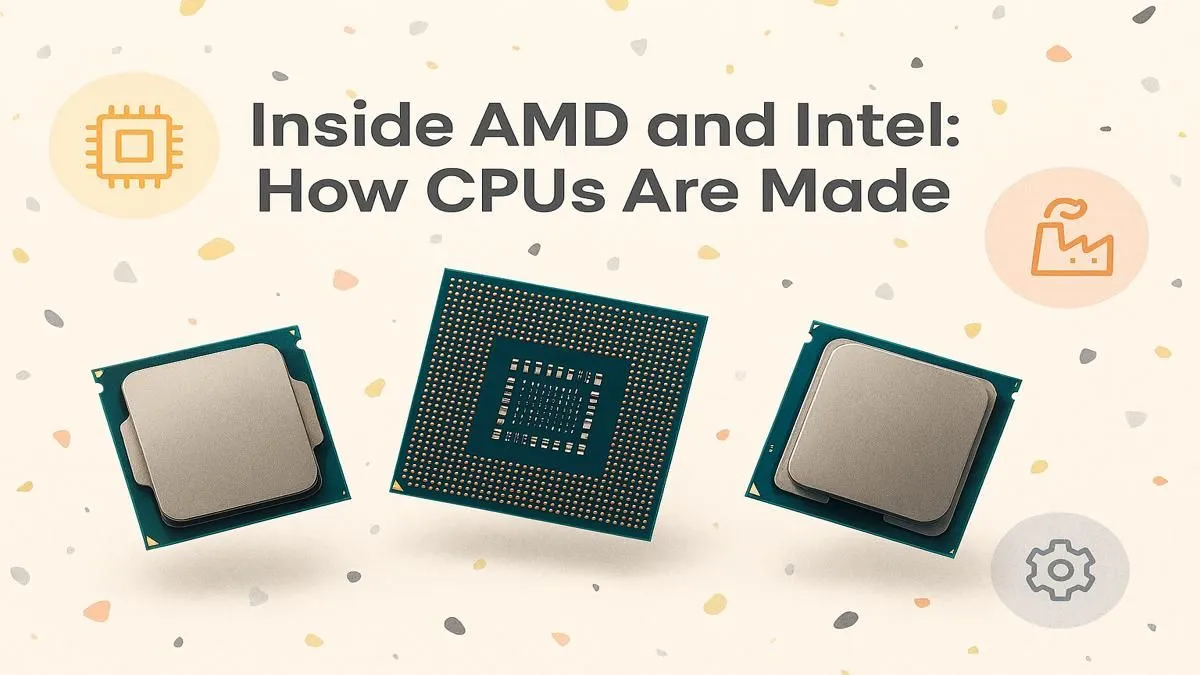
Ever stared at your PC, mid-game, and wondered what magic happens inside that tiny chip? The CPU, your rig’s brain, starts its life as simple sand. That's right... sand! From a beach element to a powerhouse capable of rendering entire worlds, the journey is one of the most incredible feats of modern engineering. We’re pulling back the curtain on how CPUs are made, revealing the secrets behind the Intel and AMD manufacturing process.
From Grains of Sand to Gaming Genius 🔧
Before we dive into the complex steps, let's get the basics right. A Central Processing Unit (CPU) is an intricate circuit containing billions of microscopic switches called transistors. These transistors, turning on and off billions of times per second, perform the calculations that run your games, your operating system, and everything in between.
The primary material for this technological marvel? Silicon. It's sourced from silicon dioxide, which is just a fancy name for quartz, the main component of common sand. The journey from a handful of sand to a high-performance processor is a testament to human ingenuity.
Inside the CPU Manufacturing Process: A Step-by-Step Look
The CPU manufacturing process is arguably the most precise and complex mass-production process on Earth. It happens in ultra-clean environments called "fabs" (fabrication plants), which are thousands of times cleaner than a hospital operating theatre. A single speck of dust can ruin a chip.
Step 1: Creating the Perfect Silicon Wafer
The process begins by purifying the sand to produce 99.9999999% pure electronic-grade silicon. This silicon is melted down and grown into a massive, single-crystal cylinder called an ingot. This ingot, which can weigh over 100 kilograms, is then sliced into perfectly thin, polished discs called wafers. These wafers are the canvas upon which hundreds of CPUs will be printed.
Step 2: Photolithography – Printing with Light 💡
This is the heart of how processors are made. Photolithography is a process that uses deep ultraviolet (DUV) light to etch the complex transistor patterns onto the silicon wafer, layer by layer.
- A layer of light-sensitive material (photoresist) is applied to the wafer.
- A "mask," which acts like a stencil for a single layer of the CPU's design, is placed between the light source and the wafer.
- The DUV light shines through the mask, hardening the exposed photoresist.
- The unhardened photoresist is washed away, revealing a pattern on the silicon.
- This pattern is then permanently etched into the silicon, and materials are deposited or implanted (a process called doping) to create the transistors.
This entire sequence is repeated dozens, sometimes hundreds, of times to build up the intricate, multi-layered structure of a modern CPU.
What is CPU Binning? 🧐
Ever wondered why an Intel Core i9 and a Core i5 can come from the same production line? It's due to a process called 'binning'. Not all chips on a wafer perform equally. After manufacturing, they are tested and sorted (or 'binned') based on their stability at certain clock speeds and voltages. The best performers become high-end models, while those with minor imperfections are designated as lower-tier models. It's a smart way to maximise yield and offer different price points!
Step 3: Dicing, Testing, and Packaging
Once all the layers are complete, the wafer is a grid of hundreds of potential CPUs, called "dies." The wafer is tested to identify faulty dies, which are marked. A diamond saw then dices the wafer, separating the individual dies.
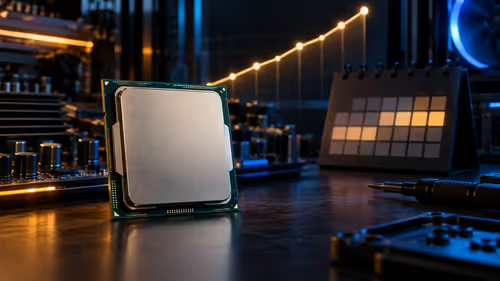
The working dies are then packaged—mounted onto a substrate that provides the pins to connect to your motherboard and covered with a heat spreader. After a final round of testing, every single one of the hundreds of CPU processors born from that single wafer is ready to be shipped.
How Intel & AMD's Manufacturing Philosophies Differ
While the fundamental principles are similar, the business models for Team Blue and Team Red are quite different, which impacts how their CPUs are made.
- Intel: The Integrated Model
Intel is an Integrated Device Manufacturer (IDM). This means they design and manufacture their own chips in their own fabs. This gives them end-to-end control over the quality and supply chain of every Intel CPU they produce, allowing for deep integration between design and production.
- AMD: The Fabless Model
AMD, on the other hand, is "fabless." They focus entirely on designing their chips and then outsource the physical manufacturing to a dedicated foundry, most notably TSMC (Taiwan Semiconductor Manufacturing Company). This strategy allows a modern AMD CPU to benefit from the absolute cutting-edge of manufacturing technology without AMD having to invest billions in building its own fabs.
Why This Process Matters to You 🚀
So, why should a gamer in South Africa care about nanometres and photolithography? Because the manufacturing process directly impacts performance, power consumption, and price.
A more advanced manufacturing "node" (like 5nm vs 10nm) allows designers to pack more transistors into the same space. This generally leads to:
- Higher Performance: More transistors can mean more cores and larger caches.
- Better Power Efficiency: Smaller, more efficient transistors generate less heat and consume less power, which is great for keeping your rig cool and your electricity bill down.
- Price and Availability: The "yield"—the percentage of working chips per wafer—directly affects how many CPUs are available and can influence their final price in ZAR.
Understanding the incredible journey from sand to silicon gives you a new appreciation for the technology powering your favourite games.
Ready to Power Up Your Rig?
Understanding how CPUs are made shows just how much precision goes into every chip. Whether you bleed Team Blue or Team Red, the right processor is the heart of your PC. Explore our massive range of CPUs and find the perfect brain for your build.