Open a coding agent, then a second one to review the first, keep two IDE windows live, and watch your machine start swapping to disk. Memory, not the CPU, is what stalls a multi-agent workflow. For developers in South Africa running concurrent AI agents and IDEs, 16GB quietly becomes the bottleneck the moment you go past a single agent, and the jump to 32GB is the upgrade that removes the stutter.
Quick Answer
16GB of RAM handles one cloud AI agent plus a single IDE comfortably. For two or more concurrent agents alongside multiple editor windows and a browser, you want 32GB. SA developers upgrading from 16GB to 32GB feel the largest improvement on parallel agentic work, and a 32GB-capable machine starts around R15,000 to R20,000 locally depending on configuration.
Why Agentic Coding Is RAM-Bound, Not CPU-Bound
Most cloud-based AI coding agents do their heavy model inference on remote servers. The token generation happens off your machine, so your laptop or desktop is not the thing doing the thinking. What your machine does carry is everything around the agent: the IDE process, the language server indexing your project, a Node or Python runtime, a local web server, a browser with the docs and the running app, and the agent's own client process holding context and file state in memory.
Each of those is a memory tenant. A modern IDE with a large project indexed can sit at 2GB to 4GB on its own. A language server for a big TypeScript or Rust codebase adds more. Spin up a second agent to work a different branch and you have effectively doubled the surrounding footprint. When physical RAM runs out, the operating system pages memory to the SSD, and that disk swapping is what you feel as lag, freezes and slow autocomplete.
It is worth being precise about why this hurts agentic work specifically. An AI agent does not just open files, it reads large portions of your codebase to build context, holds that context in memory, and often keeps a terminal, a test runner and a diff view alive while it works. Two agents running in parallel are effectively two developers' worth of open tooling on one machine. The CPU may be barely ticking over while it waits on the remote model, yet the memory stays pinned high because all that context and tooling has to remain resident. That is the precise shape of a RAM-bound workload: idle compute, saturated memory.
What Each RAM Tier Realistically Handles
The right number depends on how parallel your workflow actually is.
16GB: One Agent, One Editor
16GB is a workable floor for solo agentic coding. You can run one IDE, one agent, a browser and a small dev server. The catch is headroom. Once the browser climbs past a dozen tabs or you launch a second agent, you are close to the ceiling and swapping begins. For students and early-career developers learning the workflow on a single project, 16GB does the job.
32GB: Concurrent Agents and Multiple IDEs
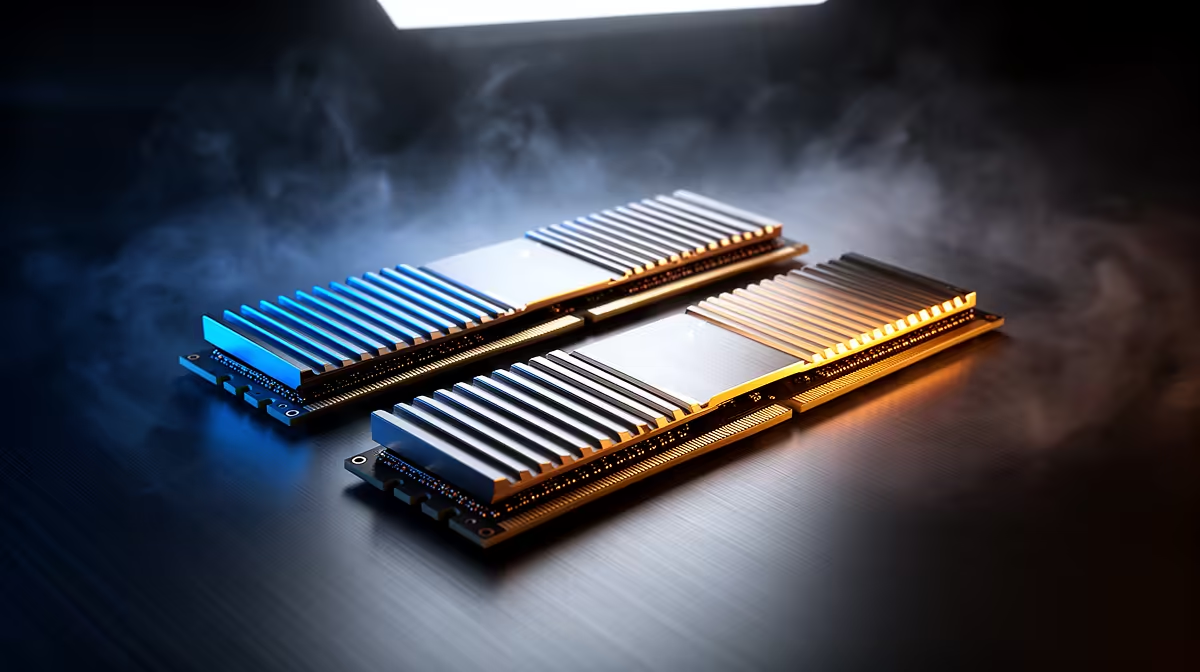
32GB is the sweet spot for professional multi-agent work. You can run two or three agents in parallel, keep separate IDE windows open per project, hold a browser with real research load, and still leave the operating system room to cache. This is the configuration that stops the disk-swap stutter, and it is the upgrade most SA developers should target if they are serious about parallel workflows. The current crop of AI-focused desktops is built around exactly this kind of memory headroom, and you can see how those machines are specced in the Evetech AI PC lineup.
64GB and Beyond: Heavy Local Workloads
You only need 64GB or more if you are also running local language models, large containers, virtual machines, or data-science notebooks alongside your agents. For purely cloud-agent coding, 64GB is comfortable overkill, though it future-proofs a workstation you intend to keep for years.
The South African Buying Angle
Local pricing and stock matter as much as the spec sheet. Because RAM is one of the cheaper components relative to the performance it unlocks, moving from a 16GB to a 32GB configuration is one of the best value upgrades a developer can make here. It costs far less than stepping up a CPU or GPU tier, yet it removes the single most common cause of a sluggish multi-agent session.
If you are buying new, prioritise a machine that ships with 32GB or has clearly accessible memory slots for a later upgrade. Soldered-memory ultrabooks lock you in, so check the configuration before you commit. Desktops give you the most flexibility because adding a second pair of DIMMs later is straightforward.
Matching RAM to Storage and CPU
RAM does not work in isolation. Pair 32GB with a fast NVMe SSD so that when the system does cache or swap, it does so quickly rather than grinding. A capable multi-core CPU helps the IDE index and the runtimes compile, but it will not rescue you from being memory-starved. Get the RAM right first, then balance the rest. For a sense of which configurations are popular with local buyers right now, the Evetech best-selling PCs show the spec mixes that move most often.
Practical Setup Tips to Stretch Your RAM
Even on the right amount of memory, habits help. Close agents you are not actively using rather than leaving five idle in the background. Limit browser tabs during heavy sessions. Disable IDE extensions you do not need, since each one adds to the process footprint. Restart long-running language servers occasionally if they balloon. These do not replace having enough RAM, but they buy breathing room when you are pushing a 16GB machine.
Frequently Asked Questions
Is 16GB enough for AI coding in 2026?
For a single agent and one editor, yes. The moment you run concurrent agents, multiple IDE windows or a heavy browser alongside, 16GB starts swapping to disk and you should step up to 32GB.
Does the AI model run on my RAM?
For cloud agents, no. The model inference happens on remote servers, so your RAM holds the IDE, runtimes, browser and the agent client rather than the model itself. Local models are the exception and need far more memory.
Will more RAM make my agent respond faster?
It will not speed up the cloud model's responses, but it stops the disk swapping that makes your whole machine feel slow during multi-agent sessions, so the overall experience is much smoother.
Should I get 32GB or a faster CPU?
For agentic coding, prioritise 32GB of RAM over a faster CPU. Memory is the more common bottleneck and the cheaper upgrade for the performance it returns.
Can I upgrade RAM later instead of buying it now?
On a desktop or a laptop with accessible memory slots, yes. Avoid soldered-memory machines if you want that option, and always check the configuration before buying.
Building a machine for parallel AI coding? Browse the Evetech AI PC range, target 32GB with a fast NVMe SSD, and get a rig that keeps every agent and IDE responsive.