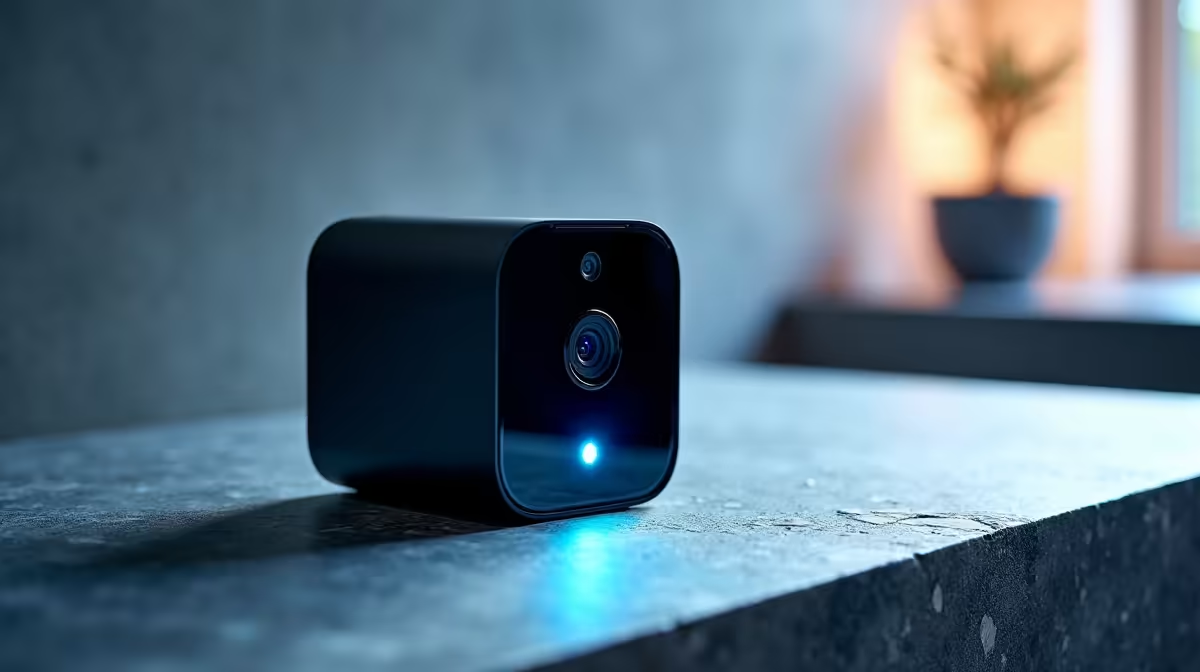
Most people buy a security camera on resolution alone, then discover the cable, the recording, and the placement decide whether the footage is actually useful. Choosing security cameras for your SA home comes down to three things that matter far more than a marketing megapixel count: how the camera gets power and data, how high its resolution genuinely needs to be, and where the recordings live. Get those right and you buy once instead of twice.
Quick Answer
Decide three things first: connection type (PoE for reliable 24/7 coverage, Wi-Fi for flexible placement, battery only where no cable can reach), resolution (2K suits most positions, 4K for wide driveways and gates), and recording method (local storage you own versus a cloud subscription). For most SA homes, PoE cameras with local recording covering the perimeter and gate beat any indoor camera count.
Connection Type Decides Reliability
How a camera receives power and sends video is the first fork, and it shapes everything else.
PoE: The Reliable Backbone
Power over Ethernet runs both power and data down one cable, so the camera has a constant supply and a wired connection that does not drop. That makes PoE the standard for continuous, around the clock recording on the spots that matter most, your gate, driveway, and perimeter. It needs cable runs, which is more install effort, but it is the most dependable choice for a permanent system.
Wi-Fi and Battery: Flexible but Limited
Wi-Fi cameras place easily wherever there is signal, though performance falls off with distance and interference. Battery cameras exist for spots no cable can reach, but a standard battery unit forced to record continuously drains in days, so they suit event triggered clips rather than 24/7 duty. Treat them as gap fillers, not the core of the system.
Resolution: 2K Covers More Than You Think
Higher numbers sell, but the right resolution depends on how far the camera looks and how wide. A 2K camera with a good sensor delivers genuinely usable detail for a front door, a passage, or a single car. The advantage of 4K is the ability to zoom into recorded footage and still read a number plate or a face across a wide area, which is why it earns its place on a long driveway or a broad gate view.
A caveat worth holding onto: a quality 2K or 3K camera with a strong image sensor often beats a cheap, upscaled "4K" unit. Sensor quality and lens matter as much as the pixel count, so do not buy the megapixel figure in isolation. The smart home and appliances range at Evetech carries cameras across these resolution tiers so you can match the spec to each position rather than overbuying everywhere.
Recording Method: Where Your Footage Lives
Footage is only worth as much as your ability to retrieve it. Two models dominate.
Local recording, typically to a network video recorder with its own drives, keeps everything in your home and free of monthly fees, and it keeps working if your internet drops. Cloud recording stores clips off site, which protects them if the recorder is stolen, but usually carries a subscription and depends on your connection. Many SA buyers favour local recording for cost and control, sometimes with a small cloud backup for the most critical camera.
One technical note that saves storage: choose cameras that record in H.265 rather than H.264. It compresses 2K and 4K footage to roughly half the file size at the same quality, so your drives hold far more days of recording.
Night Performance Matters As Much As Resolution
A camera that looks great in daylight but struggles after dark is the wrong tool for a South African perimeter. Most of the risk is night-time, so night performance should carry equal weight to resolution in your buying decision. Infrared night vision is standard and gives a clear monochrome image in complete darkness. Colour night vision uses a low-light sensor paired with a small built-in spotlight, preserving colour so you can identify clothing, vehicles and faces rather than working from a greyscale image. For gate and driveway cameras where identifying vehicles is the goal, colour night vision is worth the step up in price.
Field of View and Lens Type
A wide-angle lens, typically around 100 to 120 degrees, suits doorways and tight passages where you want to see the full approach. A narrower lens with a longer focal length works better for a driveway or boundary wall where distance is the challenge. Some cameras offer varifocal lenses that you can adjust during install, which is more expensive but removes the guesswork on difficult positions where you are not sure until the camera is mounted whether wide or narrow will work better.
Prioritise Perimeter Over Interior
SA homes generally gain more from watching the boundary than the lounge. Cover the gate, the driveway, and the perimeter approaches first, where you want to see someone before they reach the house, and add indoor cameras only after the outside is solid. Plan placement around entry points and sightlines rather than spreading cameras evenly. Buyers often round out a kit with mounts and cabling from the accessories best sellers once the camera positions are decided.
Frequently Asked Questions
Is PoE better than Wi-Fi for home security?
For permanent, 24/7 coverage, yes. PoE gives constant power and a wired link that does not drop, which is exactly what continuous recording needs. Wi-Fi is more flexible to place but less reliable for round the clock duty.
Do I need 4K cameras?
Not everywhere. 2K covers most positions well, while 4K earns its place on wide areas like driveways and gates where you may need to zoom into footage. A good 2K sensor often beats a cheap upscaled 4K unit.
Should I record locally or to the cloud?
Local recording to a network video recorder avoids monthly fees, keeps footage in your home, and works without internet. Cloud protects clips if the recorder is stolen but usually needs a subscription. Many homes use local with a small cloud backup.
Why does H.265 matter?
H.265 compresses 2K and 4K footage to about half the size of H.264 at the same quality, so your storage holds far more recording days. Choosing it lets you keep longer history on the same drive.
Where should I place cameras first?
Cover the perimeter, gate, and driveway before indoor spaces, so you see activity before it reaches the house. Plan around entry points and clear sightlines rather than spacing cameras evenly around the property.
Ready to plan a system that actually protects your home? Explore the cameras in the smart home range at Evetech and match connection, resolution, and recording to each spot on your property.