There is a quiet alternative to handing every prompt, document, and idea to a cloud service. Run AI privately on your own PC, and the model sits on your machine, processes your data locally, and never sends a single token off the device. Open-weight models like Llama, Qwen, Gemma, and Mistral make this genuinely practical now, and for SA users on a capable locally bought PC there is no subscription to pay.
Quick Answer
You can run capable AI models locally using free tools like Ollama, LM Studio, or Jan, with open models such as Llama, Qwen, Gemma, and Mistral. Your prompts and data stay on your PC, you pay no subscription, and it works offline. A machine with a modern GPU and ample RAM runs useful models comfortably.
Why Run AI Locally
The headline reason is privacy. Everything you type stays on your own hardware, which matters for confidential work, client data, legal and financial documents, or anything you would rather not feed to a third party. Nothing is logged on someone else's server because there is no server in the loop.
The second reason is cost and control. Once the hardware is bought, the models are free and there is no monthly fee per seat. It also works offline, so a flaky connection does not stop your workflow. You decide which model to run, swap them freely, and keep older versions if you prefer how they behave.
The Tools That Make It Easy
No programming background is required. Three tools have made local AI approachable for normal users, each with a different flavour.
Ollama
Ollama is the simplest starting point. Install it, then pull a model with a single command and start chatting from the terminal or through one of the many front-ends that connect to it. It handles model downloads, memory management, and GPU acceleration in the background, earning its place as the go-to first step for many local AI users.
LM Studio
LM Studio wraps the same idea in a polished graphical app. You browse a catalogue of models, download one with a click, and chat in a clean interface with no command line involved. It shows you which models will fit your hardware before you download, which saves a lot of trial and error.
Jan
Jan is an open-source desktop app that runs models locally with a familiar chat interface, positioning itself as a private, offline-first alternative to cloud chatbots. If you want something that looks and feels like a normal AI chat app but runs entirely on your machine, Jan fits.
Choosing A Model
Open models come in sizes measured by parameter count, and the size you pick is governed by your hardware. Smaller models in the few-billion-parameter range run quickly even on modest machines and handle summaries, drafting, and simple questions well. Larger models give better reasoning and writing quality but need more memory and a stronger GPU.
Llama and Qwen are strong all-rounders, Gemma is a capable lightweight option, and Mistral models punch above their size for their footprint. The practical move is to start with a smaller model, see how it performs on your machine, then step up if you have the headroom. Quantised versions of each model shrink the memory requirement with only a small quality cost, which is how most people fit a capable model onto a single consumer GPU.
Hardware You Actually Need
Local AI is mostly about memory. The GPU and its VRAM do the heavy lifting, and more VRAM lets you run larger models or longer context. System RAM matters too, since models that do not fit entirely in VRAM spill over to it, so a generous amount keeps things smooth.
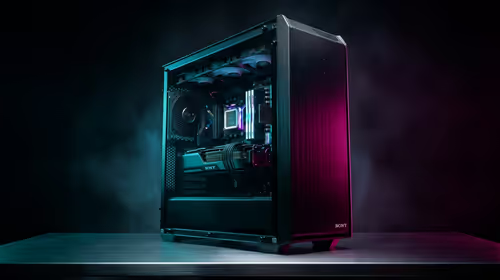
A modern gaming or creator PC with a capable GPU already handles useful local models well, which is why AI-ready desktops have become a sensible buy. The purpose-built AI PC range at Evetech is specified with exactly this kind of workload in mind. Fast NVMe storage helps too, because models are large files and load faster off a quick drive.
A Realistic SA Setup
For most South African users wanting private AI, a desktop with a current-generation GPU carrying solid VRAM, paired with plenty of RAM and an NVMe drive, runs a strong mid-size model with room to spare. That same machine doubles as a gaming or content rig, so the AI capability comes along for free rather than as a separate purchase. If you want to see how complete AI-capable systems are built and balanced, the PC best sellers at Evetech shows what SA gamers and creators are currently choosing.
Getting Started In Practice
The fastest path is to install LM Studio or Ollama, download a small-to-mid model that your hardware comfortably fits, and start using it for everyday tasks: drafting, summarising, brainstorming, and answering questions offline. Once you are comfortable, try a larger model and compare. Keep your favourites, delete the rest, and you have a private AI workspace that costs nothing to run and answers only to you.
Understanding Quantisation
Quantisation is the lever that makes local AI fit ordinary hardware, so it is worth understanding before you download. In plain terms, it shrinks the precision of a model's numbers, which dramatically reduces how much memory the model needs while keeping most of its capability intact. A model that would demand far more VRAM at full precision can run comfortably on a single consumer GPU once quantised.
You will see versions labelled with different quantisation levels. Higher precision keeps slightly more quality but needs more memory; lower precision fits smaller cards at a modest quality cost. For most users, a mid-level quantisation hits the sweet spot, running well on a typical gaming GPU while staying close to the full model's output. Start there, and only chase higher precision if you have the memory to spare and notice a real difference in your tasks.
Beyond Chat: What Local AI Can Do
Private local AI is not limited to a chat window. Many of the same tools expose the model to other applications on your machine, so you can wire it into a note-taking app, a coding editor, or a document workflow that all runs offline. Developers use local models for code assistance without sending proprietary source to a cloud service, and writers use them to draft and edit without their work leaving the desk.
Some models handle documents directly, letting you summarise a PDF or query a folder of files on your own hardware. Because nothing is uploaded, this suits sensitive material that would never be appropriate to paste into a public service. As the open model ecosystem matures, the gap between private and cloud capability keeps narrowing.
Keeping Models Current
Open models improve quickly and new releases land regularly. The advantage of a local setup is that updating is your choice. Pull a newer model when one impresses you, test it, and keep whichever performs best. There is no forced upgrade and no risk of a service changing behaviour overnight.
Frequently Asked Questions
What software do I need to run AI locally?
Ollama, LM Studio, or Jan are the easiest options. Ollama is command-driven and simple, LM Studio offers a polished graphical app with a model catalogue, and Jan provides an offline-first chat interface. All three are free.
Which models can I run on my own PC?
Open models like Llama, Qwen, Gemma, and Mistral all run locally. Pick a size that fits your hardware, since smaller models run on modest machines while larger ones need more VRAM and RAM for better quality.
Is local AI really private?
Yes. With a local model, your prompts and data are processed on your own machine and never sent to any server. It also works offline, so nothing leaves your PC at any point.
What hardware do I need for private AI?
A modern GPU with healthy VRAM is the main requirement, backed by generous system RAM and fast NVMe storage. A current gaming or creator PC handles useful mid-size models comfortably.
Does running AI locally cost anything ongoing?
No subscription. The models are free to download and run, so once the hardware is bought there is no per-month or per-seat fee. You only pay the electricity to run the machine.