So, you’re ready to dive into the world of code, but the internet is screaming conflicting advice. "You need a beastly machine!" one forum says. "Anything will do," claims another. In South Africa, where every rand counts, choosing the right laptop for programming can feel overwhelming. Let’s cut through the noise. We're busting five common myths about laptops for programming requirements to help you find the perfect dev machine without breaking the bank. 💻
Myth 1: You Need a MacBook to Be a Serious Developer
This is one of the oldest myths in the book. While MacBooks are beautiful machines popular in some dev circles, they are far from the only option. The reality is that the vast majority of development work, from web to software engineering, can be done just as effectively (if not more flexibly) on a Windows or Linux machine. Modern Windows laptops offer incredible performance-per-rand, wider hardware choices, and excellent support for development tools.
The "best" operating system often depends on your specific goal. Building iOS apps? You'll need macOS. But for everything else, the choice is yours. The powerful customisation options on Windows, especially with tools like Windows Subsystem for Linux (WSL), make it a developer's playground.
Pro Dev Tip ⚡
Windows, install Windows Subsystem for Linux (WSL) to run a genuine Linux environment directly on your machine without needing a dual-boot setup. It's perfect for web developers and anyone who needs powerful command-line tools like Bash, Git, and Grep. You get the best of both worlds: Windows' massive software library and Linux's development power.
Myth 2: A High-End Graphics Card is Essential
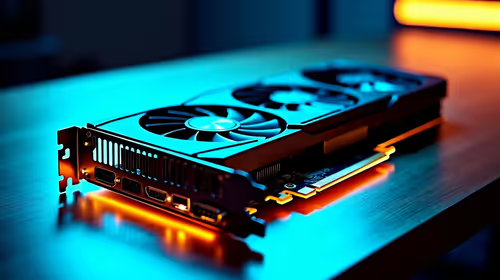
Let's be clear: for most programming tasks like web development, scripting, or building standard applications, your laptop's integrated GPU is perfectly adequate. You don't need to spend thousands extra on a dedicated graphics card. A powerful GPU sits idle during 99% of typical coding tasks, draining your battery for no reason.
So, when do the laptops for programming requirements include a beefy GPU?
- Machine Learning / AI: Training models often relies on CUDA cores found in NVIDIA GPUs.
- Game Development: Compiling shaders and testing your game requires graphical horsepower.
- 3D Modelling & Video Editing: If your work involves visual design alongside coding.
If you fall into one of those categories, exploring our best gaming laptop deals is a smart move, as they offer the perfect blend of CPU and GPU power. For everyone else, focus your budget on the CPU and RAM.
Myth 3: You Must Have 32GB of RAM
More RAM is always better, right? Not necessarily. The right amount of RAM depends entirely on your workflow. Overspending on RAM you'll never use is a classic mistake. Here’s a simple breakdown of memory requirements for a coding laptop:
- 8GB: The absolute minimum. Fine for light web development, learning to code, and simple scripting. You might feel the pinch with multiple apps, browser tabs, and a local server running.
- 16GB: The sweet spot for most developers in South Africa. This handles professional web and mobile development, multiple Docker containers, and heavy multitasking with ease. It's the best value for money. ✨
- 32GB+: Reserved for power users. Think large-scale data analysis, running multiple virtual machines, or professional Android development with a resource-hungry emulator.
Myth 4: A 4K Screen is a Must-Have for Text Clarity
A high-resolution screen is nice, but a 4K display on a 15-inch laptop is often overkill and comes with significant downsides. Firstly, it's a major battery drain. Secondly, you'll likely need to use display scaling to make text readable, which partially negates the benefit of the extra pixels.
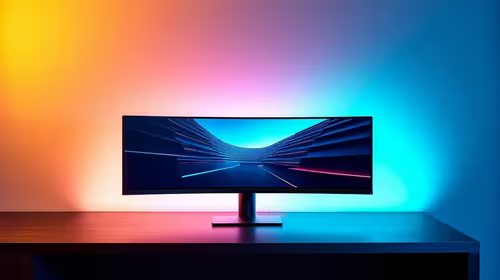
A crisp 1080p (Full HD) or 1440p (QHD) IPS panel is the ideal choice for most programmers. It provides excellent text clarity, is much kinder to your battery life, and keeps the cost down. Your money is better spent on a larger external monitor for your desk setup, which will boost your productivity far more than a 4K laptop screen.
Myth 5: Any Fast CPU Will Do the Job
While most modern CPUs are incredibly capable, not all are created equal for programming. The ideal CPU for your coding laptop hinges on balancing core count with single-core speed.
- Single-Core Speed: This is crucial for tasks like compiling code and general responsiveness. A CPU with a high boost clock will feel snappier in day-to-day use.
- Core Count: More cores are beneficial for heavy multitasking, running virtual machines, and parallel computing tasks.
Your specific needs will determine whether you lean towards the excellent multi-core performance found in many powerful AMD laptops or the strong single-core speeds often seen in versatile Intel laptops. Understanding these laptops for programming requirements ensures you get a machine that works for you, not against you. 🚀
Ready to Find Your Perfect Coding Companion?
The myths are busted. The right laptop for programming is about balance, not just raw power. For maximum choice, value, and performance in South Africa, a well-configured Windows laptop is tough to beat. Explore our massive range of laptop specials and find the perfect machine to build your next project.