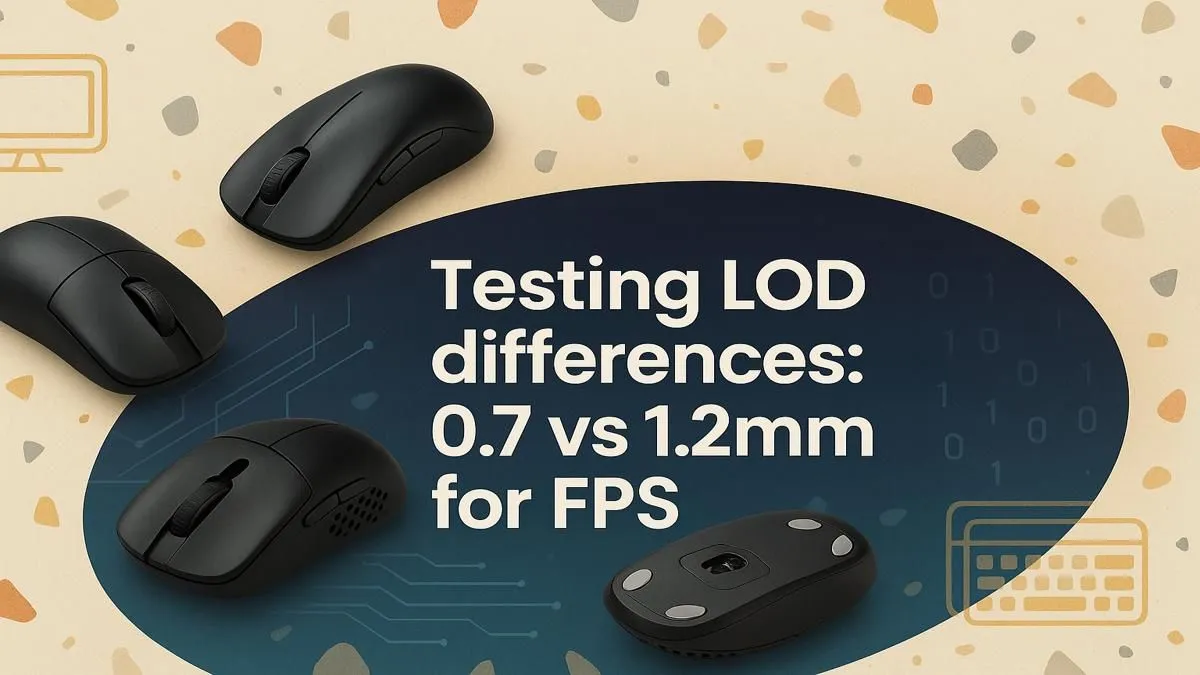
Ever felt like a tiny setting is holding back your headshot potential in Valorant or Apex Legends? When you see options for mouse Lift-Off Distance (LOD)—sometimes confusingly labelled 'Level of Detail'—like 0.7mm vs 1.2mm, it's more than just a number. It's a critical tweak that defines how your aim behaves under pressure. Getting this right can be the difference between a clutch win and a frustrating loss. Let's break it down.
Understanding Lift-Off Distance (LOD) in Gaming
First things first, let's clear up the terminology. While "Level of Detail" usually refers to graphics, in the context of mouse settings, we're talking about Lift-Off Distance (LOD). This is simply the height at which your gaming mouse sensor stops tracking after you lift it from your mousepad.
Why does this matter? Competitive FPS players, especially those with low sensitivity, constantly lift their mouse to reset its position on the mat. If the LOD is too high, the sensor keeps tracking during this lift, causing your crosshair to drift unintentionally. Not ideal when you're lining up a perfect shot. 🎯
FPS Performance: Low LOD (0.7mm) vs. High LOD (1.2mm)
So, what's the real impact of choosing a Level of Detail of 0.7mm vs 1.2mm? The answer depends entirely on your playstyle and setup.
The Case for Low LOD (e.g., 0.7mm)
A low LOD is the preferred choice for most competitive FPS players. When you lift your mouse to reposition, the cursor freezes instantly. This prevents any accidental movement and ensures your aim is exactly where you left it when you place the mouse back down.
- Best For: Tactical shooters, low-sensitivity arm aimers, and players who want maximum precision.
- Potential Downside: Can be unforgiving on uneven surfaces or if you have a habit of not lifting the mouse high enough.
For many pros, the stability of a pro-grade wired mouse combined with a low LOD is the ultimate recipe for consistency.
The Case for High LOD (e.g., 1.2mm)
A higher LOD means the mouse continues tracking for a short distance after being lifted. Some players prefer this as it feels more fluid and forgiving. If you're a high-sensitivity wrist aimer or play on a surface that isn't perfectly flat, a higher LOD can prevent the sensor from cutting out.
- Best For: High-sensitivity wrist aimers, players on uneven surfaces, or those who find low LOD feels "skippy".
- Potential Downside: Can lead to cursor drift when repositioning, which can throw off your aim in critical moments.
Thankfully, the tech in today's top-tier wireless mice is so advanced that you can get flawless tracking with adjustable LOD, giving you the best of both worlds without the cable drag. 🚀
Find Your Sweet Spot 🔧
Hop into your favourite game's practice range. Set your LOD to the lowest setting. Perform quick 180-degree turns and reset your mouse. If your aim feels stable and the cursor doesn't move when you lift, you're golden. If it feels jittery, increase the LOD one step at a time until it's perfect.
The Verdict: Which LOD Is Better?
For pure FPS performance, a lower LOD (around 0.7mm to 1mm) is almost always better. It provides the stability and precision needed for competitive play by eliminating cursor drift during resets.
However, the "best" setting is personal. The key is to have a mouse that gives you the option to choose. A premium sensor is nothing without a stable surface, so pairing your mouse with the right quality mouse accessories like a good mousepad is crucial for consistent performance, no matter your LOD preference.
Ready to Dial In Your Aim?
Having the right gear is the first step to unlocking your potential. Explore our best gaming mouse deals and grab a mouse with the customisation you need to leave lag in the dust.