


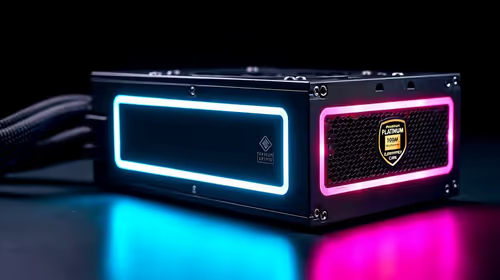
80+ Gold vs 80+ Platinum for Couch co-op gaming in SA
80+ Gold vs 80+ Platinum for couch co-op gaming is about PSU efficiency, heat, fan behaviour, quality, and wattage headroom, not direct FPS. SA buyers should compare the whole build.
Read moreStruggling with your load shedding Wi-Fi router problems? 😩 Don't let power cuts disconnect you. This guide explores the impact of load shedding on your router, from surge damage to connection drops, and provides practical solutions like mini-UPS to keep you online. Stay connected! 📶
The lights go out. Your PC, safe on its inverter, doesn’t even flicker. But the Wi-Fi icon in the corner suddenly shows that dreaded yellow triangle. Disconnected. For South African gamers and remote workers, this digital blackout is infuriatingly common. The complex relationship between backup power for your Wi-Fi router doesn't have to end in a lost match or a dropped call. This guide will help you keep the signal alive when Eskom pulls the plug. 🔌
It seems simple, but it’s a two-part problem. First, your router needs power. No electricity, no signal broadcast. Second, the little box your fibre or 5G line plugs into (the ONT or CPE) also needs power. Even though the fibre network itself often stays live during outages, these two crucial devices in your home go dark, severing your connection to the internet.
Solving the backup power for Wi-Fi router puzzle means powering both these devices. Fortunately, the solutions are surprisingly affordable and easy to implement.
Keeping your connection stable during an unexpected outage is all about providing a dedicated, independent power source for your network gear. Here are the most popular ways to do it, from quick fixes to comprehensive solutions.
A mini-UPS is a small, dedicated battery backup designed specifically for devices like routers. It sits between your router and the wall socket, charging when the power is on and instantly taking over when it cuts. It's the simplest and most popular solution for a reason.
Most modern setups are built around robust hardware, and ensuring your connection starts with one of the latest wireless routers can make a huge difference in stability, even when the power is on.
Before buying a mini-UPS, flip your router and ONT over to check their power adapters. You must match the Voltage (V) exactly. The Amperage (A) of the UPS must be equal to or higher than what your device needs. A common setup is 12V and 1.5A. Getting this wrong can fry your equipment!
Have a beefy power bank for your phone? With the right cable, you might be able to power your router. You'll need a special USB-to-DC converter cable that steps up the power bank's 5V USB output to the 9V or 12V your router requires. It’s a clever workaround, but ensure you get a quality cable to avoid damaging your router. This is a great temporary fix when dealing with backup power for your Wi-Fi router on the fly.
Beyond just keeping the lights on, you can fine-tune your setup for maximum reliability. Sometimes, your main power backup is in another room, leaving your office in a dead zone. This is where clever network planning comes in.
If your inverter is in the lounge but your gaming rig is in the bedroom, the signal might struggle to get through the walls. Strategically placed Wi-Fi range extenders can bridge that gap, ensuring your connection remains strong where you need it most. ✨
For those on fibre, investing in one of the newer dedicated fibre routers can also offer better performance and more advanced features than the standard box your ISP provided. And if your PC is far from the router and you're tired of running cables, a set of high-quality wireless adapters can give you a fast, stable connection without the mess.
A small investment in the right backup power can save you a world of frustration.
Ready to Improve Your Network? Don't let Eskom dictate your online life. From powerful routers to essential backups, having the right gear is the first step. Explore our complete range of wireless networking solutions and stay connected when it matters most.
Yes, load shedding can damage your router. The sudden power cuts and subsequent surges when power returns can harm its sensitive electronic components over time.
The best way is to use a mini-UPS (Uninterruptible Power Supply) specifically designed for routers. This device provides backup power, keeping your internet active.
It could be due to a power surge damaging the router, or it might need a simple reboot. Also, check your ISP's network status as the outage may affect their towers.
A mini-UPS is the ideal power backup for a Wi-Fi router. Look for one with the correct voltage output (usually 9V or 12V) and enough battery life for your stage.
This depends on the UPS capacity and your router's power draw. Most mini-UPS units designed for routers can last between 4 to 8 hours, covering most load shedding stages.
Not necessarily. While some routers are more power-efficient, the key is a reliable power backup solution like a mini-UPS rather than a specific router model.
80+ Gold vs 80+ Platinum for couch co-op gaming is about PSU efficiency, heat, fan behaviour, quality, and wattage headroom, not direct FPS. SA buyers should compare the whole build.
Read more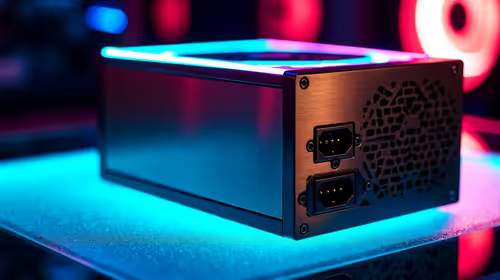
80+ Platinum or 80+ Titanium for competitive should be shortlisted around the job it must do. South African buyers should compare fit, performance, compatibility, and upgrade room, warranty path, and upgrade room before treating any pick as best.
Read more
The real world difference between IPS and OLED for AAA single-player gaming is immersion versus versatility. OLED lifts contrast and dark scenes, while IPS can suit bright rooms, mixed PC use, and SA buyers watching total setup cost.
Read more
HDMI 2.1 vs HDMI 2.0 for SA MMO needs a workload-first comparison. For SA buyers, judge real performance, platform fit, warranty path, power needs, and upgrade timing before choosing either side.
Read more
USB4 and Thunderbolt 4 differ for competitive esports through dock, display, and capture consistency. Use this real world difference between usb4 and thunderbolt 4 for competitive guide to keep SA tournament desks tidy without assuming better ping.
Read more
Magnetic switches vs Mechanical switches depends on Competitive esports needs, platform limits, and budget fit. Compare compatibility, latency, upgrade path, and real setup constraints before choosing for an SA build.
Read more
B850 motherboard FPS drops needs a methodical troubleshooting pass. Review drivers, thermals, power settings, background apps, cables and game settings before replacing parts in an SA gaming setup.

Gaming PC FPS drops in South Africa often come from drivers, thermals, background apps, power plans, or in-game settings. Check one change at a time and use the same scene before buying upgrades for your local setup.

Difference between PCIe 5.0 and PCIe 4.0 explained for PC builders starts with bandwidth, lanes, and support. SA builders should match the motherboard, GPU, NVMe drive, and budget before choosing a platform.
Windows 11 mechanical keyboard setups rarely cause display banding directly. Fix color banding by checking HDR, colour depth, GPU range, monitor profiles, and any new RGB utility conflicts.

Steam Big Art Mode enlarges library artwork in Big Picture Mode and on Steam Deck, while the same beta adds configurable screensavers. Both features are optional and currently require the Steam beta client.
Diablo 4 HDR settings work best after Windows and the display are calibrated, then the game's black point, brightness and white point are adjusted in that order. Use visible shadow detail and controlled highlights, not copied values from another screen.

The best HOTAS for Elite Dangerous is a separate stick-and-throttle set with enough analogue axes for pitch, roll, yaw and thrust, plus local support. Evetech's captured flight-simulation sample lists the complete Logitech X56 at R4,999.
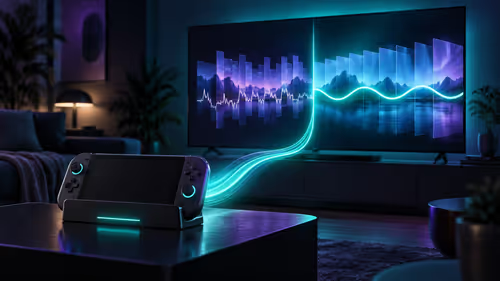
Nintendo Switch 2 docked VRR arrives with system version 23.0.0 and also requires a dock update. The connected TV or monitor and the running software must support VRR before the output can follow changing frame rates.

NVIDIA lists 550W required system power for the RTX 5060 reference specification, based on a high-end test system. A quality 550W unit can be enough, but CPU draw, transient load, connectors and ageing decide real headroom.
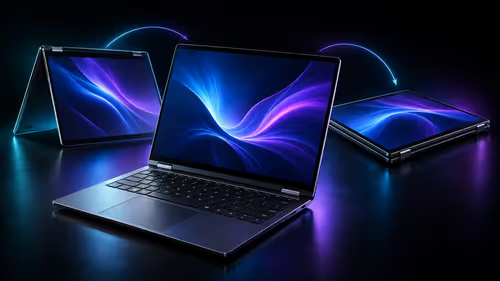
The VAIO T combines a 13.3-inch display with a multi-flip mechanism for laptop, tablet and outward-facing viewing modes. Orders begin in Japan on 18 September; South African availability is unconfirmed.

OpenRGB's master branch now carries changes labelled for 1.0 final, including translation and platform work, but the official tags page still lists 1.0rc3.1 as the newest packaged release. Stable users should wait for the signed release channel.
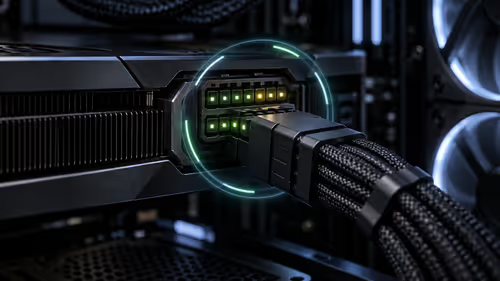
The Cooler Master GPU Shield Adapter monitors current on individual 12+4-pin contacts, adds visual and audible warnings, and can reduce system power during a severe abnormality. Local availability is unconfirmed.