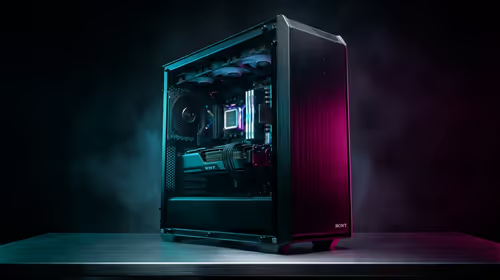
A developer weighing a R50,000 workstation against a R370 per month cloud subscription is really asking a different question: what is keeping your code, your prompts, and your client data entirely off someone else's servers actually worth? Local LLM privacy and offline use versus cloud convenience is not a pure cost calculation. The hardware premium buys data sovereignty and offline capability, not raw speed or model quality, and that trade only makes sense for specific people.
Quick Answer
A capable local AI rig runs around R40,000 to R60,000 once you fit a GPU with 24GB or more of VRAM, against roughly R350 to R400 per month for a frontier cloud coding plan. On pure economics, cloud wins for most individuals for years. You pay the local premium for privacy, data sovereignty, and the ability to keep working with no internet, not to save money.
What the R50,000 actually buys
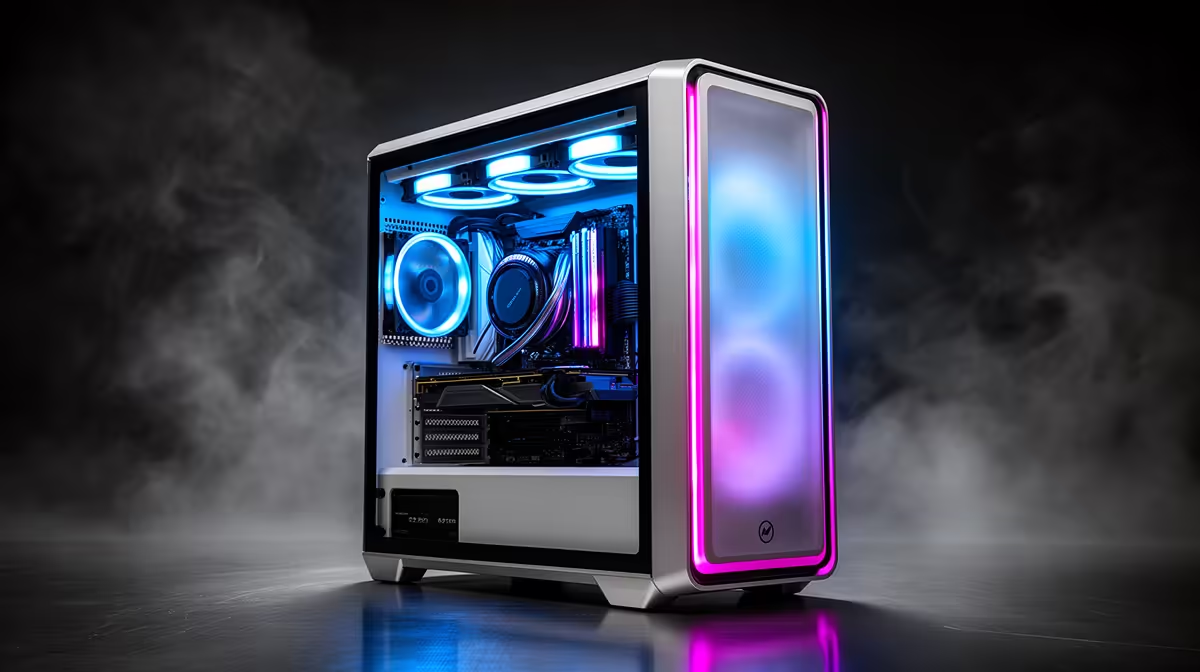
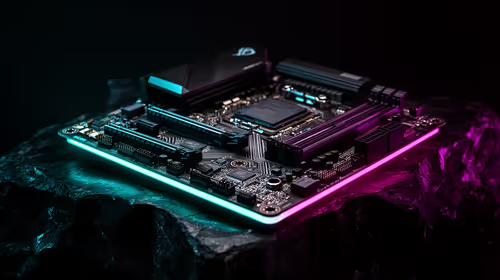
The bulk of a local AI workstation budget goes to the GPU. A card with 24GB of VRAM handles smaller quantised coding models in the 7B to 14B range at usable speeds, and stepping up to 70B-class work pushes the memory requirement to 40GB or more, which means a high-memory or dual-GPU setup well past R60,000. Add a capable CPU, 64GB of system RAM, and fast NVMe storage and the rig comes together.
What you get for that outlay is not a faster Claude or GPT. Open-weight models typically trail the frontier by a few months on most benchmarks. What you get is a machine where no prompt, no code context, and no response ever leaves your premises. For a developer handling client intellectual property, medical data, or anything under a confidentiality agreement, that boundary is the entire point.
The cloud maths, honestly
At around R370 per month, a cloud coding subscription costs roughly R4,400 a year. Even at R50,000 upfront, a local rig takes well over a decade to break even on subscription cost alone, and that ignores the electricity it draws and the fact the cloud model keeps improving while your hardware ages. For someone whose only metric is rand spent per token, cloud is the rational choice and stays that way for a long time.
The maths flips only at scale or under a hard privacy requirement. A team pushing millions of tokens a day can reach break-even on local hardware inside two years, because heavy API usage adds up fast. The break-even point lives in volume, not in the comfort of running your own box.
Data sovereignty: the South African angle
For SA developers and agencies, data residency is a genuine compliance question under POPIA when client data is involved. Sending customer records or proprietary code to an offshore API means that data crosses borders and sits on infrastructure you do not control. A local rig keeps everything inside your office, which simplifies a lot of compliance conversations and removes a whole category of risk from a client contract.
This is where the premium earns its keep. You are not buying performance, you are buying a defensible answer to "where does our data go." For a freelancer that may not matter; for an agency handling regulated clients it can be the deciding factor. If you are speccing a build for exactly this use case, the AI PC and workstation range at Evetech covers the right GPU memory tiers for matching hardware to the models you intend to run.
Offline access is the other half
The second thing money cannot rent from a cloud plan is independence from a connection. Field work, travel, a venue with no reliable WiFi, or simply a fibre outage all stop a cloud-only workflow dead. A local model keeps generating, completing, and refactoring with the network completely disconnected. Once a model is installed on your machine, inference needs nothing from the outside world, which is the core practical advantage for developers who work on the move or in places with patchy connectivity.
Most people land on a hybrid in practice: a local model for everyday completion, privacy-sensitive work, and offline sessions, with a cloud plan held in reserve for the hardest reasoning tasks. If you want to see what current pre-built machines can do before committing to a custom spec, the most popular PCs at Evetech show where the price and performance bands sit right now across the range.
Who should actually go local
Go local if you handle confidential client code or regulated data, work offline often, or run a team with high daily token volume. Stay on cloud if you are a solo developer on a budget, value always having the strongest model, and your work is not bound by confidentiality rules. Most individuals are better served by a cloud plan; the local rig is a deliberate purchase of privacy and independence, made by people who have a concrete reason to need both.
Frequently Asked Questions
Is a local LLM rig cheaper than a cloud subscription?
Almost never for an individual. At R50,000 upfront against roughly R370 per month, a local rig takes over a decade to break even on subscription cost alone. The economics only favour local at heavy team-scale token volume or where privacy is a hard requirement.
How much VRAM do I need to run useful coding models locally?
A card with 24GB or more of VRAM handles quantised 7B to 14B models at usable speed for code completion and refactoring. Larger 70B-class models need 40GB or more, which means a high-memory or dual-GPU build and a noticeably higher cost.
Will a local model match Claude or GPT for coding?
Open-weight models generally trail the frontier by a few months on benchmarks, so the very hardest reasoning tasks still favour cloud. For everyday completion and refactoring, a well-chosen local model is genuinely capable, which is why many developers run a hybrid setup.
Does running AI locally help with POPIA compliance?
It can. Keeping prompts and client data on hardware you control means data never crosses borders to an offshore API, which removes a category of data-residency risk and simplifies compliance conversations when regulated client data is involved.
Can I use a local model without an internet connection?
Yes. After a model is saved to your machine, all inference happens locally with no network dependency, which is the main practical advantage for field work, travel, or riding out a fibre outage without losing your workflow.
If privacy and offline capability justify the spend for your work, build a rig that matches your model sizes. Explore the AI workstation range at Evetech and spec the right amount of VRAM from the start.