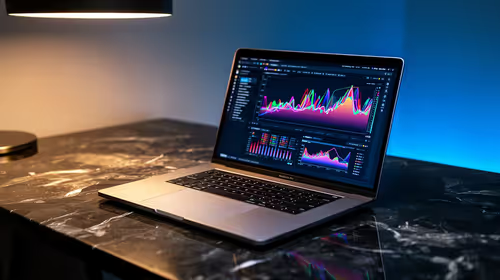
So, you've got a powerhouse MacBook, but that gorgeous built-in screen feels a bit cramped for serious gaming or a multi-window workflow. You're ready for an external monitor. The big question is… 1440p or 4K? It’s not just about pixel count; it’s about how macOS handles those pixels. This MacBook screen resolution comparison will break down the tricky business of scaling to help you find the perfect match without buyers' remorse. 💻
Understanding macOS Screen Scaling
Before diving into a 1440p vs 4K scaling test, you need to understand why this is even a debate for Mac users. Apple designs macOS for its high-pixel-density Retina displays (around 220 pixels per inch, or PPI). When you connect a non-Apple monitor, macOS tries to replicate that crisp experience through a process called scaling.
It prefers to work with resolutions it can neatly double for sharpness. A 4K monitor, for example, can perfectly mimic a 1080p display by using four physical pixels to create one logical pixel. A 1440p monitor doesn't have a resolution that macOS can easily double, which can sometimes lead to… interesting results. The right choice depends entirely on your priorities, from gaming performance to text clarity. You can explore a wide variety of PC monitors to see the different specs available.
The 1440p (QHD) Scaling Test
Connecting a MacBook to a 1440p (2560x1440) monitor is a popular choice, especially for South African gamers. Why? You often get higher refresh rates (144Hz+) for your money, which is brilliant for fast-paced titles.
However, this is where macOS scaling can get weird. At its native resolution, text and UI elements can look a little small for some. If you use macOS's scaling options to make things bigger, the system might render the image at a much higher resolution (like 5K) and then shrink it to fit the 1440p screen. For some users, this can make text look slightly less sharp than on a 4K panel. For many, especially those looking at all gaming monitors where frames-per-second are king, this is a tiny trade-off for buttery-smooth gameplay. 🤔
Check Your 'Real' Resolution
To see how macOS is scaling your display, go to System Settings > Displays. Hold the Option key while clicking on the "Scaled" radio button. This will reveal a list of resolutions. The one you choose is the "looks like" resolution, not necessarily the one being rendered.
The 4K (UHD) Scaling Test
Now for the 4K (3840x2160) experience. Plug one of these into your MacBook, and macOS immediately feels right at home. By default, it will likely scale the display to "look like" 1920x1080. The result? Incredibly sharp, crisp text and images because it's using a perfect 2:1 pixel ratio (pixel-doubling). ✨
This is a dream for developers, writers, and video editors who spend all day staring at text. The downside? At this default scaling, you don't get much more screen real estate than a standard 1080p monitor. You can scale it to "look like" 1440p, which gives you more space, but this again forces the Mac to render a higher 5K resolution and downscale it, which can tax the GPU more than a native 1440p monitor would. For pure visual fidelity, however, the range of 5K and 4K monitors is hard to beat.
Beyond Resolution: Other Factors to Consider
Your MacBook screen resolution comparison shouldn't end with just pixels. The type of monitor can dramatically change your experience.
- Immersion: An ultrawide or one of the latest curved monitors can offer a far more immersive experience for both gaming and productivity, wrapping the content around your field of view.
- Portability: If you're often on the move, a second screen doesn't have to be a desk-bound fixture. Modern portable monitors are lightweight, USB-C powered, and perfect for expanding your workspace anywhere.
- The Setup: Don't forget the little things! The right cable (a high-quality DisplayPort or Thunderbolt cable) and a good monitor arm are essential. Investing in the right monitor accessories ensures you get a stable, high-quality signal and perfect ergonomic positioning.
The Verdict: 1440p vs 4K for Your Mac? 🚀
So, what's the final call in the 1440p vs 4K scaling debate for MacBook users in South Africa?
- Choose 1440p if: You are primarily a gamer who values high refresh rates and smooth performance over perfect text sharpness. You're willing to accept minor scaling imperfections for a big boost in FPS.
- Choose 4K if: You are a creative professional, developer, or general user who prioritises razor-sharp text and image clarity. You want the most "Retina-like" experience possible and don't mind the default scaled real estate or the potential performance hit of custom scaling.
Ultimately, the best monitor is the one that fits your specific needs and budget.
Find Your Perfect MacBook Display Ready to upgrade your setup? Explore our massive range of displays to find the perfect balance of pixels, performance, and price. Check out the best PC monitor deals at Evetech today and give your MacBook the screen it deserves.