Strap a desktop graphics card to a thin laptop and you get the best of both worlds, but only if the cable between them can move the data fast enough. The fight over OCuLink vs Thunderbolt 5 for external GPUs comes down to that link, and the answer is not as simple as "the faster one wins". One squeezes out more frames; the other works on far more machines. The right pick depends on the ports you actually have.
Quick Answer
OCuLink delivered roughly 16% higher gaming performance than Thunderbolt 5 in RTX 5070 Ti eGPU testing, thanks to a more direct connection. But Thunderbolt 5 works natively on far more laptops and adds versatility OCuLink lacks. Let your laptop's available ports, not raw benchmarks alone, decide.
What Each Connection Actually Is
The two solve the same problem in different ways. An external GPU lets a laptop tap a full desktop graphics card, and the connection is the pipe carrying data between them.
Thunderbolt 5 is a mainstream, do-everything standard. It carries the GPU data but also handles displays, fast storage, charging and peripherals over one port, and it is built into a growing number of recent premium and gaming laptops. It is plug-and-play and widely supported.
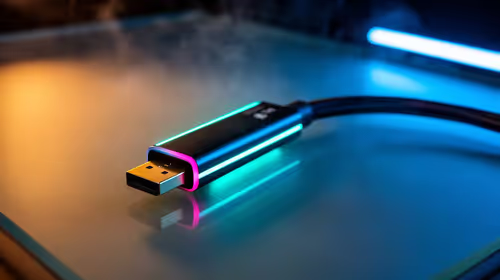
OCuLink is a more specialised, direct interface. It is closer to a straight PCIe extension, which means less overhead between the card and the laptop. The trade is that it is far less common; many laptops do not have an OCuLink port at all, and using it can mean a less tidy, less universal setup.
The Performance Picture
OCuLink's directness shows up on the frame counter. In testing with an RTX 5070 Ti, OCuLink produced around 16% higher gaming performance than Thunderbolt 5 driving the same card. That gap comes from the lower overhead of the more direct connection, which leaves more bandwidth for the GPU and less lost to protocol handling.
Why Thunderbolt 5 Gives Up Some Frames
Thunderbolt 5 does more, and that flexibility costs a little raw throughput to the GPU. It is wrapping the graphics data alongside everything else it can carry, so a slice of bandwidth and a touch of latency go to that versatility. For most games the difference is real but not dramatic; 16% is noticeable in demanding titles yet far from the gap between, say, two GPU tiers.
What 16% Actually Means In Play
In a heavy, GPU-bound game the OCuLink setup will hold higher frame rates and feel a little smoother. In lighter or CPU-bound titles the gap shrinks, since the GPU is not the limiting factor. So the performance edge matters most to people pushing high settings on demanding games and least to those playing less intensive titles.
The Decision Really Comes Down To Ports
Here is the practical heart of it: you cannot use a connection your laptop does not have. Thunderbolt 5 is far more widely fitted, especially on recent premium and gaming laptops, so for most buyers it is the only native option without adapters or modifications. OCuLink, despite the performance lead, simply is not present on most machines.
So the honest order of questions is: does your laptop have OCuLink? If yes and you want maximum frames, it is compelling. If no, Thunderbolt 5 is your route, and a strong one, since it also doubles as a full dock for displays, storage and charging. Builders weighing a setup often start by checking the docking and connectivity options at Evetech to match the eGPU plan to the ports their laptop already has.
Versatility Versus Raw Speed
Thunderbolt 5 brings a second advantage beyond compatibility: one cable can drive your eGPU, external monitors, fast SSDs and laptop charging together. OCuLink is more single-minded, focused on the GPU link and usually needing separate handling for everything else. If you want one tidy connection that does it all, Thunderbolt 5 wins on convenience even where OCuLink wins on frames.
Setup, Cost And The Things Reviews Skip
Frame counts dominate the conversation, but living with each connection differs in ways a benchmark never shows. OCuLink setups tend to be more involved: the cabling is stiffer, the enclosure choices narrower, and you often handle power and displays separately from the GPU link. It rewards a tinkerer who wants the most performance and does not mind a less polished bench.
Thunderbolt 5 is the smoother daily experience. Plug in one cable and the eGPU, your monitors and your peripherals all come alive together, and unplugging to grab the laptop and leave is a single motion. For people who dock and undock constantly, that convenience can outweigh a frame-rate gap they would struggle to notice mid-game.
The Host CPU Still Matters
Neither connection rescues a weak laptop. An eGPU feeds a powerful card to a portable machine, but the laptop's processor still drives the game, and a modest mobile CPU can cap frame rates regardless of which link you choose. Before spending on either an OCuLink or a Thunderbolt 5 enclosure, make sure the laptop behind it is strong enough to keep the desktop GPU busy, or the upgrade underdelivers.
Future-Proofing The Choice
Thunderbolt 5 is the standard with momentum; more laptops adopt it each year, and the ecosystem of docks and accessories grows with it. OCuLink remains a specialist route that delivers more frames today but stays niche. If you want a setup that carries forward to your next laptop with minimal fuss, the broader standard is the safer long-term bet even where it trails on raw speed.
Which Should You Buy
Choose OCuLink if your laptop has the port, you chase every last frame, and you are comfortable with a more specialised, less universal setup. Choose Thunderbolt 5 if you value broad compatibility, want a single cable that handles displays and peripherals too, or simply do not have an OCuLink port, which describes most laptops today.
Whichever link you land on, the card on the other end is what you feel, so it is worth pairing the connection decision with the graphics cards Evetech moves most often to make sure the GPU justifies the eGPU build in the first place.
Frequently Asked Questions
Is OCuLink really faster than Thunderbolt 5 for an eGPU?
In testing with an RTX 5070 Ti, OCuLink produced roughly 16% higher gaming performance because its more direct connection carries less overhead. The gap is real but matters most in demanding, GPU-bound games.
Why would I choose Thunderbolt 5 if OCuLink is faster?
Compatibility and versatility. Thunderbolt 5 is built into far more laptops and also carries displays, storage, peripherals and charging over one cable. If your laptop lacks an OCuLink port, Thunderbolt 5 is the practical choice.
How do I know which connection my laptop supports?
Check the port labels and specifications for your model. Thunderbolt 5 is common on recent premium and gaming laptops, while OCuLink is far rarer and usually only on specific machines designed for it. If unsure, the spec sheet confirms it.
Does the 16% difference matter for casual gaming?
Less so. In lighter or CPU-bound games the GPU is not the limit, so the gap narrows. The performance edge counts most when you are pushing high settings in demanding titles where the graphics card is working hardest.
Can Thunderbolt 5 also act as a dock?
Yes, that is a key strength. A single Thunderbolt 5 connection can drive an eGPU plus external monitors, fast storage and laptop charging at once, which OCuLink generally cannot do on its own.
An eGPU is only as good as the card inside it, so once you have picked your connection, compare the options in the graphics card range at Evetech to build a setup that earns its keep.