Is your WiFi signal weaker than a slap tjip? You're trying to stream the latest show or clutch a Warzone match, but your home's sturdy, double-brick walls have other plans. It’s a classic South African problem… from older suburban houses to platteland farmhouses, our homes are built to last, but they can be WiFi killers. Don't stress. You can optimise your thick walls' WiFi signal without having to knock them down. Let's get your connection sorted.
Why Your Mzanzi Home is a WiFi Fortress 🧱
Before we fix the problem, let's understand it. WiFi signals are radio waves, and just like sound, they get muffled or blocked by dense materials. The main culprits in many SA homes are:
- Brick & Concrete: These are the big ones. They are dense and absorb a significant amount of the signal.
- Steel Reinforcement (Rebar): That steel inside your concrete slabs? It's fantastic for structural integrity but acts like a cage, scattering and blocking WiFi waves.
- Metal Appliances: Your fridge, stove, and even metal door frames can reflect and interfere with the signal.
Simply put, the more obstacles between your device and the router, the weaker the connection. But getting a better signal through concrete walls isn't impossible.
Quick Fixes to Boost Your WiFi Signal (Before You Spend a Rand)
You can often improve WiFi through thick walls with a few strategic tweaks. These free steps are the best place to start your mission for a stronger connection.
The Golden Rule: Router Placement is Everything
Where you place your router is the single most important factor. Think of it like a lightbulb… you wouldn't put it in a cupboard and expect it to light up the whole room.
- Go Central: Place your router as close to the centre of your home as possible.
- Get High: Position it on a high shelf or mount it on a wall. WiFi signals radiate downwards and outwards.
- Clear the Area: Keep it away from other electronics, especially microwaves and cordless phones, and out in the open, not hidden in a cabinet.
Antenna Angle Pro-Tip
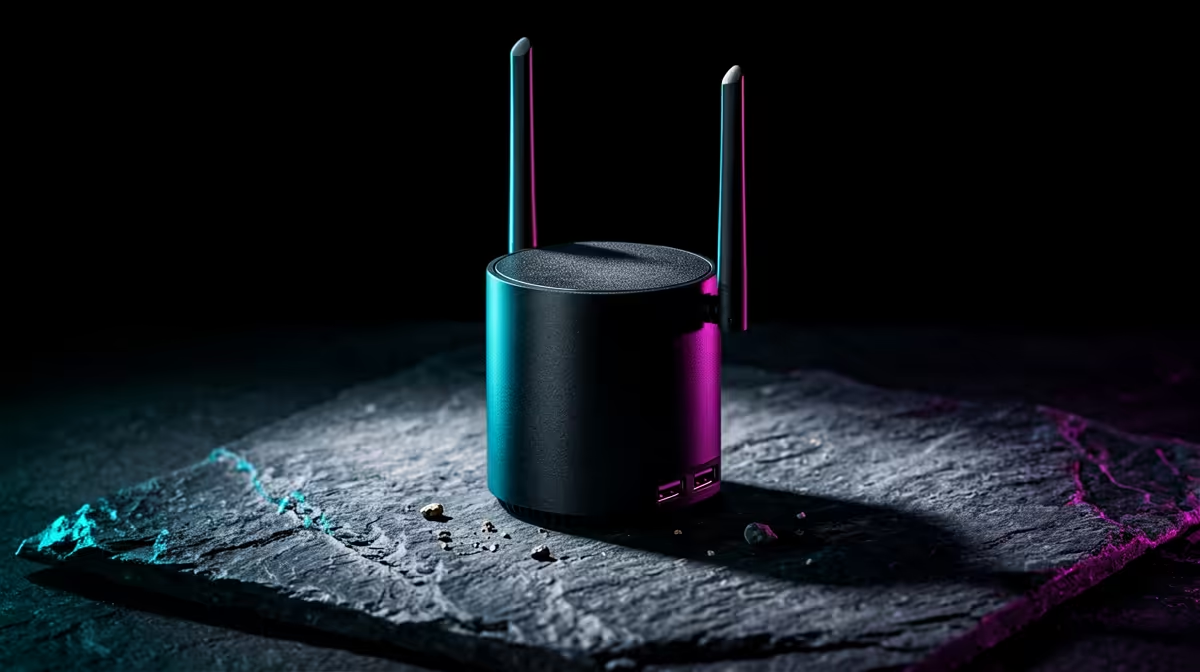
If your router has external antennas, try positioning one vertically and one horizontally. Devices connect differently depending on their internal antenna orientation, and this trick covers both bases for a more stable link.
Hardware Upgrades to Conquer Concrete and Brick 💪
If the free fixes don't cut it, it's time to bring in the big guns. Investing in the right hardware is the most reliable way to get a powerful thick wall WiFi solution.
Mesh WiFi: The Ultimate Whole-Home Solution
Forget signal dead zones. A Mesh WiFi system uses multiple "nodes" placed around your home to create one large, seamless network. As you move around, your device automatically connects to the strongest node. It's the perfect way to blanket a large or complex home with flawless WiFi. Systems from leading brands, like these powerful TP-Link mesh routers, are designed specifically to solve this exact problem.
WiFi Range Extenders: A Simple, Targeted Boost
If you just have one or two problem areas, like a braai room or a home office at the far end of the house, a range extender can be a great fix. It picks up your existing WiFi signal and rebroadcasts it, pushing the network's edge further. For a simple and effective fix, check out these affordable Cudy WiFi extenders to stretch your signal without breaking the bank.
Powerline Adapters: Using Your Home's Electrical Wiring ⚡
This is a clever bit of tech. A Powerline kit uses your home's electrical wiring to carry the internet signal. You plug one adapter into a power socket near your router and connect it with an Ethernet cable. Then, you plug the second adapter into any other socket in the house. Voila! You have a fast, stable access point. These are brilliant for reaching a granny flat or a garage-turned-gaming-den. These kits, found in our wired networking solutions, offer a near-perfect wired connection without running cables through the ceiling.