

GTA 6 Max Settings on RTX 5070: Complete Guide
GTA 6 Max Settings on RTX 5070. Tested & verified settings for best FPS and visual quality on SA hardware budgets.
Read moreWondering if PCIe 4.0 x8 vs x16 affects your workstation? We break down bandwidth, latency, and performance limits for gaming, AI, and creative work. ✅⚙️
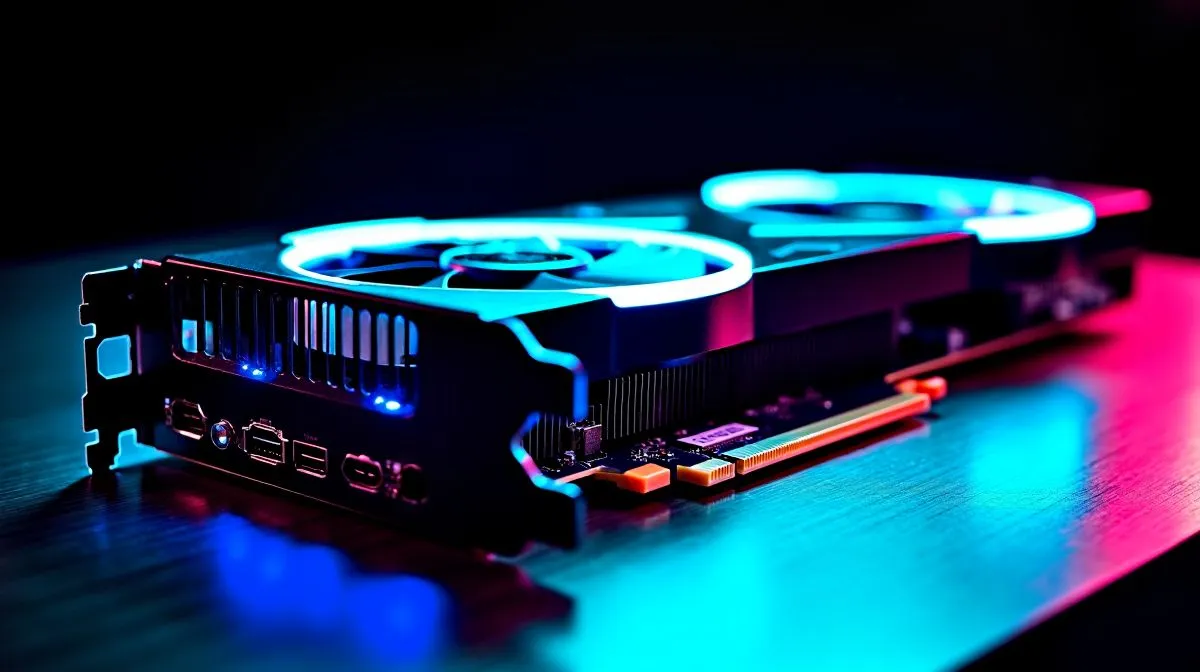
If you build or buy a workstation in South Africa, PCIe lane count can look like a small detail. It is not. When a GPU runs at PCIe 4.0 x8 instead of x16, the question is simple: will your workloads feel it? For many creators, editors, and CAD users, the answer depends less on hype and more on how your software moves data. That is where smart buying starts.
PCIe 4.0 doubles the per-lane bandwidth of PCIe 3.0, according to the PCI-SIG specification. In practical terms, x16 has more headroom than x8, but real-world impact varies by task. A GPU that spends most of its time rendering from local VRAM may not care much. A GPU that constantly shuttles textures, assets, or simulation data can care more.
For most workstation buyers, this means the slot is only one part of the story. GPU architecture, VRAM size, driver stability, and your software stack all matter. Autodesk, Adobe, and Blender workloads often behave differently from one another. So do AI and data-science tools.
The biggest differences usually appear in edge cases. Think huge datasets, multi-GPU setups, heavy host-device transfers, or memory-constrained workflows. In many content-creation tests published by hardware reviewers and GPU vendors, the gap between x8 and x16 on PCIe 4.0 is often modest for a single modern card. But “modest” is not “none”.
If you are shopping for a workstation graphics card, look at the whole platform. A PCIe 4.0 x8 card in a fast system can still be excellent for 4K editing, 3D modelling, and design work. But if you are pairing it with a bandwidth-hungry workflow, x16 offers more breathing room. That matters when project files get large and deadlines get rude.
South African buyers should think in value, not just specs on a box. If one card costs more in ZAR because it is x16-capable, ask whether your software can actually use that extra lane bandwidth. Sometimes the better purchase is more VRAM, a stronger cooler, or a better CPU.
You can compare mainstream options on Evetech, including NVIDIA and AMD graphics cards, MSI graphics cards, Intel Arc graphics cards, workstation graphics cards, and AMD Radeon graphics cards. That makes it easier to match lane count, budget, and workload without guessing.
If your work is mostly editing, design, or general creator tasks, PCIe 4.0 x8 is often enough. If your work involves simulation, serious 3D scene streaming, or future-proofing a high-end build, x16 is safer. If you are unsure, look at software benchmarks for your exact apps. That is better than buying on instinct alone.
If you are choosing between two GPUs, check your app benchmarks before chasing lane count. In many real projects, VRAM and driver support matter more than x8 versus x16. A smart match saves money and keeps your workstation balanced.
Bandwidth matters, but only when your workload asks for it. For plenty of workstation users, PCIe 4.0 x8 is perfectly acceptable. For heavier professional work, x16 adds useful margin. The best choice is the one that fits your actual workload, not just the loudest spec sheet.
Ready to Find Your Perfect Match? The Mac vs Windows debate is complex, but for maximum power, choice, and value in South Africa, Windows is hard to beat. Explore our massive range of laptop specials and find the perfect machine to conquer your world.
Often it does not. Many PCIe 4.0 GPUs do not saturate x8 in typical workstation tasks, but bottlenecks can appear in bandwidth-heavy workloads.
PCIe 4.0 x8 delivers half the lanes of x16, cutting peak theoretical throughput. Real-world results depend on workload and whether the GPU uses that bandwidth.
Usually the difference is small at 1080p-to-1440p for many GPUs. Higher-res or GPU-bound settings often show minimal gaps, while some scenarios can widen.
For many training and inference pipelines, compute and memory dominate. PCIe 4.0 x8 is frequently sufficient, but data-transfer-heavy setups may see impact.
Big drops usually come from workload types that stream lots of data across PCIe, plus platform constraints like using fewer effective lanes or older chipsets.
Latency is typically not the main driver for overall GPU performance. Bandwidth and queueing under load are more likely to influence results.
Check your motherboard/BIOS lane routing and use OS tools to read link width. Verify the GPU reports x8 or x16 under load for your exact configuration.
If you want maximum headroom for unknown future GPUs and traffic-heavy workloads, prioritize x16. But x8 can be a smart value when benchmarks show small losses.
GTA 6 Max Settings on RTX 5070. Tested & verified settings for best FPS and visual quality on SA hardware budgets.
Read more
Cyberpunk 2077 Max Settings on RTX 5080. Tested & verified settings for best FPS and visual quality on SA hardware budgets.
Read more
Starfield Max Settings on RTX 5070 Ti. Tested & verified settings for best FPS and visual quality on SA hardware budgets.
Read more
AMD RX 9050 XT: Rumoured Specs, Price & Release. SA-focused analysis with local pricing data, real-world insights & actionable buying advice.
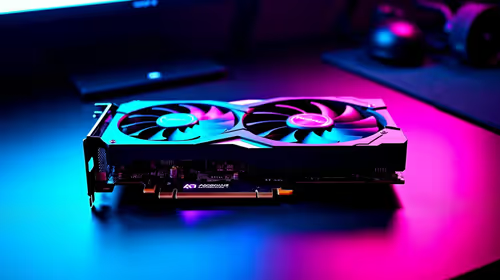
Can RTX 4080 Super Run AI Workloads for SA Developers Detailed answer with SA data, expert analysis & practical recommendations for local buyers.
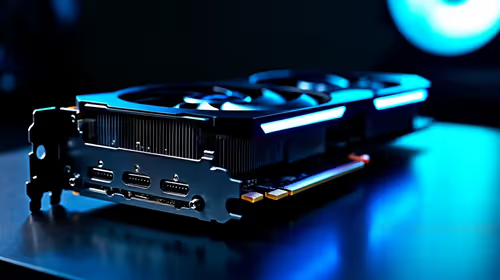
Can RTX 4090 Run AI Workloads for SA Developers Detailed answer with SA data, expert analysis & practical recommendations for local buyers.
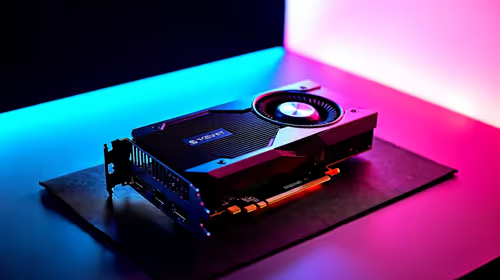
Top Settings for Intel Arc B580 at Ultrawide 1440p picks evaluated on performance, value & SA availability with current Rand pricing from Evetech.

RTX 4060 CS2 Low Settings at 1080p: FPS Results. Real-world benchmark data, FPS numbers & performance analysis. What SA gamers can actually expect.

Visual Artifacts: Possible GPU Issue Issue #1. Diagnosis steps, proven fixes & when to seek professional help. SA-specific support info included.
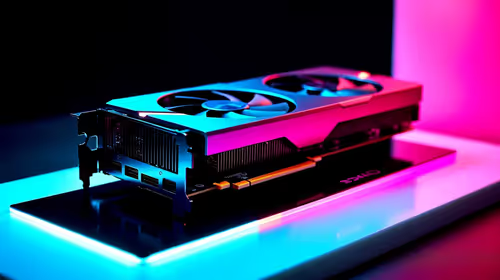
Can the RTX 4090 Handle 1440p 144Hz Gaming. Performance testing verdict with real data & practical recommendations for SA buyers.

Top ASUS GPU Under R15000 picks evaluated on performance, value & SA availability with current Rand pricing from Evetech.
GTA 6 Max Settings on RTX 5070. Tested & verified settings for best FPS and visual quality on SA hardware budgets.
Cyberpunk 2077 Max Settings on RTX 5080. Tested & verified settings for best FPS and visual quality on SA hardware budgets.
Starfield Max Settings on RTX 5070 Ti. Tested & verified settings for best FPS and visual quality on SA hardware budgets.
Top RTX 5090 Under R5000 picks evaluated on performance, value & SA availability with current Rand pricing from Evetech.