

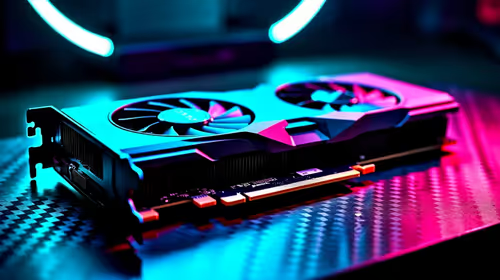
GPU Setup Guide for SA Gamers
GPU Setup Guide Gamers. Clear setup instructions with SA-specific considerations, troubleshooting tips & recommended components.
Read moreEvery spec on plug-and-play external storage explained in plain English. What matters for gaming and creator work in 2026, what's marketing fluff, and how each number translates to real-world.

You buy a shiny new drive. The box promises seamless plug-and-play external storage. You plug it in... and nothing happens. For South African gamers juggling massive install sizes and load shedding, portable drives are absolute lifesavers. But what does plug-and-play actually mean? Let us explore how this tech works, why it sometimes fails, and how to fix it instantly.
At its core, plug-and-play external storage means your device should recognise the drive automatically. There is no need for manual driver installations. Windows and macOS have built-in generic drivers for this exact purpose. When you connect via USB, the operating system mounts the drive. It sounds simple enough.
However, formatting is where things get tricky. If you grab a drive formatted for Mac, your Windows machine will not read it. That is why checking the file system is crucial before transferring your game library. If you are shopping for modern laptops for sale, you want a drive formatted in exFAT. This allows you to easily bounce between different operating systems without formatting headaches.
Sometimes the tech simply refuses to cooperate. You plug the cable into your front panel USB port, and Windows throws an error. Why does this happen? Power delivery is usually the main suspect.
Older USB ports might not supply enough juice for high-capacity drives. If you recently picked up one of our best gaming PC deals, always plug external hard drives into the rear motherboard ports. These ports deliver stable power and faster data transfer rates.
Another common issue is drive letter conflicts. Windows might assign your new drive a letter already used by a mapped network drive.
If your plug-and-play external storage does not appear in File Explorer, right-click the Start button and open Disk Management. Find your drive, right-click the unallocated space, and assign it a new drive letter. It takes ten seconds and solves most connection issues.
To get true plug-and-play performance, you need the right hardware combination. A blazing-fast NVMe portable SSD is completely wasted on an old USB 2.0 port. Always match your drive to your fastest available port. Look for the blue USB 3.0 ports or Type-C connections.
Budget also plays a major role in your daily experience. A quality 1TB portable SSD will cost you around R1,500 to R2,500 depending on read speeds. Mechanical hard drives are cheaper per gigabyte but are sensitive to physical drops. If you travel often, spending the extra R500 on a solid-state drive is a smart investment for peace of mind.
If you want to expand your storage without breaking the bank, keep an eye out for weekly tech specials. A solid portable SSD can save you from constantly uninstalling games to make room. It also acts as a brilliant local backup solution when the power grid becomes unpredictable.
Ready to Expand Your Digital Horizon? Running out of space is a gamer's worst nightmare. Whether you need lightning-fast NVMe drives or massive external HDDs to back up your life, Evetech has you covered. Explore our massive range of storage deals and never delete a favourite game again.
The products, tools and accessories referenced in this article are stocked at Evetech.co.za with local SA warranty, ZAR pricing and nationwide delivery.
The article breaks down the real-world impact on gaming FPS, creator workflows and everyday responsiveness — not just raw spec numbers.
Only a handful of specs meaningfully change your experience. The guide ranks them by real impact so you spend on what counts.
We cover upgrade headroom, platform longevity and the specific features worth paying extra for if you plan to keep this build for several years.
The article includes a clear generational uplift summary so you can judge whether upgrading from your current hardware is worthwhile.
GPU Setup Guide Gamers. Clear setup instructions with SA-specific considerations, troubleshooting tips & recommended components.
Read more
When Will the RTX 6090 Launch in South Africa Detailed answer with SA data, expert analysis & practical recommendations for local buyers.
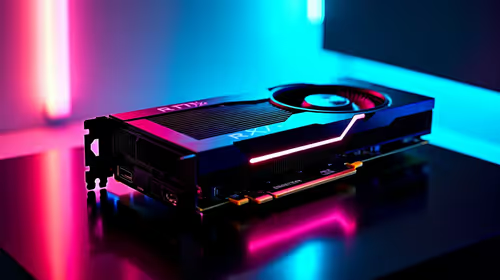
Top Valorant Settings for RTX 5070: FPS Optimisation picks evaluated on performance, value & SA availability with current Rand pricing from Evetech.
RDNA 3.5 Graphics in Ryzen AI 400? Can You Game. Plain-English explanation of what it means, why it matters & how it affects your buying decisions in SA.

GPU Price Index : December Report. Current stock data & price tracking for SA buyers. See what is available and where prices are heading.
Core i5-14600K + B760 + RTX 5060 Build Under. Full parts list, Rand pricing & expected performance. Build confidently with SA-available components.
RX 7600 Apex Legends at 4K: FPS Benchmark. Real-world benchmark data, FPS numbers & performance analysis. What SA gamers can actually expect.
RX 7900 XTX GTA 6 at 4K: FPS Benchmark & Optimal. Real-world benchmark data, FPS numbers & performance analysis. What SA gamers can actually expect.
Head-to-head comparison of RTX 5070 vs RX 9070 XT: Gaming Performance for SA gamers. Performance benchmarks, Rand pricing & which delivers better value.
GPU Setup Guide Gamers. Clear setup instructions with SA-specific considerations, troubleshooting tips & recommended components.
Top RTX 5090 Under R12000 picks evaluated on performance, value & SA availability with current Rand pricing from Evetech.
Call of Duty Warzone 2 Settings on RX 7600. Real-world benchmark data, FPS numbers & performance analysis. What SA gamers can actually expect.
GTA 6 Settings on RTX 5070 Ti: Performance. Real-world benchmark data, FPS numbers & performance analysis. What SA gamers can actually expect.