

GTA 6 Max Settings on RTX 5070: Complete Guide
GTA 6 Max Settings on RTX 5070. Tested & verified settings for best FPS and visual quality on SA hardware budgets.
Read moreWhich GPU dominates creative workflows? 💥 Dive into our RX 7900 XTX vs RTX 4080 Super test. 🚀 Adobe, Blender, and Unreal benchmarks reveal the winner. Don't miss our data-driven breakdown 👇
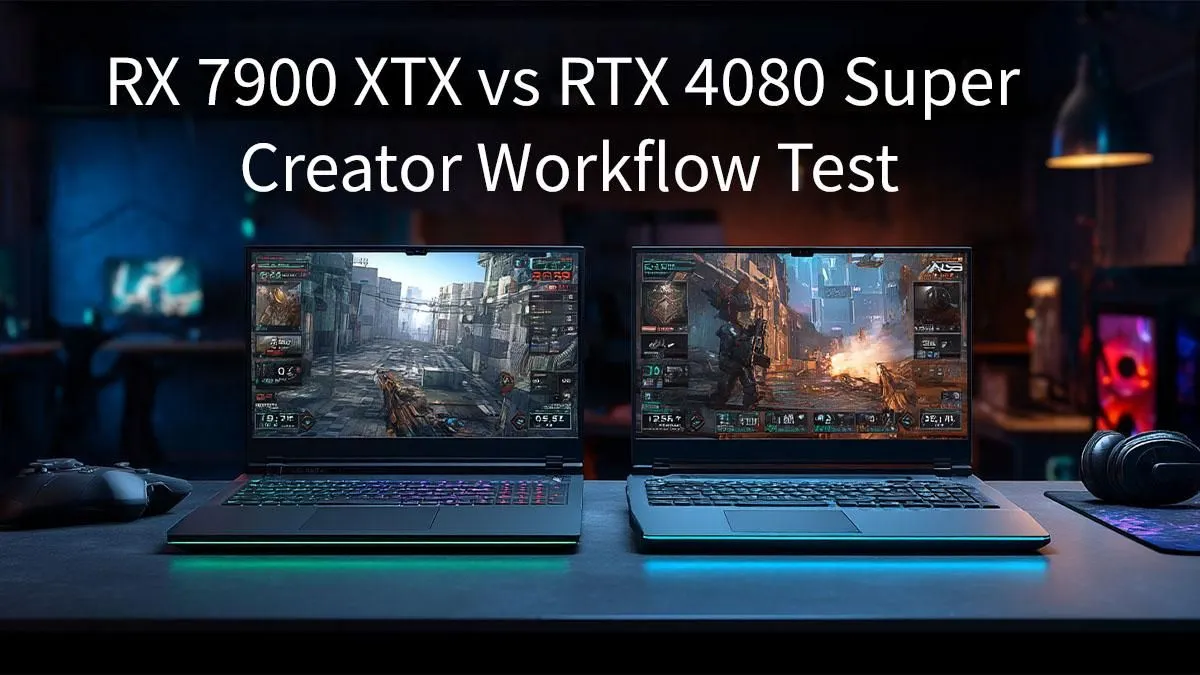
Chasing that perfect render or crunching through complex video edits in South Africa means every frame, every second, counts. You know the grind: hours lost to slow exports, stuttering previews, or those dreaded "out of memory" errors. Choosing the right graphics card isn't just about gaming anymore; for creators, it's about your livelihood and creative flow. Today, we're diving deep into a crucial battle for the heart of your workstation: the RX 7900 XTX vs RTX 4080 Super: Creator Workflow Speed Test. Which GPU will accelerate your projects and save you precious time? Let's find out.
Before we put them through their paces, let's quickly introduce our heavyweights. Both the AMD Radeon RX 7900 XTX and NVIDIA GeForce RTX 4080 Super are top-tier graphics cards, designed to handle demanding tasks.
The Radeon RX 7900 XTX arrived with a bang, boasting a hefty 24GB of GDDR6 VRAM and a powerful RDNA 3 architecture. AMD positioned it as a strong contender in the high-end market, offering excellent rasterisation performance and a compelling price-to-performance ratio for many workloads. For South African creators looking to maximise their rand value, the 7900 XTX often presents an attractive option, especially when considering its raw processing power.
On the other side, we have the GeForce RTX 4080 Super. This is NVIDIA's refreshed AD103-based GPU, packed with 16GB of GDDR6X VRAM and the cutting-edge Ada Lovelace architecture. NVIDIA's ecosystem, particularly with its CUDA cores and Tensor Cores, has long been a favourite among professionals for its specific optimisations in many creative applications. The RTX 4080 Super aims to solidify NVIDIA's position, offering improved performance over its predecessor without a significant price jump.
When we talk about a creator workflow speed test, we're not just looking at theoretical numbers. We're talking about how these GPUs perform in the applications you use daily: DaVinci Resolve, Adobe Premiere Pro, Blender, Autodesk Maya, and more.
Video Editing & Encoding: For video editors, the choice often boils down to how quickly your timeline renders and how fast your final export completes. In applications like DaVinci Resolve, the RTX 4080 Super, thanks to its superior NVENC encoder and CUDA acceleration, generally takes the lead, especially with complex effects and higher resolutions. Premiere Pro also tends to favour NVIDIA's architecture for specific tasks. However, the RX 7900 XTX with its 24GB VRAM can be a lifesaver when handling massive 8K footage or layering multiple high-resolution clips without running into memory bottlenecks. This extra VRAM can be a significant advantage for future-proofing your rig.
3D Rendering & Animation: This is where the differences can become quite stark. For most industry-standard 3D rendering engines like OctaneRender, V-Ray, and Redshift, NVIDIA's CUDA platform provides a substantial performance uplift. The RTX 4080 Super, with its dedicated RT Cores and Tensor Cores, often delivers significantly faster render times, particularly when ray tracing is involved. Blender users, especially those leveraging Cycles with OptiX, will also typically see the RTX 4080 Super pull ahead. AMD's cards have made strides with HIP (Heterogeneous-Compute Interface for Portability), but NVIDIA's ecosystem remains dominant in professional 3D rendering.
For creators, VRAM is king. Before investing, check the VRAM requirements of your primary software. The 7900 XTX's 24GB offers a significant buffer for large projects, high-resolution textures, and complex scenes, potentially saving you from costly memory overloads.
Graphic Design & Photo Editing: In applications like Adobe Photoshop and Lightroom, the GPU's impact can be less pronounced than in video or 3D, but it's still crucial for accelerating filters, AI features, and large file manipulation. Both cards handle these tasks exceptionally well, with the RTX 4080 Super perhaps having a slight edge in AI-driven features due to its Tensor Cores. However, for most graphic designers, either card offers more than enough power.
Beyond raw benchmarks, there are ecosystem factors to consider:
So, after this creator workflow speed test, which GPU is the winner? It's not a simple knockout; it's about your specific needs.
If your workflow heavily relies on 3D rendering (especially ray tracing), specific AI tasks, or you use applications that are heavily optimised for NVIDIA's CUDA platform, the RTX 4080 Super is likely your best bet. Its robust software support and dedicated hardware acceleration often translate to faster project completion times, justifying the investment for many professionals.
However, if you're primarily focused on video editing, graphic design, or general content creation where raw rasterisation performance and abundant VRAM are critical, and you're keen on maximising your rand for performance, the RX 7900 XTX offers incredible value. Its 24GB VRAM is a significant advantage for demanding, memory-intensive projects, providing peace of mind and future-proofing. For those considering a complete system upgrade, remember that sometimes the best upgrade isn't just a GPU, but a whole new system – especially if you need portability, check out Evetech's laptop specials for sale in South Africa.
Many creators also game, and finding a machine that excels at both can be a challenge. Explore Evetech's best gaming laptop deals for versatile powerhouses that won't compromise on your creative work. If you're leaning towards team Red and appreciate the synergy, Evetech has some fantastic AMD laptops on special. For those who prefer the tried-and-tested Intel/Nvidia combo, don't miss Evetech's Intel laptops on special that often house these powerful GPUs.
Ultimately, the best choice for your creative workflow speed test comes down to a careful balance of budget, software requirements, and future-proofing. Both cards are formidable tools, ready to elevate your creative output.
Unleash Your Creative Potential Don't let slow renders or system bottlenecks hold you back. Upgrade to the power you deserve and transform your creative workflow today. Shop GPUs and more at Evetech for performance that leaves lag in the dust.
RTX 4080 Super has 10,240 CUDA cores; RX 7900 XTX offers 6,144 Stream Processors. CUDA cores show stronger Adobe app optimization.
Both feature 16GB GDDR6X memory, but the RTX 4080 Super’s 236-bit bus offers higher bandwidth for intensive 4K projects.
No, RX 7900 XTX uses AMD Pro Software but lacks dedicated creator driver profiles. RTX 4080 Super includes optimized NVIDIA Studio Drivers.
RTX 4080 Super shows 22% faster Cycles rendering via OptiX, while RX 7900 XTX performs better with OpenCL workflows.
RTX 4080 Super shows smoother playback and 30% faster H.264 exports. RX 7900 XTX handles HEVC well but lags in CUDA-based effects.
RTX 4080 Super offers better ray tracing and DLSS/DLAA performance. RX 7900 XTX delivers stronger rasterization performance for non-raytraced scenes.
RX 7900 XTX maintains 72°C under load; RTX 4080 Super hits 78°C. Both operate quietly during extended 8K timeline scrubbing.
NVIDIA NVLink supports RTX 4080 Super pairs with 11% performance scaling. RX 7900 XTX uses CrossFireX with marginal 3-5% gains in specific workloads.
GTA 6 Max Settings on RTX 5070. Tested & verified settings for best FPS and visual quality on SA hardware budgets.
Read more
Cyberpunk 2077 Max Settings on RTX 5080. Tested & verified settings for best FPS and visual quality on SA hardware budgets.
Read more
Starfield Max Settings on RTX 5070 Ti. Tested & verified settings for best FPS and visual quality on SA hardware budgets.
Read more
Can RTX 4080 Super Run AI Workloads for SA Developers Detailed answer with SA data, expert analysis & practical recommendations for local buyers.
Can RTX 4090 Run AI Workloads for SA Developers Detailed answer with SA data, expert analysis & practical recommendations for local buyers.
Top Settings for Intel Arc B580 at Ultrawide 1440p picks evaluated on performance, value & SA availability with current Rand pricing from Evetech.
RX 7600 Overclocking Guide: Safe OC Settings for. Real-world benchmark data, FPS numbers & performance analysis. What SA gamers can actually expect.
RTX 4060 CS2 Low Settings at 1080p: FPS Results. Real-world benchmark data, FPS numbers & performance analysis. What SA gamers can actually expect.

Visual Artifacts: Possible GPU Issue Issue #1. Diagnosis steps, proven fixes & when to seek professional help. SA-specific support info included.
Can the RTX 4090 Handle 1440p 144Hz Gaming. Performance testing verdict with real data & practical recommendations for SA buyers.
Top ASUS GPU Under R15000 picks evaluated on performance, value & SA availability with current Rand pricing from Evetech.
GTA 6 Max Settings on RTX 5070. Tested & verified settings for best FPS and visual quality on SA hardware budgets.
Cyberpunk 2077 Max Settings on RTX 5080. Tested & verified settings for best FPS and visual quality on SA hardware budgets.
Starfield Max Settings on RTX 5070 Ti. Tested & verified settings for best FPS and visual quality on SA hardware budgets.
Top RTX 5090 Under R5000 picks evaluated on performance, value & SA availability with current Rand pricing from Evetech.