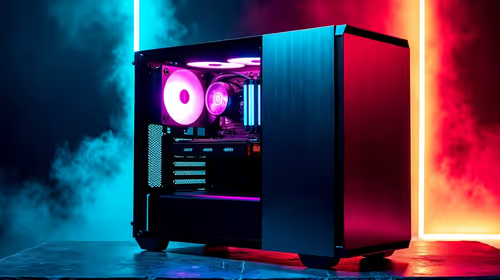
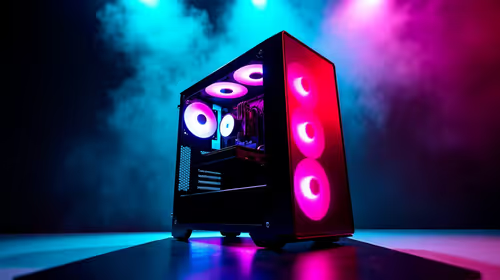
Remember the days of blocky, pixelated players sliding across a digital pitch? From the simple joy of Sensible Soccer to today’s hyper-realistic F1 simulators, the sports gaming PC evolution has been nothing short of breathtaking. The hardware that powers these virtual arenas has transformed, turning basic sprites into lifelike athletes with ray-traced reflections. Let's take a visual journey through the history of the hardware that brought our favourite sports home. ⚽
The Dawn of Digital Sport: From Pixels to Polygons
In the early days, sports games were defined by their simplicity. The focus wasn't on realism but on core gameplay mechanics. The processing power required was minimal by today's standards, yet it laid the groundwork for everything to come.
As PCs grew more powerful in the late 90s, we witnessed the shift from 2D sprites to 3D polygons. This was a monumental leap. Suddenly, players had depth, stadiums had dimension, and the sports gaming PC evolution kicked into high gear. This era wasn't just about sports; the same foundational tech allowed for the creation of endlessly creative worlds, with titles like Minecraft showing how compelling block-based 3D could be on the right Minecraft gaming PCs.
The High-Definition Revolution: Physics and Photo-Realism
The mid-2000s brought the HD era (720p and 1080p), and with it, a hunger for more detail. This is when multi-core processors and powerful graphics cards like the NVIDIA 8800 GT became essential. Developers could now focus on advanced physics engines, making a soccer ball swerve realistically or a car handle with authentic weight.
This technological arms race wasn't limited to sports. Massive open worlds became possible, demanding powerful hardware to render sprawling cities and dynamic events. A well-built machine could seamlessly switch from scoring goals to exploring the detailed streets on one of our GTA V gaming PCs. The rise of online multiplayer also meant that a stable, high-framerate experience was crucial for competitive titles, from battle royales on our recommended PUBG gaming PCs to team-based hero shooters that require the performance of dedicated Overwatch 2 gaming PCs.
Frame Rate is King ⚡
In fast-paced sports games like F1 or football, a higher frame rate (FPS) provides a smoother, more responsive experience. Aim for at least 120 FPS by pairing a powerful GPU with a 144Hz monitor. You can often achieve this by slightly lowering settings like shadow quality or crowd density—a small visual trade-off for a huge competitive advantage.
Today’s Arena: The 4K, Ray-Tracing Standard 🚀
Welcome to the modern era. Today, the ultimate sports gaming experience is defined by 4K resolutions, ultra-high refresh rates, and real-time ray tracing. Ray tracing simulates the physical behaviour of light, creating incredibly realistic reflections on a wet racetrack, the gleam on a basketball court, or the lighting in a stadium.
This level of immersion demands serious hardware. A modern sports gaming PC needs a potent GPU from the NVIDIA RTX 40-series or AMD RX 7000-series, a fast multi-core CPU, and a speedy NVMe SSD to eliminate loading times. This is especially true for simulation-heavy titles like the breathtakingly realistic Microsoft Flight Simulator, which pushes PC hardware to its absolute limits.
The same powerful components that render a perfect flight sim experience also drive the most demanding games across all genres. Whether it's the neon-drenched streets on a top-tier Cyberpunk 2077 gaming PC or the high-stakes firefights that demand the best Call of Duty: Warzone gaming PCs, the core technology is the same.
What Powers the Modern Sports Gaming PC?
The evolution of sports gaming PCs shows a clear trend: as our desire for realism grows, so do the hardware requirements. For today's esports titles and AAA sports simulations, a balanced system is key.
Key Components for Victory:
- A Powerful GPU: This is the heart of your rig, responsible for rendering every blade of grass and every reflection.
- A Capable CPU: Handles the complex AI, physics calculations, and game logic without bottlenecking your GPU.
- Fast RAM & Storage: 16GB of DDR4/DDR5 RAM is the standard, while an NVMe SSD ensures you're the first to load into the match.
This powerful hardware isn't just for sports... it's the foundation for victory in any competitive game. From landing the perfect shot with our optimised Counter-Strike 2 gaming PCs to securing a Victory Royale on one of our powerful Fortnite gaming PCs, a great rig makes all the difference.
Ready to Step Onto the Virtual Pitch?
The sports gaming PC evolution shows that to play the latest titles at their best, you need the right gear. Don't let lag or low frame rates keep you on the sidelines. Explore our incredible range of gaming PC deals and find the perfect machine to dominate the game.