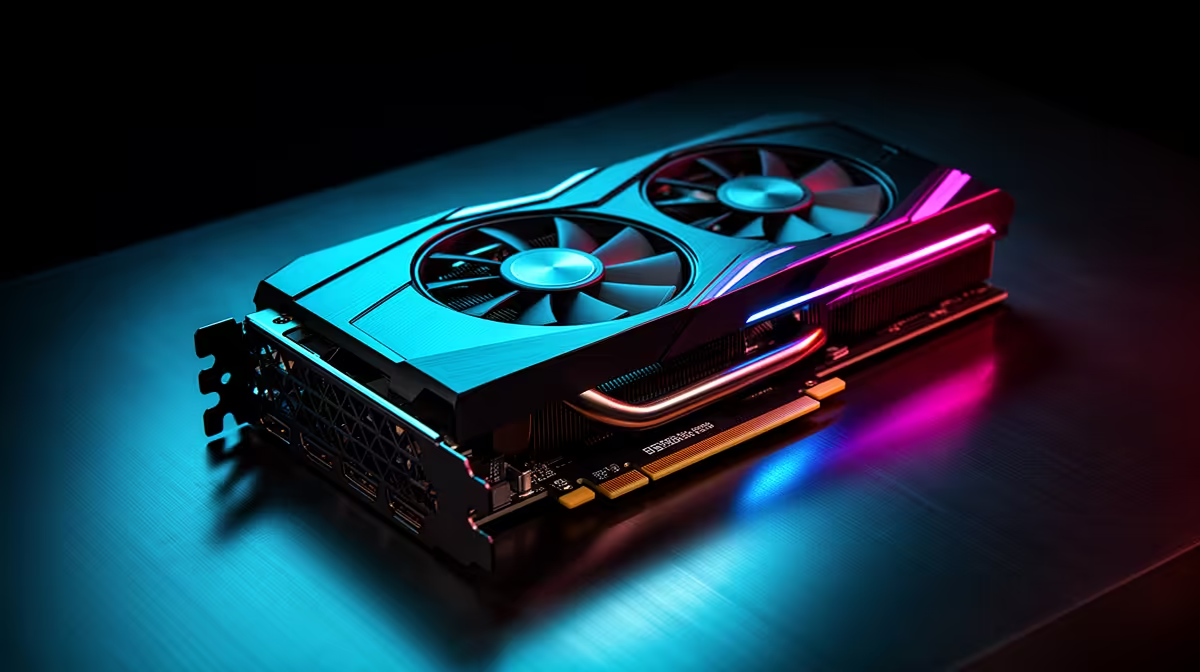
There is a familiar trap for anyone running tired graphics hardware: hold out a little longer, wait for the next generation, surely better value is just around the corner. For a GPU upgrade in 2026, that logic falls apart on the timeline. The next genuinely new flagship architectures from Nvidia and AMD are not expected until late 2027 at the earliest. Waiting does not save you money; it just locks you into another year-plus of degraded performance.
Quick Answer
If your graphics card is showing its age, upgrade in 2026 rather than waiting. The next true next-generation flagships, Nvidia's successor to the current line and AMD's RDNA 5, are pointing at late 2027 at best. Holding out means over a year of compromised frame rates with no guarantee of a price drop, while a current-generation card delivers a large jump in performance today.
The waiting math does not work
The "wait for next-gen" instinct assumes the wait is short and the reward is certain. Neither holds in 2026. Credible roadmaps put the next architectures from both Nvidia and AMD in late 2027. Count it out: choosing to wait now commits you to running an ageing card through all of 2026 and most of 2027, then dealing with the usual launch-window reality where new flagships arrive expensive and in short supply.
Meanwhile the card you already have is not standing still in relative terms. New game engines keep raising the bar, and a GPU that handled everything comfortably two or three years ago increasingly forces you to drop settings, lower resolution, or accept stutter. Every month spent waiting is a month of that compromise with nothing gained.
What a current-generation card buys you now
The argument for upgrading is not just about avoiding a long wait, it is about how much better today's cards already are. If you are sitting on something like a GTX 1080 or an RTX 2080, the leap to a current RTX card is enormous, not incremental.
Raw performance and resolution headroom
A modern mid-range or upper-tier card delivers far higher frame rates at higher resolutions than a several-year-old flagship. Games that crawl at 1440p on older hardware run smoothly, and 4K becomes genuinely playable on the stronger cards. The jump in raw rasterisation alone justifies the move for anyone gaming on an ageing GPU.
Upscaling and frame generation change the picture
This is the part older cards simply cannot access. Modern upscaling and frame-generation technology lets a current card render at a lower internal resolution and intelligently reconstruct a sharp, high-frame-rate image. An older GPU either lacks these features entirely or runs an inferior version. The practical effect is that a current card stretches its performance far further into the future than its raw numbers suggest, which directly undercuts the "wait for more power" argument. The current Nvidia and AMD graphics card range spans the tiers where these features become available.
Efficiency and features
Newer cards also run more efficiently per frame and bring features an old card never will: better ray tracing, modern display outputs, and improved video encoding for anyone who streams or records. These are not headline reasons to upgrade, but they sweeten the deal once you have decided.
VRAM is the quiet upgrade
One spec that catches out anyone clinging to older hardware is video memory. Several-year-old cards shipped with VRAM amounts that game engines have since outgrown, especially at higher resolutions and with high-resolution texture packs. When a game runs out of VRAM it stutters, hitches and drops frames in ways that no amount of raw power fixes. Current cards carry larger, faster memory pools, which is part of why they hold up so much better in modern titles. If your old GPU stutters in newer games even at modest settings, a VRAM shortfall is often the hidden culprit.
"But prices might drop if I wait"
This is the hope that keeps people on old hardware, and it rarely pays off. New flagship launches do not reliably push current-generation prices down in a hurry, and launch stock is typically tight and premium-priced. Betting on a future discount means gambling a year-plus of poor performance against an uncertain saving. Buying a well-priced current card today is the known quantity.
How to choose the right tier
You do not need the most expensive card to escape an ageing GPU. Match the card to your monitor and goals. For 1080p high-refresh gaming, a current mid-range card is a massive upgrade over a several-year-old GPU. For 1440p, step up a tier. For 4K, aim for the upper end. Pair the choice with your CPU and power supply so nothing bottlenecks the new card. The best-selling GPU listing is a useful shortlist of what currently offers the strongest value at each tier.
Two compatibility checks save grief on upgrade day. First, your power supply: newer cards have specific wattage and connector requirements, and an old supply may need replacing alongside the GPU, so factor that into the budget. Second, the CPU pairing. Drop a powerful new card next to a much older processor and the CPU becomes the limit, particularly at 1080p where the processor works hardest. If your processor is also several generations old, plan the upgrade as a pair or aim the GPU at a higher resolution where it leans less on the CPU. Getting these two right is the difference between unlocking the full jump and leaving performance on the table.
Who should act now, and who can hold
Upgrade now if your card struggles in current titles, you are dropping settings to stay playable, or you want access to modern upscaling and ray tracing. The performance and feature gap is large and the next-gen wait is long.
You can reasonably hold only if your current card still runs everything you play at the settings you want. If it does the job, there is no urgency. The point is not that everyone must upgrade, it is that "waiting for next-gen" is a bad reason to suffer poor performance when the next generation is more than a year out.
Frequently Asked Questions
When is the next GPU generation actually coming?
The next genuinely new flagship architectures from Nvidia and AMD are expected in late 2027 at the earliest. That is over a year away, which is why waiting from 2026 means a long stretch on ageing hardware.
Will GPU prices drop if I wait for next-gen?
There is no guarantee. New flagships typically launch expensive and in limited supply, and they do not reliably push current-card prices down quickly. Buying a well-priced current card now is the safer bet than gambling on a future discount.
I have a GTX 1080, is upgrading worth it?
Very much so. The jump from a GTX 1080 to a current RTX card is enormous in both raw performance and features like modern upscaling and ray tracing. You gain far higher frame rates and access to technology the 1080 cannot run.
What card should I buy for 1440p gaming?
A current upper-mid-range card handles 1440p high-refresh gaming well. Match it to your CPU and power supply, and factor in upscaling support, which stretches the card's usable life further at that resolution.
Is it worth upgrading just for ray tracing and upscaling?
For many players, yes. Older cards either cannot run modern upscaling and frame generation or run weaker versions. These features meaningfully boost performance and image quality, and they are a real part of the value a current card delivers.
With the next generation more than a year out, 2026 is the year to stop compromising on frame rates. Compare current options in the Nvidia and AMD graphics card range and pick the tier that matches your monitor and your games.