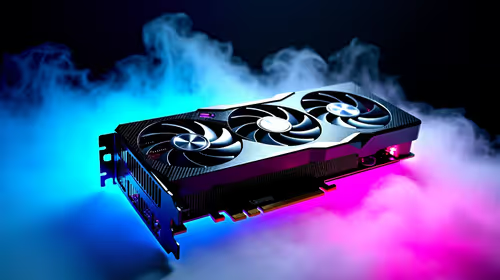
The next-gen GPU roadmap has three names worth tracking, and all of them point at 2027 rather than this year. Nvidia's RTX 60 series built on the Rubin architecture, AMD's RDNA5 and unified UDNA approach, and Intel's Arc Celestial each represent the next step from their respective camps. For South African buyers the practical question is not which is fastest on paper, but whether holding out for 2027 silicon makes sense, or whether a current-gen card is the smarter rand spent today.
Quick Answer
The two confirmed 2027 GPU targets are Nvidia RTX 60 Rubin and AMD RDNA5, both expected in the second half of 2027 based on information from board partners at Computex 2026. Intel's discrete gaming Celestial card has reportedly been cancelled, leaving Battlemage as the current Arc generation for gamers. All remaining architectures are largely unconfirmed in firm detail, so for most buyers a current-generation card is the practical choice right now rather than waiting through an uncertain timeline.
Nvidia RTX 60 and the Rubin architecture
Nvidia's next consumer line, expected to carry the RTX 60 badge, is tied to the Rubin architecture that follows the current Blackwell generation. Indications point to a launch window in the second half of 2027 at the earliest, with the data-centre and AI versions of Rubin likely arriving before the gaming cards, as has been the pattern in recent cycles. Rubin is expected to be manufactured on TSMC's 3nm-class process, which the process node supplier claims can deliver a 10 to 15 percent performance improvement at equivalent power, or a 20 to 30 percent power reduction at equivalent performance. In practical gaming terms that is meaningful headroom, but it lands on top of a year-plus wait before a consumer card is in anyone's hands.
What that means for gamers is a wait, and history suggests the flagship parts appear first at the highest prices before more affordable tiers trickle down over the following year. For anyone building now, the more relevant point is that the current Nvidia line-up is mature, well-supported and widely stocked. You can see the Nvidia and AMD graphics card range at Evetech to gauge where today's pricing sits before betting on a 2027 release.
AMD RDNA5 and the move to UDNA
AMD's roadmap is the most structurally interesting of the remaining two. The company has signalled a shift toward UDNA, a unified architecture that brings its gaming and compute designs back under one roof rather than splitting them as RDNA and CDNA. The next gaming-focused generation, referred to as RDNA5, is the practical successor most buyers care about, and board makers at Computex 2026 indicated they expect RDNA5 cards in the second half of 2027, roughly alongside Nvidia's Rubin. Early specification talk points to a flagship with around 96 compute units and roughly 6,144 FP32 shader units, which would represent about a 50 percent increase in compute units compared with RDNA4. The unification matters because it could improve feature parity and driver support across AMD's stack, though the real-world gaming impact will not be clear until silicon ships.
As with Nvidia, none of this is locked down, and AMD's launch dates have moved before. Treat the second half of 2027 as a target, not a promise.
Intel Arc: Celestial cancelled for gaming
Intel's discrete gaming Celestial card has reportedly been cancelled, which removes the third competitor from the next-gen desktop gaming picture entirely. That leaves Xe2 Battlemage as the current and near-term Arc generation for gamers, which is not without merit as a value and driver-maturity play, but it changes the competitive dynamic. With Intel stepping back from the discrete gaming desktop GPU race for now, the next-gen battle reduces to Nvidia versus AMD, both in the second half of 2027. The encouraging secondary effect for buyers is that Intel's presence kept pressure on pricing across the market, and that pressure now depends more heavily on the AMD versus Nvidia competition.
Wait or buy now: the SA buyer's call
Here is the honest assessment. Both remaining architectures are 2027 stories at best, and early flagships always launch scarce and expensive before prices settle. AMD AIBs at Computex 2026 explicitly placed RDNA5 expectations in the second half of 2027 alongside Nvidia, which aligns the two launches closely and reduces the chance of one brand discounting early to gain ground.
If your current card still runs the games you play, there is a reasonable case for patience. But if you need a GPU now, waiting a year or more for an unconfirmed release, then waiting further for stock and sane pricing to reach South Africa, is a long time to play on old hardware. A capable current-gen card bought today will serve you well past the first wave of 2027 cards. Compare value across the best-selling GPUs at Evetech to see what your money buys right now.
Frequently Asked Questions
When will the RTX 60 series launch?
Current indications from board partners and leaks point to the second half of 2027 for Nvidia's Rubin-based RTX 60 gaming cards, with data-centre versions likely arriving first. No firm consumer date is confirmed.
What is the difference between RDNA5 and UDNA?
UDNA is AMD's planned unified architecture merging its gaming and compute lines. RDNA5 is the gaming-focused generation most buyers track, expected in the second half of 2027 based on AIB information from Computex 2026, and it sits within that broader UDNA direction.
Is Intel Arc Celestial still coming?
The discrete gaming version of Celestial has reportedly been cancelled. Xe2 Battlemage remains the current Arc generation for desktop gamers, and there is no confirmed successor for the near term.
Should I wait for 2027 GPUs or buy now?
If your current card handles your games, patience is reasonable. If you need performance today, waiting through an uncertain 2027 launch and the additional delay before stock reaches SA at fair prices is a long gamble. A current-gen card remains a strong buy.
Will these new GPUs be expensive at launch in South Africa?
History strongly suggests yes. Flagship cards launch scarce and at premium prices, and that pressure is amplified once import timing and stock delays reach the local market. Early adopters always pay the most.
Not sure whether to wait or buy? Compare current performance and pricing on the graphics card range at Evetech and make the call that fits your budget today.