Your PC runs fine, but Windows tells you it cannot upgrade to Windows 11, and Windows 10 stopped getting mainstream support in October 2025. The blocker is almost always the CPU. Microsoft requires an 8th-generation Intel chip, AMD Zen 2, or newer, plus TPM 2.0, and has repeatedly confirmed it will not soften that line. So the real question for a Windows 11 upgrade is simple: is the cost of making your old machine compliant smaller than the cost of replacing it?
Quick Answer
If your PC is from 2018 or later, you can often qualify for free by switching on fTPM or PTT in the BIOS. If it predates 2018, real compatibility needs a new CPU and motherboard, which on an older platform usually means new RAM too, landing around R6,000 to R10,000 in parts. At that point a fresh system from roughly R12,000 is the smarter spend, because you are not pouring money into a dead-end socket.
First, Check Whether You Already Qualify
Plenty of "incompatible" PCs are actually eligible and just have the right feature switched off. Both Intel and AMD desktop platforms from around 2018 onward include a firmware TPM (Intel calls it PTT, AMD calls it fTPM) that ships disabled by default. Enabling it in the BIOS, along with Secure Boot, can flip a failing PC Health Check into a pass with zero spend.
Run the PC Health Check app first. If it names TPM or Secure Boot as the only problem, you have a five-minute BIOS fix, not a hardware bill. If it names the processor itself as unsupported, the firmware toggle will not help, and you are into the genuine cost comparison below.
The Real Cost: When the CPU Is the Blocker
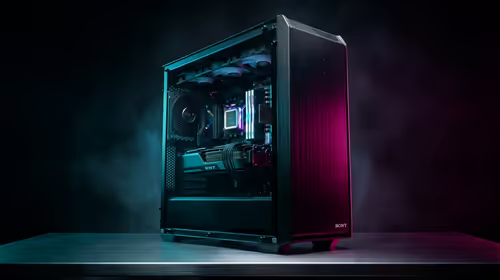
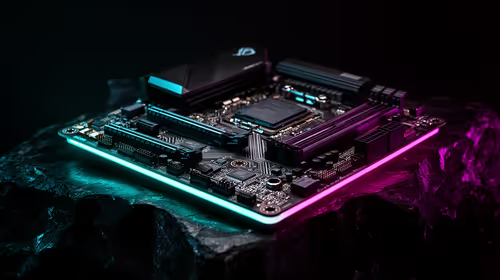
An unsupported CPU is the expensive scenario, because you cannot just drop a newer chip into an old board. A pre-2018 motherboard uses a socket and chipset that newer CPUs do not fit. So "upgrading for Windows 11" really means a new CPU plus a new motherboard, and older DDR3 or early DDR4 RAM usually will not work with a current board either, so that gets added to the bill.
Stacked up, a budget-to-midrange CPU, a compatible motherboard and a fresh RAM kit land in the region of R6,000 to R10,000 depending on the tier you choose. That keeps your existing case, power supply, storage and graphics card, which is the saving. But it also keeps you on an ageing PSU and an older GPU, so you have spent meaningfully without modernising the whole machine.
When Buying New Wins
Once the upgrade bill climbs past roughly half the cost of a capable new system, the maths tips. A new desktop or mini PC from around R12,000 gives you a current-generation CPU that is supported for years of Windows updates, a fresh warranty, modern connectivity, and storage and memory that match it, rather than a 2017 graphics card bottlenecking a 2026 processor.
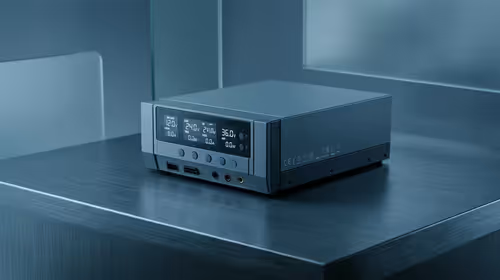
Compact systems make this especially clean for everyday and office use. The mini PCs range at Evetech covers small-footprint machines that ship Windows 11 ready, draw little power, and slot behind a monitor, which suits a home office or a student desk far better than nursing an old tower along. If gaming or heavier work is the goal, the PC best sellers at Evetech show what most buyers are actually pairing with a Windows 11 build right now.
What the Parts Bill Looks Like in South Africa
Running the actual numbers helps make the decision concrete. A budget-to-midrange upgrade for a pre-2018 machine that needs a new CPU, motherboard and RAM looks roughly like this in 2026:
- Entry AMD option: a Ryzen 5 5600 on an AM4 board (B550) carries over your DDR4 sticks and costs around R2,500 to R3,500 for the CPU plus R2,000 to R3,000 for the board, depending on the tier. This is the one scenario where you may not need new RAM, since AM4 still uses DDR4.
- Mid-range Intel option: a Core i5-12400 or similar on a B660/B760 board uses DDR4 or DDR5 depending on the board revision. Budget roughly R4,000 to R5,500 for the CPU and R2,500 to R4,000 for the board, plus R1,500 to R3,000 for DDR4 or DDR5 RAM if yours is incompatible.
- Reinstalling Windows and your applications adds time rather than hard rands, but it is real cost in the sense of an afternoon you will not get back.
The AMD AM4 path is the cheapest legitimate upgrade route because the socket survived from 2017 through 2022 and a Ryzen 5000-series chip satisfies Windows 11 requirements. It is worth checking whether your specific board supports a BIOS update that enables Ryzen 5000 compatibility before buying, since not every AM4 board received that update.
Against those upgrade costs, a capable compact desktop from around R12,000 to R15,000 brings a current-generation CPU, fresh DDR5 memory, a new warranty and modern connectivity. The gap between "upgrade an old machine" and "buy new" is often R3,000 to R5,000, which narrows fast when you add the value of a clean setup and years of forward compatibility.
What About Bypassing the Requirements?
It is technically possible to force Windows 11 onto unsupported hardware with a registry change, and doing so is not illegal. The catch is that Microsoft explicitly warns these machines may hit bugs and may eventually stop receiving security updates. For a daily driver that holds your banking, work files and personal data, betting on an unsupported configuration is a poor trade against the modest cost of doing it properly. Treat the bypass as a stopgap on a secondary machine, not a plan for your main PC.
Frequently Asked Questions
How do I know if my CPU supports Windows 11?
Run Microsoft's PC Health Check app. As a rough rule, Intel 8th-gen (2018) and later, and AMD Ryzen 2000-series (Zen 2) and later, are supported. If your processor is older than that, no BIOS setting will make it compliant.
Can I just enable TPM in the BIOS instead of buying hardware?
If your CPU is already supported and only TPM or Secure Boot is failing, yes, that is a free fix. Look for PTT (Intel) or fTPM (AMD) in the BIOS and enable Secure Boot. It does nothing for a genuinely unsupported processor, though.
Is it cheaper to upgrade my CPU and motherboard or buy a new PC?
On a pre-2018 system, a CPU, board and RAM upgrade often runs R6,000 to R10,000 and still leaves you on an old PSU and GPU. A new system from about R12,000 modernises everything with a fresh warranty, so the gap is smaller than it looks.
What happens if I stay on Windows 10?
Mainstream support ended in October 2025. You can keep using the PC, but you stop getting feature updates and, before long, security patches, which leaves the machine increasingly exposed for online use.
Is a mini PC powerful enough to replace my old tower?
For browsing, office work, streaming and light photo editing, yes. Modern mini PCs handle everyday computing comfortably and ship Windows 11 ready. For gaming or heavy creative work, a full desktop is the better target.
Stop nursing a machine Windows 11 will not support. Compare current-generation systems in the mini PCs range at Evetech and spend your rands on hardware that stays supported for years.