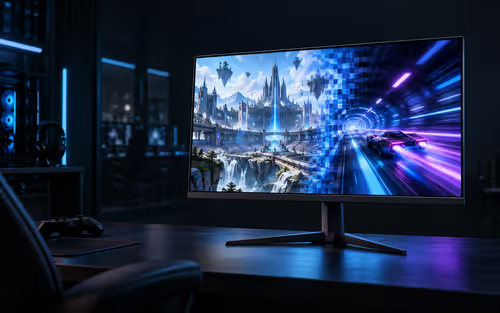
Ever lined up the perfect headshot in Valorant, clicked, and still lost the duel? Or felt a slight... floatiness... to your car in a racing sim? You're not going crazy. You might be a victim of input lag, the silent performance killer that separates the winners from the spectating screen. Understanding what input lag is isn't just for pro gamers; it's crucial for anyone wanting the most responsive experience from their PC.
Understanding Input Lag: The Unseen Enemy
So, what is input lag in simple terms? It's the delay between you performing an action—like clicking your mouse or pressing a key—and seeing the result on your monitor. This delay is measured in milliseconds (ms), and even a tiny amount can be the difference between a clutch win and a frustrating loss.
It's easy to confuse input lag with two other key monitor specs:
- Response Time: This measures how quickly a single pixel can change colour (e.g., from grey to grey). A fast response time prevents "ghosting" or motion blur.
- Refresh Rate (Hz): This measures how many times your screen updates its image per second. Higher Hz means smoother motion.
While related, they aren't the same. You can have a monitor with a great response time and high refresh rate that still suffers from high input lag due to slow internal processing.
Why Even a Few Milliseconds Matter in Gaming
In casual, single-player games, a bit of monitor input lag might go unnoticed. But in the competitive arena, it’s everything. Think about it… in a fast-paced shooter, your opponent's position changes constantly. If your screen is even 20ms behind reality, you're aiming at where they were, not where they are. That's a guaranteed miss. 🚀
This delay impacts every genre. It affects your ability to nail perfect combos in fighting games, take corners precisely in racing sims, and react to enemy abilities in MOBAs. Investing in one of the latest competitive gaming monitors is one of the most effective ways to sharpen your edge.
The Main Culprits Behind Monitor Input Lag
The delay doesn't just come from one place. Several factors contribute to the total input lag you experience, and most happen right inside the monitor itself.
Internal Image Processing
Modern displays do a lot of work to make images look good. Features like dynamic contrast, motion smoothing, and complex colour adjustments all take time. While great for watching movies, this extra processing adds milliseconds of delay. This is why many high-resolution 5K and 4K monitors come with a dedicated "Game Mode" to bypass these non-essential features.
Display Scaling
Running a game at a resolution that isn't your monitor's native resolution (e.g., 1080p on a 4K screen) forces the monitor's internal scaler to work. This process of stretching the image to fit the screen adds a small but measurable amount of input lag.
Quick Fix for Lower Lag ⚡
Most modern monitors have a 'Game Mode' or 'Fast' setting in their on-screen display (OSD). Enabling this often disables heavy image processing, significantly cutting down monitor input lag. It's the first thing you should check before diving into complex software settings!
Practical Steps to Reduce Input Lag 🔧
While you can't completely eliminate it, you can take concrete steps to reduce input lag and make your gameplay feel incredibly responsive.
- Activate Game Mode: As mentioned above, this is your first and best tool. Find it in your monitor's settings menu.
- Use the Right Connection: Always use a DisplayPort connection if possible, as it generally offers the best performance for high refresh rates. A high-quality cable is a must, so check out our monitor accessories if you need an upgrade.
- Disable V-Sync: In your game's graphics settings, turn V-Sync off, especially if your monitor supports G-Sync or FreeSync. V-Sync can introduce significant input lag by forcing your GPU to wait for the monitor.
- Choose the Right Hardware: Ultimately, the monitor itself is the biggest factor. Modern panels, including many immersive curved monitors, are now engineered specifically for low input lag.
Input Lag on Different Types of Displays
The battle against latency isn't just for desktop gamers. As technology improves, we're seeing fantastic performance across a range of display types. Even high-quality portable monitors now offer low-latency modes, making them a viable option for a responsive gaming session on the go. When shopping, always look for input lag or total latency figures in professional reviews to make an informed choice. ✨
Ready to Eliminate Delay?
Understanding what input lag is gives you a massive competitive edge. Don't let your hardware hold you back. Explore our massive range of PC monitors and find the perfect screen to match your reflexes.