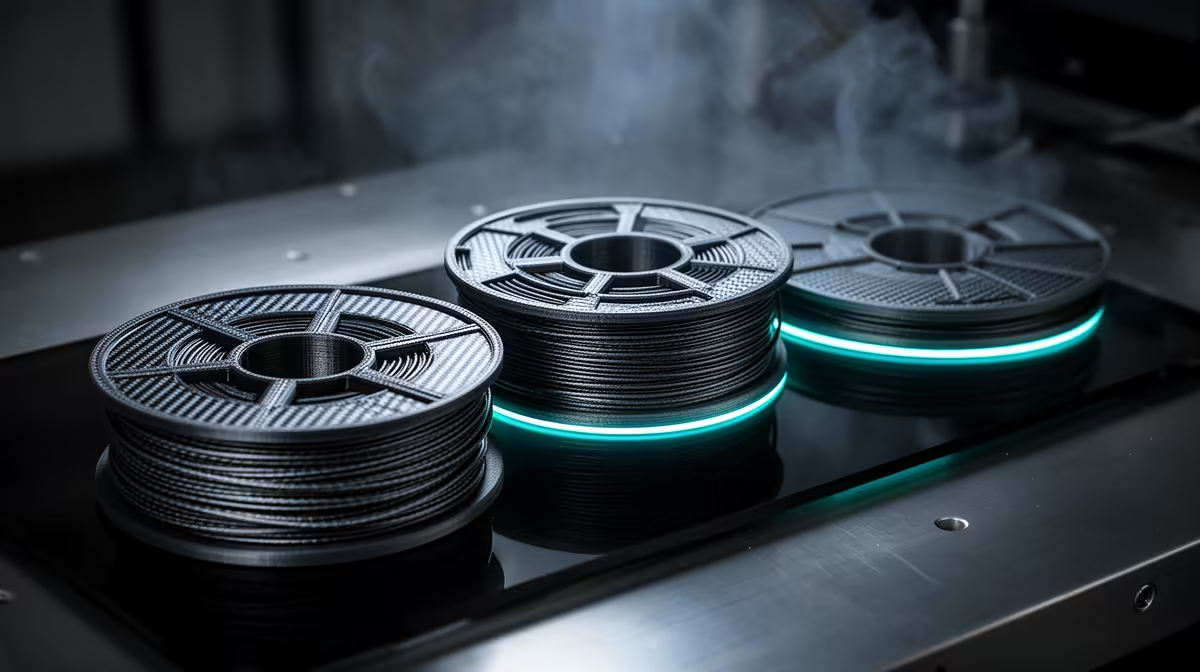
Load a spool of chopped-carbon filament into a printer running a standard brass nozzle and the bore starts widening within the first few hundred grams. Carbon-fibre filament is one of the most abrasive materials hobby printers handle, and PLA-CF, PETG-CF and PA-CF each chew through soft tips at different rates depending on heat and how aggressively you print them. The short version: a hardened nozzle is not optional for any of the three, but the rest of the hotend matters too.
Quick Answer
All three carbon-fibre blends need a hardened nozzle. Brass wears out after roughly a few hundred grams of CF filament, while hardened steel costs little and lasts through 5 to 10kg before it needs inspecting. PLA-CF is the easiest entry point at around 210 to 230C, while PA-CF demands the most heat and a fully hardened hotend with an enclosure.
Why carbon fibre destroys brass nozzles
The carbon in these filaments is chopped into short, hard fibres, typically making up 10 to 15 percent of the material by weight in a PLA base. As that abrasive grit passes through a brass tip under heat and pressure, it grinds the inner bore wider. An oversized bore stops laying down consistent lines, so extrusion becomes patchy, layer adhesion suffers, and dimensional accuracy drifts. Brass is chosen for filaments like plain PLA because it conducts heat well, but its softness is exactly the wrong property for an abrasive composite.
A hardened steel nozzle solves the wear problem directly. It handles CF, glass-fibre and glow-in-the-dark filaments comfortably, and because steel conducts heat slightly less efficiently than brass, you usually nudge the printing temperature up by 5 to 10C to compensate. If you are choosing a machine built for this kind of material from the start, Evetech's 3D printer selection covers everything from entry-level units to enclosed machines suited to abrasive composites.
Steel, ruby or tungsten carbide
Hardened steel is the affordable default and the right first upgrade for almost everyone moving into composites. Above it sit two longer-lasting options. Ruby-tipped nozzles fit a synthetic ruby into a brass or steel body, combining excellent wear resistance with near-brass thermal conductivity, which suits high-speed printing where you do not want to fight the temperature penalty of steel. Tungsten carbide goes further still, resisting wear so well it lasts almost indefinitely against even the harshest abrasives, at a much higher price. For a home printer running occasional CF spools, steel is plenty. The case for ruby or carbide grows the more abrasive filament you push through in volume.
PLA-CF: the accessible starting point
PLA-CF takes the familiar PLA base and loads it with chopped carbon, so it prints at ordinary PLA temperatures, roughly 210 to 230C, on a PEI bed with no enclosure and no special preparation. The carbon gives it a matte finish that hides layer lines and adds stiffness, which is why it has become the gentle on-ramp into composites. It is still abrasive, so the hardened nozzle rule applies from the first print, but everything else about the workflow stays close to standard PLA.
What PLA-CF does not give you is heat resistance. Like ordinary PLA it softens at modest temperatures, so a part left in a hot car or near a window in a Joburg summer can deform. Treat it as a stiffness and aesthetics upgrade, not a structural-heat material.
PETG-CF: the middle ground
PETG-CF sits between PLA-CF and the nylon blends. It keeps PETG's better temperature and impact resistance while gaining the rigidity and matte look of carbon reinforcement. It runs hotter than PLA-CF and benefits from a well-tuned bed and controlled cooling, but it does not strictly require the enclosure that nylon does.
Where PETG-CF earns its place
For functional brackets, enclosures and parts that live outdoors or get knocked around, PETG-CF is a sensible default. It is more forgiving than PA-CF on a printer that is not fully kitted out, while clearly outperforming PLA-CF on durability and heat tolerance. The same hardened-nozzle requirement holds throughout.
PA-CF: the demanding end
PA-CF is carbon-filled nylon and asks the most of your hardware. It needs high hotend temperatures, an all-metal hardened path, and ideally a heated enclosure to manage warping. Nylon is also strongly hygroscopic, so it pulls moisture from the air and must be dried before printing, otherwise you get popping, stringing and weak layers. In a humid coastal city like Cape Town or Durban, drying is not a nicety, it is part of the process.
The payoff is the best mechanical properties of the three: high stiffness, good heat resistance and toughness suited to genuine engineering parts. PA-CF is the reward for a printer that is already set up for abrasive, high-temperature materials rather than a casual first experiment. Budget for a printer with an all-metal hotend rated for high temperatures, an enclosure that holds chamber heat, and a way to keep the filament dry, since a half-equipped machine will fight you on every print and waste expensive material.
Looking after a hardened nozzle
Hardened nozzles last, but they are not eternal. A practical habit is to replace or closely inspect them every 5 to 10kg of abrasive filament, checking the tip under magnification for a rounded or widened orifice. Keeping a spare on hand means a worn tip never stalls a long print. For the tools, spare tips and other consumables that keep a printer running, browsing Evetech's top accessories is a good place to start when building out your supplies.
Frequently Asked Questions
Do I really need a hardened nozzle for PLA-CF, or only for nylon?
You need it for all three. PLA-CF prints at low temperatures, but the carbon content is just as abrasive as in PETG-CF or PA-CF, so a brass nozzle still wears out quickly. The hardened tip is about the abrasive filler, not the heat.
How long does a hardened steel nozzle last with CF filament?
A reasonable guideline is to inspect or replace it every 5 to 10kg of abrasive material. Steel resists wear far better than brass, which can degrade noticeably within a few hundred grams of carbon-fibre printing.
Why do I need to raise the temperature with a steel nozzle?
Hardened steel conducts heat slightly less efficiently than brass, so the melt zone runs a touch cooler at the same setting. Adding 5 to 10C to your usual temperature compensates and keeps extrusion smooth.
Which carbon-fibre filament should a beginner start with?
PLA-CF. It prints at standard PLA temperatures on a PEI bed with no enclosure, so the only new requirement is the hardened nozzle. PA-CF is best left until you have a heated enclosure and a filament dryer.
Does PA-CF really need to be dried before printing?
Yes. Nylon absorbs moisture from the air readily, and wet PA-CF prints poorly with popping, stringing and weak layers. Drying it before each session is part of the normal workflow, especially in humid coastal areas.
Matching the right hotend to PLA-CF, PETG-CF or PA-CF is the difference between clean parts and a ruined nozzle. Browse the 3D printers stocked at Evetech to find a machine ready for abrasive composites, then add the hardened tips and tools to keep it printing.