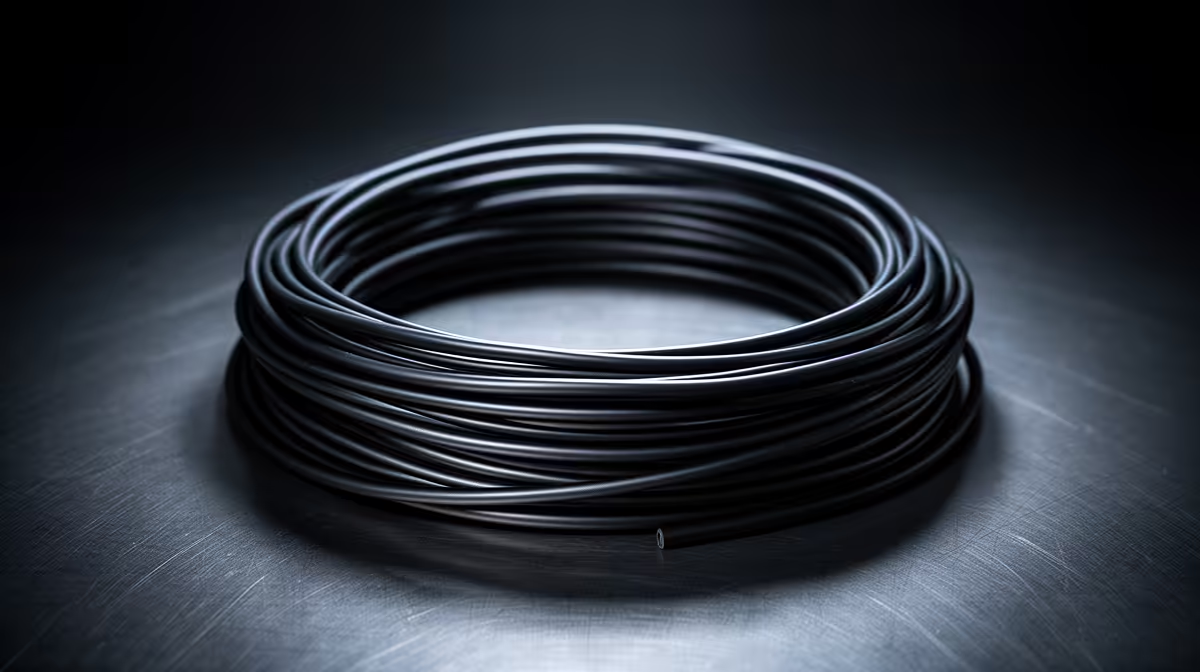
Pick the wrong TPU Shore hardness and a flexible print fails before the first layer finishes. The number stamped on the spool, 95A or 85A, is not marketing shorthand. It tells you exactly how the finished part will behave under your fingers and how hard it will be to print in the first place. A 95A phone bumper and an 85A shoe insole are made from the same family of elastomer, yet they print, feel and wear nothing alike.
Quick Answer
Choose 95A for firm, springy parts that still print on almost any machine, and 85A for soft, compressible grips that need a direct-drive extruder and slow speeds. Lower Shore A numbers mean softer rubber: 95A bends like a shopping-cart wheel, 85A squashes like a shoe sole.
What Shore Hardness Actually Measures
Shore A is a scale that records how far a standardised needle sinks into the material under a fixed load. The higher the number, the more the rubber resists that needle, so a higher rating equals a stiffer part. TPU spools sit almost entirely in the Shore A band, with the common rungs being 85A, 90A, 95A and 98A.
The practical translation is simple. At 98A the filament behaves close to a hard plastic with a little give. At 95A you get a confident flex that springs back. Drop to 85A and the part becomes genuinely soft, the kind of squish you feel in a wrist rest or a sole. The gap between two rungs of ten points is far larger in the hand than the small number difference suggests.
A good 3D printer paired with the right filament makes the difference obvious, and the range of 3D printers stocked at Evetech covers both the Bowden and direct-drive layouts that decide which TPU grades you can realistically run.
95A: The Workhorse Flexible
95A is where most makers should start. It is flexible enough to be useful and stiff enough to feed reliably, which means it will print on a wide spread of machines, including many Bowden setups, with careful tuning. The material holds its shape under load yet bends out of the way when pushed.
That balance suits the bulk of real flexible jobs: protective bumpers and cases, cable strain reliefs, RC and robot wheels, belt tensioners, seals and gaskets that need to compress slightly without going floppy. If you are printing something that should bend and recover rather than squash and stay squashed, 95A is almost always the correct answer.
Why 95A Forgives Beginners
The stiffness that makes 95A useful is the same stiffness that makes it print well. The filament resists buckling as the extruder pushes it forward, so it is far less likely to kink and jam inside a feed tube. You can usually run it at moderate speeds with light retraction and get clean walls.
85A: Soft, Demanding, Worth It
85A unlocks properties that 95A simply cannot reach. It is the grade for compressible gaskets, soft-touch grips, wearable straps and anything that needs to deform under gentle pressure and stay comfortable. Nothing in the firmer tiers feels like it.
The catch is printability. 85A is soft enough to bend sideways the instant the extruder applies forward pressure, so it buckles inside a Bowden tube without exception. A direct-drive extruder, where the motor sits right above the hot end, is not optional here, it is required. Even then, speeds drop to roughly 15 to 25 mm/s and retraction must be minimal or switched off entirely to avoid grinding the filament against the drive gear.
When the Extra Effort Pays Off
If the part lives against skin, absorbs shock or seals an irregular surface, the softness of 85A earns its keep. For a watch strap, a vibration-damping foot or a squeezable enclosure, the slow print is a fair trade for a result the firmer grades cannot deliver.
Settings and storage: what TPU actually needs
Getting the grade right is only half the job. TPU also has firm requirements around temperature, retraction and moisture that trip up makers who treat it like PLA.
Temperature
Most 95A spools print cleanly between 220 and 240C. A 85A grade sometimes prints at the lower end of that band or slightly below, because less heat means the already-soft filament moves through the hot end with less risk of ooze. Always check the datasheet on the specific spool before dialling in a number: manufacturers vary, and the printed range on the label overrides any rule of thumb.
Retraction
Keep retraction low across all TPU grades. Even with 95A, the recommended starting point is 0 to 2 mm, not the 4 to 7 mm that works well for PLA on a Bowden machine. Too much retraction drags the soft filament back against the drive gear and grinds it. With 85A the safest approach is to disable retraction entirely and manage stringing through temperature and travel speed instead. A clean wipe pattern or a well-tuned coast-at-end setting handles most of the residual ooze.
Bed adhesion
TPU does not need a heated bed on many surfaces. PEI spring steel and blue painter's tape both give reliable first-layer adhesion at room temperature, which simplifies setup. If you do run bed heat, keep it modest. TPU that sits too long on a very hot surface can bond harder than intended and tear during removal.
Moisture and SA storage
TPU absorbs moisture from the air, and wet filament strings badly, produces a rough surface and weakens the finished part. Dry a suspect spool at 70C for 4 to 8 hours before printing. In Cape Town and Durban, where coastal humidity is consistently high, a spool left open on the bench can absorb enough moisture to affect print quality within a few hours.
TipBox: Reseal the spool within minutes of finishing a session. An airtight container with a few silica gel sachets keeps TPU in print-ready condition indefinitely. Silica gel is cheap and reusable: bake it dry at around 120C for an hour and it is ready to use again.
Matching Grade to Job
Work backwards from how the finished part must feel. If it should spring back, pick 95A. If it should squash and cushion, pick 85A and commit to direct-drive printing. If you only own a Bowden machine and want to experiment, 95A is the safe entry point, and a 90A spool sits as a middle option once you are comfortable. The accessories that make flexible printing cleaner, from spool holders to nozzle and bed upgrades, turn up regularly in the Evetech accessories best sellers list.
Frequently Asked Questions
Is a lower Shore A number softer or harder?
Softer. Shore A counts how strongly the material resists a needle, so a lower number means the needle sinks further and the rubber is more flexible. 85A is noticeably softer than 95A.
Can I print 85A TPU on a Bowden printer?
In practice, no. 85A buckles inside the long feed tube the moment forward pressure is applied and jams. It needs a direct-drive extruder with the motor mounted close to the hot end.
What is the most printer-friendly flexible filament?
95A. It is stiff enough to feed reliably on most machines, including many Bowden setups, while still bending and recovering like rubber. It is the recommended starting grade for anyone new to flexibles.
What can I make with 95A TPU?
Phone bumpers, cable strain reliefs, RC and robot wheels, belt tensioners, protective cases and seals. Anything that should flex and spring back rather than stay compressed suits 95A well.
What print speed does 85A need?
Slow. Around 15 to 25 mm/s, with retraction kept minimal or disabled, so the soft filament does not grind or kink during the print.