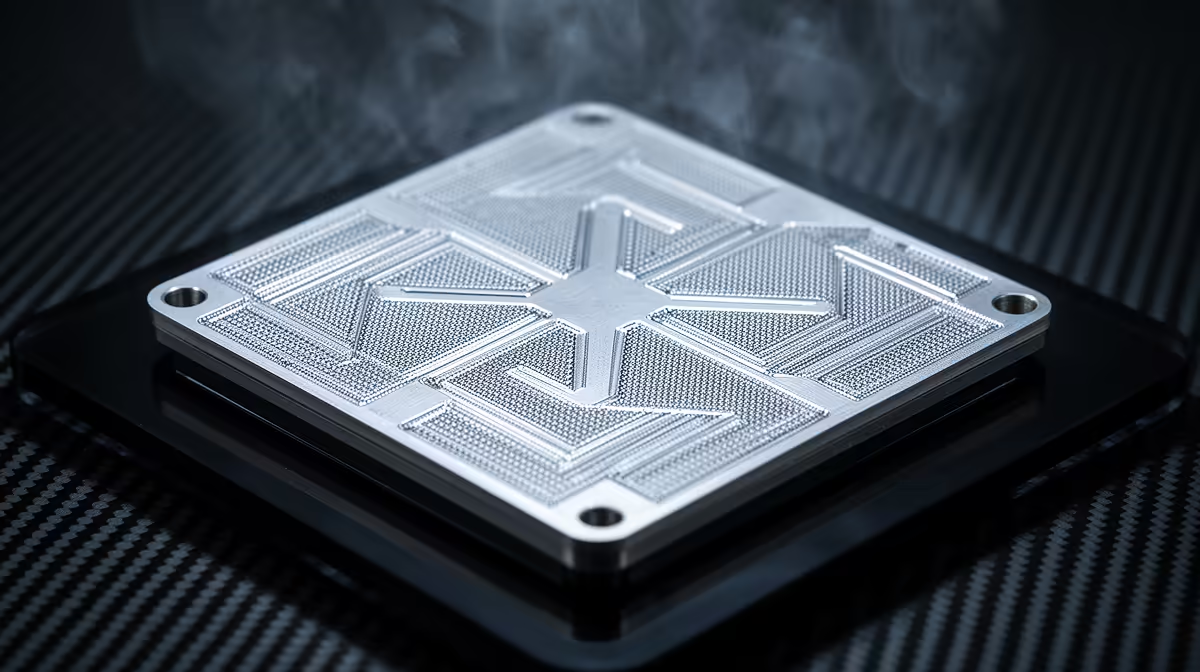
Pull a finished ABS bracket off the wrong surface and you already know the story: the corners curled, the first layer let go halfway through, and the part warped into something useless. The fix is rarely a hotter nozzle or more glue. It is the surface itself. A high-temp engineering build plate uses a coating rated for roughly 100 to 120C bed temperatures, which is exactly the window ABS, ASA and polycarbonate need to stay flat and bonded from first layer to last.
Quick Answer
An engineering build plate is a steel sheet with a reinforced, corrosion-resistant coating tuned for high-warp filaments. Run it at a 100 to 120C bed (often inside an enclosed chamber) and ABS, ASA and PC stay locked down while printing, then pop free cleanly once the plate cools. A standard smooth PEI sheet simply cannot hold these materials at that temperature without corner lift.
Why ABS, ASA and PC Lift on the Wrong Surface
These three filaments share one expensive habit: they shrink as they cool. Each layer contracts slightly the moment the nozzle moves on, and that contraction pulls the perimeter inward. On a surface that does not grip hard enough, the pull wins, and the corners peel off the plate mid-print. ABS is the classic offender, ASA behaves similarly with better UV resistance, and polycarbonate is the most demanding of the three because it prints hottest and shrinks hardest.
Heat is the counter. A bed held at 100 to 120C keeps the lower layers of the part warm and pliable, so the contraction is gentler and the adhesion has time to hold. That is why bed temperature, not glue, is the real lever, and why a plate that can take that heat and grip at it matters more than any slicer tweak.
What Makes an Engineering Plate Different
A general-purpose smooth or textured PEI sheet is built for PLA and PETG, where adhesion needs to be moderate and release needs to be easy. Engineering plates flip that priority. The coating is applied through a reinforced process that resists the corrosion and degradation that high bed temperatures cause over time, so the surface lasts through repeated 110C cycles instead of breaking down after a few months.
The texture is usually fine and uniform, which leaves a smooth, almost glossy bottom on the finished part. More importantly, the bond is strong while hot and releases on cooldown. You are not fighting the plate with a scraper at the end of every print. The part holds during the job, then lets go once the steel drops back toward room temperature and the differing contraction rates break the bond for you. If you are picking a printer to pair with one, the FDM machines in the 3D printers range at Evetech cover the enclosed, high-temperature models that suit these materials.
Where Glue Still Earns Its Place
An engineering plate is not always a no-adhesive surface. ABS and ASA often run cleanly on bare engineering coating inside a heated chamber. Polycarbonate and nylon are the exception: they can bond so aggressively to the plate that they tear the coating on removal. A thin layer of PVA glue stick acts as a release agent there, protecting the surface and letting the part separate without damage. It is the opposite logic to PLA, where glue adds grip. With PC, the glue is there to let go.
Chamber Temperature Matters as Much as the Plate
A great plate on an open-frame printer still fights a losing battle with ABS. Warping is driven by the temperature difference between the warm lower layers and the cooler upper ones, and an open printer lets the top of a tall part cool too fast in a draughty room. An enclosed chamber traps heat around the whole model, narrowing that gradient and letting even tall ABS prints finish without splitting at the layer lines.
This is why the engineering plate is usually sold alongside enclosed machines rather than open hobby printers. The plate handles the first-layer bond; the chamber handles everything above it. Treat them as a pair when you are building a setup for engineering filaments rather than expecting one to cover for a missing other.
Matching the Plate to Your Material
If your printing is mostly PLA and PETG with the occasional functional part, a textured PEI sheet plus the odd glue stick covers you, and an engineering plate is overkill. The moment ABS, ASA or PC becomes a regular part of your workflow, the engineering plate stops being optional. Functional brackets, automotive trim, outdoor enclosures and anything that needs to survive heat or sun all point to these filaments, and these filaments point to a plate built for the temperatures they demand.
Keep a spare sheet on hand if you switch materials often, since dedicating one plate to PC and nylon (with their glue layer) and another to clean ABS and ASA saves you constant cleaning. The spare sheets and consumables you need to keep a plate fresh are all stocked in the top-selling accessories at Evetech.
Frequently Asked Questions
What bed temperature does an engineering build plate handle?
The coating is rated for sustained use around 100 to 120C, with PEI variants tolerating surface temperatures up to roughly 200C. That covers the bed temperatures ABS (typically 100 to 110C), ASA and polycarbonate all need to stay adhered.
Do I need glue on an engineering plate for ABS?
Usually not. ABS and ASA tend to bond well to a clean engineering coating in a heated chamber. Save the glue stick for polycarbonate and nylon, where it works as a release agent to stop the part from over-bonding and tearing the surface.
Will an engineering plate work for PLA too?
It can, but PLA does not need it, and the strong-grip coating can make low-temperature PLA parts harder to remove than they would be off a standard textured sheet. Match the plate to the filament rather than running everything on one surface.
Why did my ABS print still warp on an engineering plate?
Most likely the chamber is too open or the room is draughty, so the upper layers cooled faster than the lower ones. The plate fixes first-layer adhesion, but an enclosure is what controls warping higher up the part.
Can I use one plate for every engineering filament?
You can, but it is cleaner to keep a glue-coated plate for PC and nylon separate from a bare plate for ABS and ASA. That avoids constantly washing glue off a surface you would rather run dry.
Ready to print engineering filaments without the corner lift? Browse enclosed FDM machines and high-temperature surfaces in the 3D printers range at Evetech and set yourself up for clean ABS, ASA and PC parts from the first layer.