



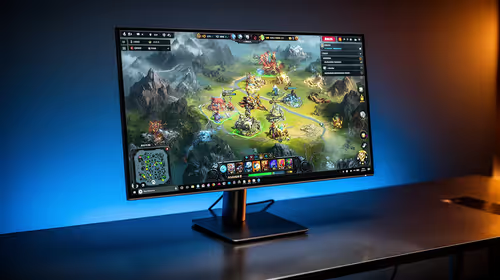
IPS vs VA for Strategy and Sim Games in SA
IPS vs VA for strategy and sim games should be judged by fit, not a single winner. Compare compatibility, latency, capacity, upgrade path, cost planning, and South African setup needs.
Read moreConfused about Workstation vs Gaming GPUs? 🛑 We break down why the new RTX PRO 4000 Blackwell is essential for 3D rendering and AI. Discover the power of ISV certification and ECC memory for your professional workflow. 🚀

Thinking of dropping a top-tier gaming GPU into your professional rig for 3D modelling or video editing? Hold on a second, boet. While that card smashes framerates in Helldivers 2, it might not be the ace you think it is for your workflow. The real debate of workstation vs gaming GPUs isn't just about raw power; it's about precision, stability, and purpose-built drivers. Let’s dive into why pros are eyeing the new NVIDIA RTX PRO 4000 Blackwell series.
At first glance, a high-end gaming card and a workstation card look similar. They both use NVIDIA silicon, have heaps of VRAM, and promise incredible performance. So, what’s the catch? It all comes down to the drivers—the software that lets your hardware talk to your applications.
NVIDIA's GeForce gaming GPUs use drivers optimised for one thing: maximum frames per second in games. They push the hardware to its absolute limit for speed. Workstation GPUs, on the other hand, use professional RTX drivers. These are meticulously tested and certified for stability and accuracy in dozens of professional applications like SolidWorks, Adobe Premiere Pro, and Blender. This focus on reliability is crucial when a single render crash could cost you hours... or even a client.
Imagine you're an architect finalising a massive 3D model of a new building. A gaming GPU might produce tiny visual glitches or rounding errors in the viewport—artefacts that are unnoticeable in a fast-paced game but could lead to costly real-world construction mistakes. This is a classic scenario where the workstation vs gaming GPUs argument becomes crystal clear.
Professional cards, like those in our range of workstation graphics cards, often include features like ECC (Error Correcting Code) VRAM to prevent data corruption and support for 10-bit colour for unparalleled accuracy in video grading. They are built for marathon rendering sessions, not just quick gaming sprints. 🚀
In the NVIDIA Control Panel, navigate to 'Manage 3D Settings'. You can create custom profiles for your professional apps (e.g., Blender, AutoCAD). Forcing settings like 'OpenGL GDI compatibility' to 'Prefer performance' and 'Power management mode' to 'Prefer maximum performance' can significantly boost viewport responsiveness without sacrificing stability.
This brings us to the latest evolution: the NVIDIA RTX PRO 4000 series, built on the groundbreaking Blackwell architecture. While a powerful gaming card from a brand like MSI is fantastic for entertainment, the RTX PRO 4000 Blackwell is engineered specifically for the next generation of AI-accelerated workflows, complex simulations, and high-fidelity creative projects.
These cards are expected to deliver a massive leap in performance for tasks that leverage Tensor Cores and RT Cores, from AI denoising in renders to real-time ray tracing in design software. For South African engineers, data scientists, and content creators whose livelihoods depend on performance and precision, this isn't just an upgrade; it's a necessary investment in productivity.
It's a fair question. The short answer is yes, you absolutely can. However, you'll be paying a premium for professional features you won't use in games. A workstation card might deliver lower framerates than a similarly priced gaming GPU from a manufacturer like Palit because its drivers aren't optimised for that specific task.
If you're a professional who games on the side, a workstation card is perfect. But if you're a gamer who occasionally edits a YouTube video, a future powerhouse like the RTX 5070 or the more mainstream RTX 5060 will offer far better value for your money. It's about choosing the right tool for your primary job. ✨
Ready to Power Up Your Workflow? The workstation vs gaming GPU debate is clear: for mission-critical work, stability is king. If your projects demand certified drivers and flawless accuracy, investing in a professional card is the smartest move you can make. Explore our powerful range of workstation graphics cards and give your creativity the hardware it deserves.
Workstation GPUs prioritize precision, ECC memory, and software stability (ISV certification), while gaming GPUs focus on raw frame rates and texture speeds.
While capable of gaming, the RTX PRO 4000 Blackwell is optimized for professional apps like AutoCAD and Blender, offering stability over high FPS.
For basic editing, no. However, for 8K rendering and complex color grading, the RTX PRO 4000 provides better VRAM management and driver reliability.
ISV certification ensures the GPU drivers are tested and guaranteed to work bug-free with professional software vendors like Adobe, Autodesk, and Dassault.
Yes, the RTX PRO 4000 Blackwell features Error Correction Code (ECC) memory to prevent data corruption during long render cycles or simulations.
Blackwell architecture introduces advanced Tensor Cores designed specifically to accelerate generative AI and deep learning inference workloads.
IPS vs VA for strategy and sim games should be judged by fit, not a single winner. Compare compatibility, latency, capacity, upgrade path, cost planning, and South African setup needs.
Read more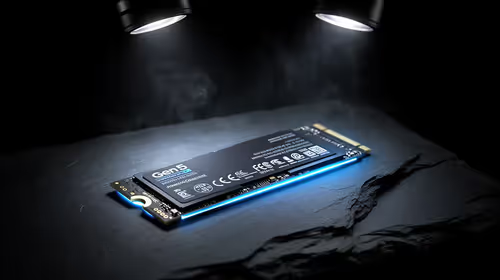
Gen 5 NVMe SSD guide for Bloemfontein gamers should be shortlisted around the job it must do. South African buyers should compare capacity, speed, thermals, and motherboard support, warranty path, and upgrade room before treating any pick as best.
Read more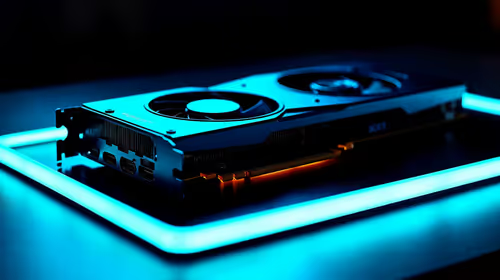
Skip the RTX 5070 if your first-time builder budget needs better balance. Better SA picks can free room for the right CPU, PSU, case, monitor, storage, and cooling while still giving a strong first gaming PC experience this year in South Africa.
Read more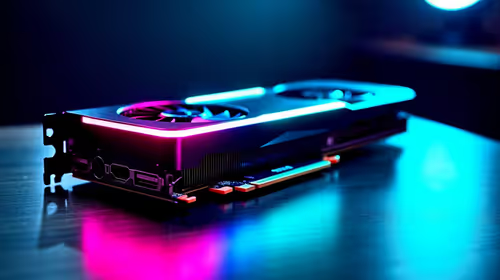
RTX 5080: weighing the pros and cons for SA should be shortlisted around the job it must do. South African buyers should compare GPU tier, VRAM, cooling, and PSU headroom, warranty path, and upgrade room before treating any pick as best.
Read more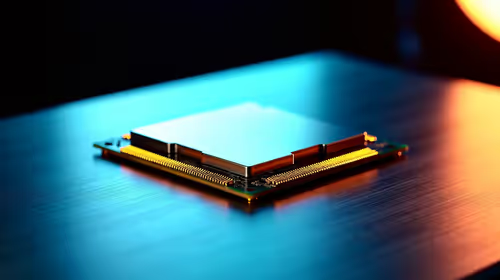
Core i5-13400F gives South African PC builders a capable mid-range CPU choice with clear limits. Check its gaming fit, discrete GPU requirement, LGA1700 platform costs, and upgrade path before locking in your parts list.
Read more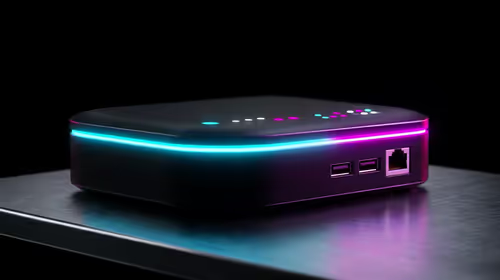
Pros and cons of the Wi-Fi 7 routers for SA should be shortlisted around the job it must do. South African buyers should compare WiFi standard, coverage, latency, and device support, warranty path, and upgrade room before treating any pick as best.
Read more
Steam content servers unreachable needs a download-path check, not an immediate reinstall of every game. Restart the client, inspect download settings and compare another connection when practical. Clearing the download cache is separate from deleting installed games.

Keychron G6 HE has built-in and swappable battery versions with different weights. The product brief lists 42g and 46g respectively, each with a 3g tolerance. Choose by grip and battery preference before treating one headline weight as universal.

Corsair HS80 v2 MAX supports 2.4GHz wireless and Bluetooth. Its maximum battery figures use RGB-off conditions and differ by connection. Check microphone routing, comfort and the exact device support before assuming every wireless mode behaves alike.

Windows taskbar notification badges can be shown or hidden in Taskbar behaviours. This changes the small app indicators, not the underlying messages. Choose a calmer desktop while keeping a deliberate routine for checking important conversations and app updates.

Windows title bar window shake can minimise other open windows when you shake the active window by its title bar. Inspect the Multitasking setting and switch it off if that gesture interrupts your work. The preference costs R0 and does not require new hardware.

Windows Print Screen opens Snipping Tool when its keyboard preference is enabled. Change the option under Accessibility, Keyboard to choose another workflow. Test whether you need a clipboard image or a saved file.

Windows desktop icons missing may be a visibility setting. Right-click the desktop, choose View and inspect Show desktop icons. If only system icons are absent, use Desktop icon settings. Check the Desktop folder before assuming files were deleted.

Windows set time zone automatically greyed out calls for a location and device-policy check. Automatic time-zone selection relies on location services. A manual time-zone choice is separate from synchronising the clock; check both before replacing hardware.
Windows title bar window shake can minimise other open windows when you shake the active window by its title bar. Inspect the Multitasking setting and switch it off if that gesture interrupts your work. The preference costs R0 and does not require new hardware.
Windows Print Screen opens Snipping Tool when its keyboard preference is enabled. Change the option under Accessibility, Keyboard to choose another workflow. Test whether you need a clipboard image or a saved file.
Windows desktop icons missing may be a visibility setting. Right-click the desktop, choose View and inspect Show desktop icons. If only system icons are absent, use Desktop icon settings. Check the Desktop folder before assuming files were deleted.
Windows set time zone automatically greyed out calls for a location and device-policy check. Automatic time-zone selection relies on location services. A manual time-zone choice is separate from synchronising the clock; check both before replacing hardware.