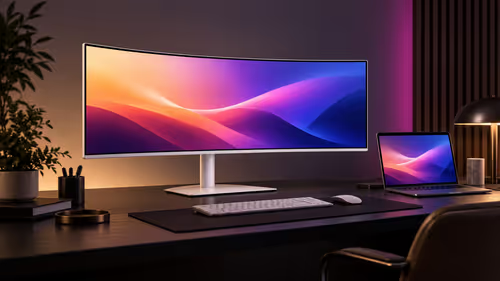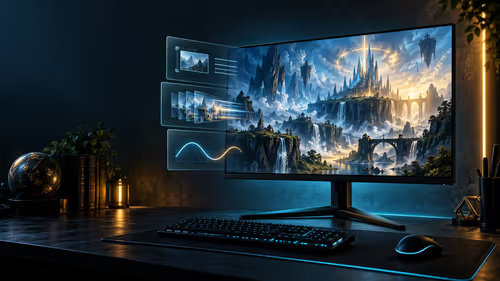
You’ve spent thousands on a beast of a PC. You’ve downloaded the latest AAA title. You dim the lights, boot up the game, and… it just feels flat. Lifeless. That epic, movie-like experience you were promised feels miles away. What gives?
Often, the culprit is hiding in plain sight: your monitor settings. Factory defaults are designed to look good on a showroom floor, not for the rich, atmospheric world of Cyberpunk 2077 or the haunting landscapes of Elden Ring.
Why Your Monitor's Factory Settings Fall Short
Think of your new monitor like a high-performance car straight from the factory. It’s capable of incredible things, but it’s tuned for a smooth, average ride. To truly feel the road, you need to pop the hood and make some adjustments. The same goes for achieving the best monitor settings for cinematic gaming immersion.
Out of the box, most screens are too bright, with colours that are either washed out or wildly oversaturated. They're not optimised for the subtle shadows and vibrant highlights that make a game world feel real. Before you can dial in those perfect cinematic settings, you need a quality canvas. You can browse a wide variety of general-purpose PC monitors to see what foundational features matter most.
The Core Settings for Cinematic Gaming Glory 🎬
Getting these basics right accounts for 80% of the visual upgrade. Navigate to your monitor’s on-screen display (OSD) using the buttons on the unit itself and let’s get tweaking.
Brightness & Contrast: The Foundation of Depth
These two settings work together. Brightness controls the overall luminance, while contrast defines the difference between your darkest blacks and brightest whites.
- Brightness: Set this first. Lower it until the black areas of your screen look truly black, not a hazy grey. A good test is a dark scene in a game or a calibration screen. You should still be able to make out details in the shadows, but just barely.
- Contrast: Once brightness is set, adjust the contrast. Increase it to make the bright parts of the image pop without "clipping" the whites—that’s when you lose detail in very bright areas, like clouds.
The goal is a deep, rich image, not a washed-out or blindingly bright one. This balance is key for cinematic immersion.
Colour Temperature & Saturation: Setting the Mood
Colour is what sells the emotion of a scene.
- Colour Temperature: Most monitors have presets like "Cool," "Normal," and "Warm." For a cinematic feel, "Warm" (or a manual setting of 6500K) is usually the best starting point. It gives a more natural, film-like quality, avoiding the harsh blue tint of cooler settings.
- Saturation: This controls colour intensity. Factory settings often push this too high. Nudge it down a few points from the default for more realistic skin tones and environments. On today's stunning 4K and 5K monitors, even subtle colour adjustments have a massive impact on image quality.
Gamma & Black Levels: Uncovering the Shadows
Gamma affects the mid-tones of your image and is crucial for seeing detail in dark areas without making the whole scene look faded. A gamma setting of 2.2 is the standard for most content. If your game looks too dark or washed out, a small gamma adjustment is often the fix. This is especially noticeable on panels that offer deep blacks. To take it a step further, many gamers find that curved monitors enhance this depth by filling your peripheral vision, making those carefully calibrated shadows even more impactful.
Quick Calibration Trick 🔧
Most modern games include their own calibration screens in the graphics settings. Use these! They often provide simple patterns like "adjust until the logo is barely visible." This is a fantastic, game-specific way to fine-tune your brightness and contrast for the best possible experience in that title.
Advanced Tweaks for Peak Immersion
Once you’ve mastered the core settings, a few advanced features can push your visuals over the top. Features like HDR, variable refresh rate, and low input lag are why a dedicated display from our range of all gaming monitors can make such a difference.
- HDR (High Dynamic Range): If your monitor and game support it, turn it on! HDR expands the range of both colour and contrast, allowing for brighter highlights and deeper blacks in the same scene. It’s a huge step up for cinematic realism.
- Response Time / Overdrive: This setting controls pixel transition speed to reduce motion blur. Set it too high, and you can get "inverse ghosting" (a weird halo effect). Find the middle ground—usually a "Normal" or "Fast" setting works best.
Achieving the best monitor settings for cinematic gaming immersion is a process of small, deliberate adjustments that combine to create a breathtaking result.
Don't Forget the Physical Setup ✨
Your environment matters just as much as your screen’s settings. For true immersion, your monitor should be at eye level, about an arm's length away. Consider a monitor arm or stand from our collection of monitor accessories to get the perfect ergonomic position.
Also, play in a dimly lit room, not complete darkness. A soft light behind your monitor (known as bias lighting) can reduce eye strain and improve perceived contrast. Even if you're gaming on the go, these principles still apply. Getting the right angle and managing reflections on portable monitors can transform a cramped gaming session into an enjoyable one.
Ready for True Cinematic Immersion? The best settings can only take you so far... a great monitor is the foundation. If your current screen isn't cutting it, it's time for an upgrade. Explore our massive range of gaming monitors and find the perfect display to bring your games to life.