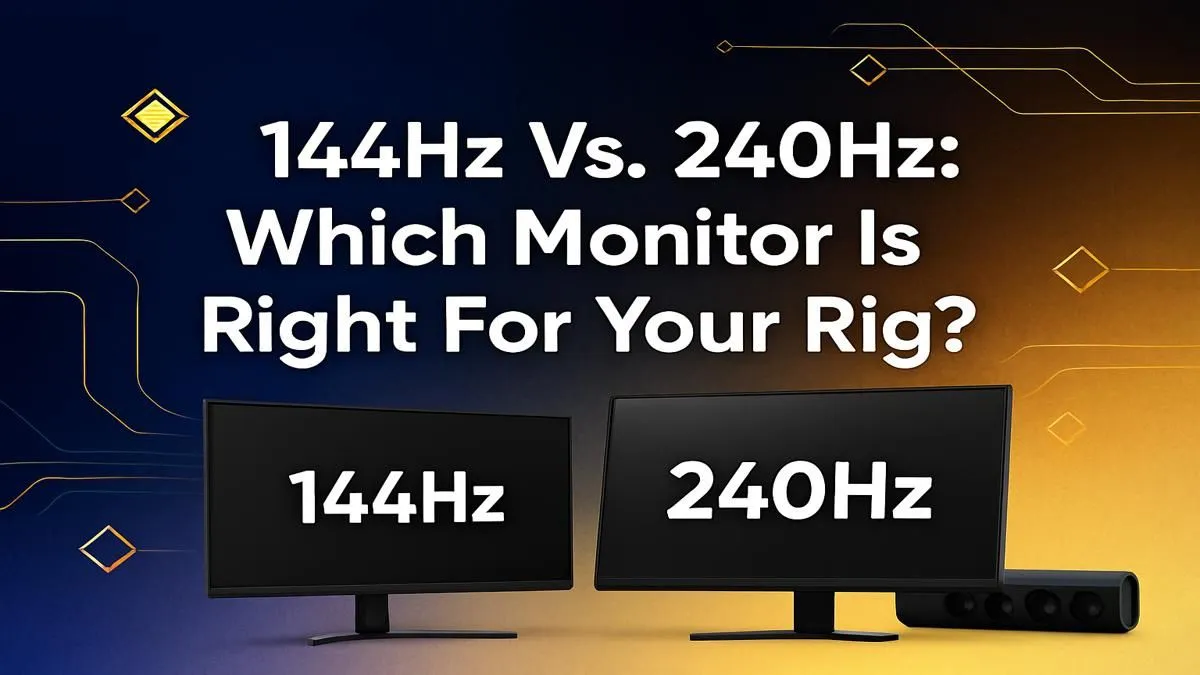
Staring down the sights in Valorant, you need every millisecond. But is the jump from a 144Hz to a 240Hz monitor a true competitive edge, or just hype? For South African gamers, where every rand counts, this decision is massive. Let’s break down the 144Hz vs 240Hz debate to find the perfect refresh rate for your rig and budget, helping you secure that win. 🚀
Understanding Refresh Rate: What is Hz?
Before we dive into the 144Hz vs 240Hz showdown, let's quickly cover the basics. A monitor's refresh rate, measured in Hertz (Hz), is the number of times per second the screen updates the image. A 60Hz monitor refreshes 60 times a second, while a 144Hz monitor refreshes 144 times.
A higher refresh rate means more frames are displayed every second, resulting in:
- Smoother Motion: Animations and camera pans look incredibly fluid.
- Reduced Motion Blur: Fast-moving objects appear sharper and clearer.
- Lower Input Lag: You see what's happening fractions of a second sooner, giving you a slight edge.
The difference between 60Hz and 144Hz is massive and immediately noticeable. But what about the jump from 144Hz to 240Hz? That's where things get interesting.
The 144Hz Sweet Spot: Gold Standard for SA Gamers
For years, 144Hz has been the gold standard for serious PC gaming, and for good reason. It offers a huge leap in smoothness and responsiveness over older 60Hz panels without requiring a supercomputer to run.
A 144Hz monitor is the perfect all-rounder. It makes fast-paced shooters like Apex Legends and Warzone feel incredibly responsive, while also making sprawling single-player adventures like Cyberpunk 2077 look buttery smooth. It’s the ideal middle-ground, balancing performance and price for the vast majority of gamers. For many, this is the best refresh rate to optimise performance. You can explore a wide variety of excellent options in our complete all gaming monitors collection.
Stepping Up to 240Hz: The Pro-Gamer's Edge ⚡
So, if 144Hz is so good, why does 240Hz exist? The answer is simple: competitive advantage. For esports professionals and aspiring pros playing titles like CS:GO, Valorant, or Overwatch, the smallest advantage matters. The jump from 144Hz to 240Hz provides that extra layer of motion clarity and the lowest possible input lag.
While the visual difference isn't as dramatic as the 60Hz to 144Hz jump, a trained eye can spot it. Opponents appearing around corners are rendered just a little bit clearer, and tracking fast-moving targets becomes slightly easier. Many competitive players favour curved monitors at this refresh rate for added immersion.
Check Your GPU First! 🔧
A 240Hz monitor is only useful if your graphics card can consistently push 240+ frames per second (FPS). Before you upgrade your screen, make sure your GPU is up to the task. Otherwise, you're paying for performance you can't even use.
144Hz vs 240Hz: The Head-to-Head Breakdown
Let's put them side-by-side to see which monitor is best for you.
Visual Smoothness & Your GPU
The law of diminishing returns is real. The improvement from 144Hz to 240Hz is noticeable, but far more subtle than from 60Hz to 144Hz. Crucially, you need a powerful GPU (think NVIDIA RTX 4070 or higher) to consistently hit the 240+ FPS needed to take full advantage of a 240Hz monitor, especially at 1440p resolution.
Price in ZAR
This is often the deciding factor. 240Hz monitors carry a significant price premium over their 144Hz counterparts. You could be looking at a difference of a few thousand rand for a similar-sized screen. It's always a good idea to check for the best PC monitor deals to see where your budget can take you.
The Final Verdict: Which Monitor Is Best For You?
The 144Hz vs 240Hz debate doesn't have one right answer... it depends entirely on you.
Choose a 144Hz monitor if:
- You play a wide variety of games, from AAA titles to casual indies.
- You're a competitive gamer, but not at a semi-pro or professional level.
- Your budget is a primary concern.
- Your PC has a mid-range graphics card.
Choose a 240Hz monitor if:
- You are a highly competitive esports player in games like Valorant or CS:GO.
- You have a top-tier GPU that can consistently deliver 240+ FPS.
- Budget is not your main constraint, and you want every possible competitive edge.
Ultimately, both are fantastic choices that will elevate your gaming experience. Your decision should align with your games, your hardware, and your wallet. ✨
Ready to Upgrade Your View? Whether 144Hz is your sweet spot or 240Hz is your competitive goal, the right panel is waiting. Browse our full range of PC monitors for performance that leaves lag in the dust.