Keeping a phone secured through a sharp bend or a sudden emergency stop requires more than a mount that looks sturdy. Auto-clamping cradle mounts use a specific sequence of mechanical actions to grip, lock, and hold the phone, and understanding that sequence tells you exactly why some mounts release unexpectedly and others stay firm through every rough patch of road.
Quick Answer
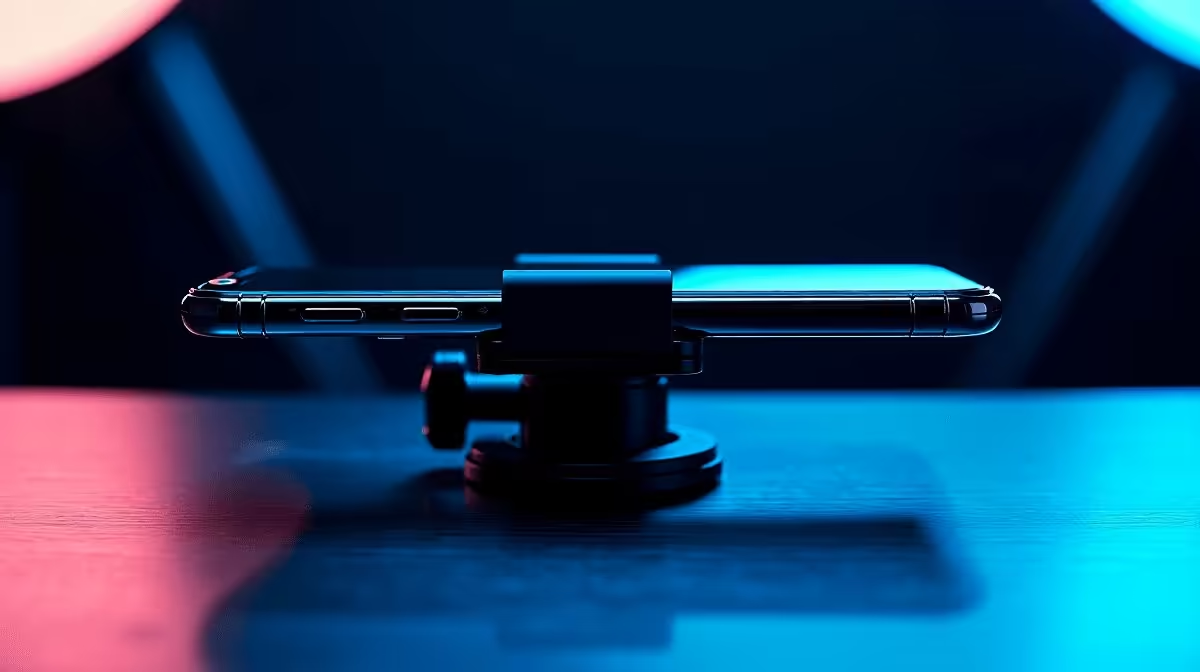
Auto-clamping cradle mounts trigger arm closure either by detecting the phone's weight on a base plate or by breaking an infrared sensor beam. Once triggered, a motor drives the arms to close against the phone's sides with a set clamping force, and a locking mechanism holds the arms in the closed position independently of the motor. On a quality mount, the phone does not move even if the motor is unpowered, because the lock is mechanical rather than motorised.
⚙ Gravity Trigger vs Infrared Sensor: How Each Secures the Phone
Weight-triggered mounts use a spring-loaded pressure plate at the base. When the phone's mass pushes the plate down past a threshold, a contact switch activates the motor. The motor runs for a fixed duration, closing the arms to a preset maximum inward position. This design is simple and fails less often than sensor designs, but it can be slow to react if the phone is placed very lightly. Infrared sensor designs are more responsive. Two IR emitters face each other across the opening. When the phone breaks the beam, the sensor signals the motor immediately. The arms close faster and the response feels more precise. Both designs arrive at the same final state: arms pressed against the phone's sides and a ratchet or gear-lock holding that position. The motor does not need to stay energised to keep the phone gripped, which is important. If the USB power is disconnected while driving, the phone stays held.
🔐 What Keeps the Phone Locked Over Bumps
After the motor drives the arms closed, the locking mechanism takes over. In gear-lock designs, the motor drives a worm gear that cannot be back-driven by external force. This means road vibration pressing on the phone cannot push the arms open. In ratchet designs, the arm movement is one-directional: the arms can only open when a release signal is sent to the motor. Both achieve the same safety outcome. The phone cannot fall out by bouncing or shifting under inertia because the arms are mechanically locked, not just motor-held. This is the key advantage over a manual spring cradle, where arm opening force is limited by spring tension alone. A heavy phone hitting a sharp kerb-drop can compress a weak spring enough to momentarily loosen the hold. The mechanical lock in an auto-clamp mount does not compress under impact. Where auto-clamp mounts can fail over bumps is at the ball joint or arm pivot, not the lock itself. A loose ball joint allows the entire mount head to angle under inertia rather than the arms releasing the phone.
📡 Arm Geometry, Clamping Force, and Phone Protection
The arms on a quality auto-clamp extend from top and bottom rather than only from the sides, creating a four-point hold. This prevents the phone from pivoting around a single axis if the mount is jolted sideways. Inner pad material affects both grip and phone body protection. Silicone pads with light ribbing grip without scratching and distribute clamping pressure evenly. Hard plastic pads concentrate pressure at the edge contact point, which can mark phone cases over time. Clamping force is fixed at the factory on most auto-clamp mounts, typically calibrated for 150g to 280g phones. Very light phones at 150g can occasionally trigger the release sequence accidentally if the mount senses reduced resistance during a bump. Adding a slim case increases effective weight and stabilises the sensing, which is worth knowing if you have noticed this on lighter devices.
Frequently Asked Questions
What happens if the motor fails while the phone is inside the mount?
On most auto-clamping mounts, motor failure leaves the arms in their last position. If the arms were closed when the motor failed, the phone stays held by the mechanical lock until you manually override by pressing the release switch repeatedly or by disassembling the mount. A good-quality mount includes an emergency manual release for exactly this scenario.
Can an auto-clamping cradle hold a tablet instead of a phone?
Auto-clamp mounts are calibrated for phones, typically up to 100mm wide. A compact 7-inch tablet may fit, but the arm clamping force is designed for phone weights. A dedicated tablet mount with heavier construction is the appropriate choice for tablets.
Does the infrared sensor activate in bright sunlight?
High-intensity direct sunlight can interfere with IR sensors in some budget mounts because ambient IR swamps the sensor's detection range. Premium mounts use frequency-modulated IR signals that are harder to wash out. If your mount misfires in sunlight, a weight-trigger model avoids this completely.
How do I clean the inner arm pads without damaging them?
Wipe the silicone pads with a damp cloth and mild detergent. Avoid alcohol wipes on bare silicone pads as they can dry the material and reduce grippiness over time. Alcohol is fine on the plastic housing.
Is there any risk of wireless charging being blocked by the arm design?
Auto-clamp mounts with a built-in Qi coil can charge through arms and the base simultaneously. If your auto-clamp mount does not have a coil, you would need a separate in-car charger. Check whether the mount's arm position covers your phone's charging coil before assuming compatibility.
Ready to mount your phone with the confidence it will not shift mid-drive? Explore Evetech's auto-clamping cradle mount range and find a model with the right sensor type and build quality for your phone and daily route.