Quick Answer
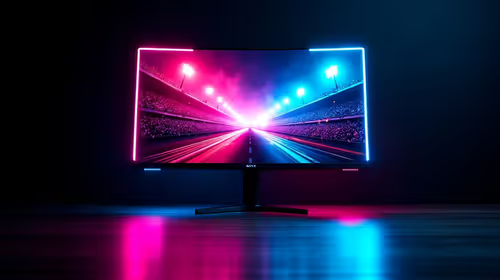
The best 1080p monitor for the RTX 5070 in South Africa prioritises high refresh rates above 144Hz, ideally 240Hz or higher, to take full advantage of the GPU's frame output. Look for fast IPS or TN panels with response times at or below 1ms and adaptive sync support. In SA, budget from around R3,500 to R6,000 for a quality 1080p gaming monitor that pairs well with this card.
Why Monitor Refresh Rate Matters More Than Resolution for the RTX 5070
The RTX 5070 is built for high framerates. At 1080p, this GPU can push well above 200 FPS in competitive titles like Valorant, CS2, and Apex Legends, and 120-180 FPS in more demanding games like Cyberpunk 2077 at high settings. A 60Hz or even 144Hz monitor becomes a hard ceiling on what you actually see -- you pay for a powerful GPU and leave performance on the table if the display cannot keep up.
For South African gamers running the RTX 5070 at 1080p, the sweet spot is a 240Hz or 360Hz monitor. These panels let the GPU breathe and translate its output advantage into a genuine competitive edge in fast-paced games. For single-player gaming where framerates stay closer to 60-120 FPS, a 144Hz IPS monitor is a more sensible choice that frees budget for other components.
Key Specs to Look for in a 1080p Monitor for the RTX 5070
Refresh rate: 240Hz minimum for competitive play; 360Hz if your budget allows and your primary games are esports titles.
Panel type: IPS offers the best balance of colour, viewing angles, and response time for most gamers. TN panels remain relevant for pure speed (highest refresh rates at lower prices), while VA panels suit single-player and content viewing but can show motion blur in fast scenes.
Response time: 1ms GtG (grey-to-grey) or lower. Panels rated at 0.5ms GtG or better are ideal for motion-critical gameplay.
Adaptive sync: NVIDIA G-Sync Compatible or G-Sync certified monitors eliminate screen tearing and stuttering. Many FreeSync monitors also work with G-Sync Compatible mode on the RTX 5070 -- check the NVIDIA compatibility list.
Resolution: 1080p (1920x1080) is the target here. It keeps GPU load lower and framerates higher, which is the entire point of this pairing.
HDR: Not a priority at 1080p. True HDR1000 panels are rare below 1440p, and budget spent on HDR at this resolution is better directed at refresh rate.
Panel Size and Ergonomics for SA Setups
At 1080p, the ideal panel size sits between 24 and 27 inches. Larger than 27 inches at 1080p results in a pixel density that makes text and fine detail look soft when viewed up close. Most competitive players favour 24.5-inch panels for a tight field of view and consistent pixel density.
For SA students in res or digs, desk space is often limited. A 24-inch monitor with a height-adjustable stand or VESA mount compatibility gives flexibility for shared or compact setups. During loadshedding, a monitor with a lower wattage draw (24-27W for a 24-inch IPS versus 35-45W for a 27-inch) extends UPS runtime, which is a practical advantage when power goes out mid-session.
What to Spend in ZAR
In South Africa, a quality 240Hz 1080p IPS monitor suitable for the RTX 5070 typically costs between R3,500 and R5,500. Moving to 360Hz adds roughly R1,500 to R2,500 to that price. The RTX 5070 is a significant GPU investment, so matching it with a monitor that can use its output makes financial sense -- spending R3,000+ less on a slower display and then pairing it with this GPU is a poor use of the system budget.
For NSFAS-funded students, the R5,200 laptop allowance does not stretch to this GPU tier, but students investing their own savings or bursary income into a desktop build should factor monitor cost into the total spend from the start.
Frequently Asked Questions
Is 1080p still worth using with an RTX 5070?
Yes, specifically for competitive gaming where high framerates matter more than resolution. For single-player or creative work, 1440p or 4K is a better match for the RTX 5070's capabilities.
Do I need G-Sync certified or will G-Sync Compatible work?
G-Sync Compatible (which covers many FreeSync monitors) works well with the RTX 5070 for the vast majority of gaming scenarios. Full G-Sync certification adds hardware-level processing but comes at a price premium that most gamers will not notice the benefit of.
What cable should I use to connect my monitor to the RTX 5070?
Use DisplayPort 1.4 or higher for 240Hz and above at 1080p. HDMI 2.1 also supports high refresh rates at this resolution. Avoid older HDMI 1.4 cables which cap out at lower refresh rates.
Ready to Find Your Perfect Match? Pair your next monitor with a GPU that delivers at every refresh rate. View graphics cards at Evetech