Digital signage has become standard equipment in South African retail environments - from Johannesburg mall stores to Cape Town boutiques - replacing static printed posters with dynamic, updateable displays that can promote products, show pricing, and run branded video content. For small-to-medium retailers in SA, the hardware and software decisions around digital signage can be confusing, with a wide range of price points and technical configurations on the market. This guide breaks down what you actually need and what to prioritise for a reliable, cost-effective setup.
Quick Answer
A functional SA retail digital signage setup requires a commercial-grade display (or a consumer monitor with a media player), a dedicated mini PC or media player running signage software, and a stable internet connection for remote content management. Budget from R5,000 upwards for a single screen setup, scaling per display added.
🖥️ Display Hardware: What Screen Do You Need?
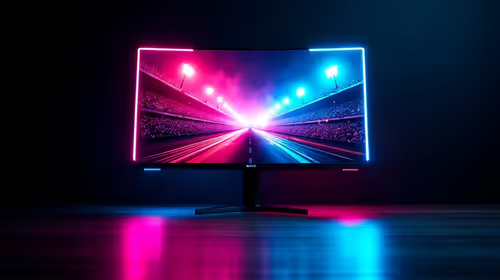
For retail environments with extended daily operating hours, commercial displays are preferable to consumer TVs. Commercial panels are rated for 16–18 hours of daily operation versus the 4–6 hours consumer panels are designed for, and they include features like auto-on scheduling and RS-232 control. However, if your signage will run under 8 hours daily and the environment is dust-controlled, a quality consumer monitor can serve perfectly well at a lower price point.
Screen size depends on viewing distance: a 55" display is appropriate for viewing distances of 3–5 metres; a 43" screen works for 2–3 metres. For window-facing displays visible from outside the store, choose a panel with at least 700 nits brightness. Standard indoor retail displays operate fine at 300–450 nits. Check the Evetech monitor range for commercial and high-brightness display options suitable for retail environments.
Orientation matters too: portrait (vertical) mode is increasingly popular in South African retail for product spotlights and menu boards. Confirm your chosen display supports native portrait mode or VESA rotation before purchasing.
💻 The Signage Player: Mini PC vs Dedicated Media Player
Your content needs a device to drive it. The two main options are a dedicated signage media player (a plug-in Android or Linux device purpose-built for signage) or a small-form-factor Windows PC.
Dedicated Android-based signage sticks and boxes (typically R800–R2,500) are sufficient for static images, simple video loops, and basic scheduling. They draw very little power and are nearly silent. The limitation is software flexibility - many lock you into a proprietary CMS subscription.
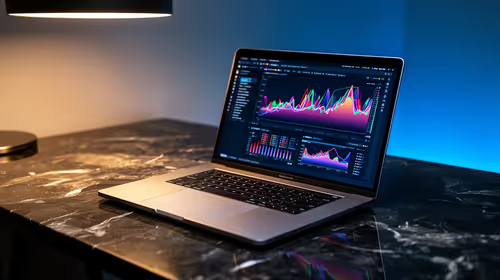
A mini PC running Windows gives you full software flexibility: you can run any signage CMS, browser-based content, live data feeds (pricing pulled from your POS), or custom applications. For a small retail operation, a mini PC in the R3,500–R6,000 range with an Intel N-series or Ryzen processor handles multi-zone 1080p signage without strain. For a multi-screen setup driving 4K content or running a video wall controller, step up to a more capable unit. Browse Evetech gaming PCs - compact gaming desktops often double as excellent signage players due to their powerful GPUs and small footprints.
📡 Content Management and Connectivity
A cloud-based CMS (content management system) lets you update your signage remotely - critical for SA retailers with multiple branches or for owners who manage from off-site. Popular platforms include Screenly, Yodeck, and NoviSign, with plans starting from roughly R150–R600/month per screen. Most operate on a browser-based dashboard where you schedule content, set playlists, and push updates in real time.
Your signage player needs a stable internet connection. Wired Ethernet is strongly preferred over Wi-Fi in retail environments where thick walls, POS systems, and customer devices all compete for airtime. A simple managed switch and Cat6 cabling to each display location eliminates the connectivity issues that plague Wi-Fi signage deployments. Check networking solutions at Evetech for switches, routers, and cabling to support your signage infrastructure.
For content creation: 1920x1080 (landscape) or 1080x1920 (portrait) at 30fps video, or static images at matching resolution, are your target formats. Avoid overly compressed video as retail displays on bright commercial panels will show compression artefacts clearly.
🔌 Power, Mounting, and Reliability
Plan your power runs before mounting. Each display needs a dedicated power point - avoid daisy-chaining extension cords for commercial use. If your store has planned or periodic power events, a UPS for the signage player (not the display) ensures your content player stays online and reconnects cleanly when power returns. A small desktop UPS in the R1,500–R3,000 range is sufficient for most mini PC signage players.
VESA mounting is standard for retail wall mounts - confirm your display's VESA pattern (75x75 or 100x100 for small panels, 200x200 or 400x400 for larger) and purchase a matching tilt or full-motion wall mount. Cable management channels should be factored into your installation to keep the setup looking professional and preventing cable snag.
❓ FAQ
Q: Can I use a regular TV instead of a commercial display for retail signage? A: Yes, for limited daily usage (under 8 hours). For stores running signage all day, commercial panels are a better investment due to their longer-rated operating hours and anti-burn-in features.
Q: How many screens can one mini PC drive? A: Most mini PCs support 2 displays via HDMI and DisplayPort. For 3–6 screen setups, you'll need a dedicated video wall controller or a PC with a multi-output GPU. The Evetech GPU range includes multi-output cards suitable for this.
Q: What internet speed do I need for cloud-managed signage? A: Standard 1080p signage content is pre-loaded on the player and only needs bandwidth for updates. A 10 Mbps connection is sufficient for most deployments; 4K streaming content needs 25 Mbps minimum.
Q: Is it possible to show live pricing from my POS system on the signage display? A: Yes, with a Windows-based player and a compatible CMS or custom integration. Some POS systems (like Vend or Lightspeed) have direct signage integrations, or you can export pricing data as a CSV that a CMS reads on a schedule.
Evetech stocks Graphics Card Deals and Evetech Best Sellers — shop online with fast delivery across South Africa.
Ready to Find Your Perfect Match? Shop Mini PCs and Gaming Desktops at Evetech