Quick Answer
For Ableton Live in South Africa in 2026, the best GPU is one that efficiently handles multi-monitor setups and video integration without throttling - the NVIDIA RTX 4060 or AMD RX 7600 offer the best value for music producers who do not need extensive GPU rendering.
Does GPU Matter for Ableton Live?
Ableton Live is fundamentally a CPU and RAM intensive application. Unlike video editing or 3D rendering software, Ableton does not offload audio processing to the GPU in any meaningful way during standard music production workflows. The DAW itself runs on the CPU, and even the most complex Live sets with hundreds of tracks, instruments, and effects rely almost entirely on processor performance and RAM capacity to run without dropouts or latency spikes.
However, GPU matters to Ableton users in several specific ways. If you run multi-monitor setups - which is extremely common in music production studios in South Africa - a capable GPU handles the display workload without competing with your CPU for system resources. A weak or integrated GPU struggling to drive two 1080p or one 4K display while Ableton runs at 5ms buffer settings creates subtle but real stability issues.
Ableton Live also integrates video for sync to picture work - scoring for film, TV, and advertising. This video playback is decoded using the GPU, and a capable graphics card significantly improves scrubbing and playback performance when working with high-resolution video files. South African music producers working in advertising, film scoring, or broadcast content production will find a mid-range dedicated GPU meaningfully improves their video-sync workflow.
Finally, many modern producers use GPU-accelerated plugins, AI-assisted mixing tools, and machine learning-based instruments. Tools like iZotope Neutron's AI modules, LANDR's mastering integration, and certain spectral analysis visualizers benefit from GPU acceleration when available. As this trend continues into 2026, having a capable GPU future-proofs your production setup.
Best GPU Options for Ableton Live in South Africa 2026
Given that Ableton Live is not GPU-bound, the strategy for South African producers is to find a GPU that covers the bases - display output, video decode, and light GPU compute for plugins - without overspending on gaming-centric performance you will never use.
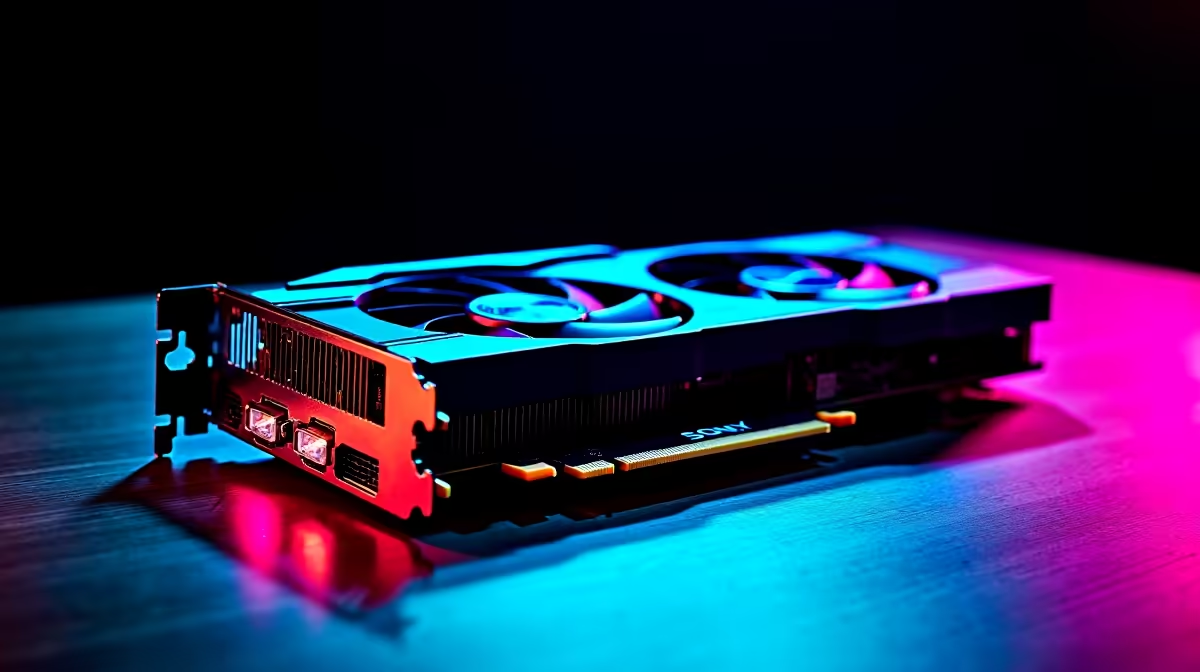
The NVIDIA RTX 4060 (8GB) is the strongest recommendation for most SA music producers in 2026. At R5,000 to R6,500 in the local market, it delivers efficient multi-monitor output, excellent hardware video decode for H.264, H.265, and AV1 formats common in video-sync workflows, and CUDA acceleration for plugins and tools that support GPU compute. Its 115W TDP means it runs cool and quiet - important for a studio environment where fan noise is a concern during recording sessions. NVIDIA's Studio Driver package (an alternative to the gaming Game Ready driver) is specifically tuned for creative application stability and is recommended for producers.
The AMD RX 7600 is a strong alternative at R4,500 to R5,500. It offers comparable multi-monitor output capability and solid hardware video decode via AMF. Some producers prefer AMD for their Linux-compatible workflows if they dual-boot for specific audio tools. The RX 7600 runs slightly warmer than the RTX 4060 but remains within acceptable studio noise parameters.
For Ableton producers on tighter budgets, the NVIDIA RTX 3060 (R3,800 to R4,800) remains an excellent value option. Its 12GB of VRAM is genuinely generous for a GPU at this price point and covers virtually any video-sync or GPU compute task an Ableton workflow demands. The RTX 3060 also supports NVENC hardware encoding, useful if you record or stream sessions.
Budget producers or those focused purely on audio with no video integration can get by with even more modest options - an RTX 4060 is not required if your workflow is pure audio, multi-monitor optional, and plugin GPU acceleration not a priority. An entry-level card that drives your display reliably and stays quiet is sufficient.
What to Avoid When Choosing a GPU for Ableton
The biggest mistake SA music producers make is buying a GPU based on gaming benchmarks without considering studio-specific factors. A high-end gaming GPU with aggressive fan curves and loud cooling solutions is genuinely problematic in a recording environment. A GPU that ramps its fans to high RPM under any load will contaminate room recordings with fan noise unless you have a fully isolated machine room.
Similarly, GPUs with very high TDP (200W-plus) generate significant heat that can warm your studio room, requiring more aggressive air conditioning - a meaningful consideration in South Africa's warm climate and in the context of rising electricity costs. The RTX 4060 and RX 7600 both sit under 130W at full load, making them studio-friendly in ways that enthusiast gaming cards are not.
For producers running integrated graphics on a budget, be aware that integrated solutions on modern AMD Ryzen or Intel Core Ultra chips are capable enough for single-display Ableton use. Once you add a second monitor or video integration, a dedicated card becomes worthwhile.
Setting Up Your GPU for Optimal Ableton Performance
Once your GPU is installed, a few settings optimise it for Ableton use. In NVIDIA Control Panel, set Power Management Mode to Prefer Maximum Performance for the Ableton application specifically. This prevents the GPU from throttling during playback, which can manifest as subtle display stuttering during high CPU load moments.
Set your NVIDIA drivers to Studio Driver rather than Game Ready Driver for overall creative application stability. Enable hardware-accelerated GPU scheduling in Windows 11 Display settings, which reduces CPU overhead for display composition - freeing up CPU cycles for audio processing. Finally, ensure your monitor refresh rate is set correctly in Windows display settings. Running a 144Hz monitor at 60Hz by mistake wastes no GPU resources but misses the benefit; running at full refresh rate while on a low-power GPU setting can cause subtle frame drops that distract during detailed arrangement work.
Frequently Asked Questions
Q: Does Ableton Live use the GPU for audio processing?
A: No. Ableton Live processes audio on the CPU. The GPU handles display rendering, video playback (for video sync workflows), and GPU-accelerated plugins or AI tools. A mid-range GPU is sufficient for almost all Ableton workflows.
Q: What is the best GPU for Ableton Live with video sync in South Africa?
A: The NVIDIA RTX 4060 is the top recommendation - it offers hardware decode for all common video formats, CUDA acceleration, runs cool and quiet, and is well-priced in the South African market for the capability it delivers.
Q: Can I run Ableton Live on integrated graphics?
A: Yes, for single-monitor audio-only workflows. Integrated graphics on AMD Ryzen or Intel Core Ultra handles Ableton fine for basic setups. Add a second monitor or video integration requirements and a dedicated GPU becomes worthwhile.
Q: Does load shedding affect GPU choice for South African producers?
A: Indirectly yes. Lower TDP GPUs like the RTX 4060 (115W) extend UPS runtime during load shedding more than high-power cards. For studio environments dependent on uninterrupted power for recording, choosing an energy-efficient GPU is a practical consideration.
Also at Evetech: All Graphics Cards | Graphics Card Deals
Ready to Find Your Perfect Match? Shop at Evetech