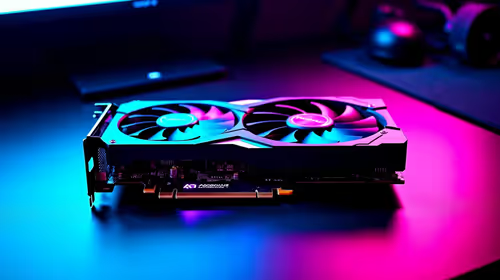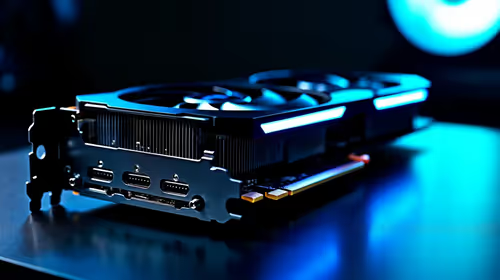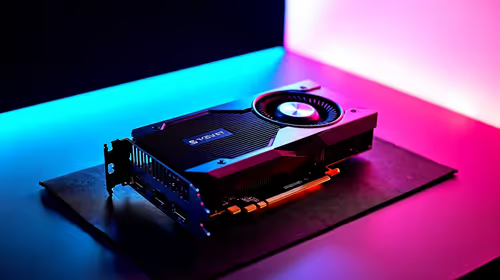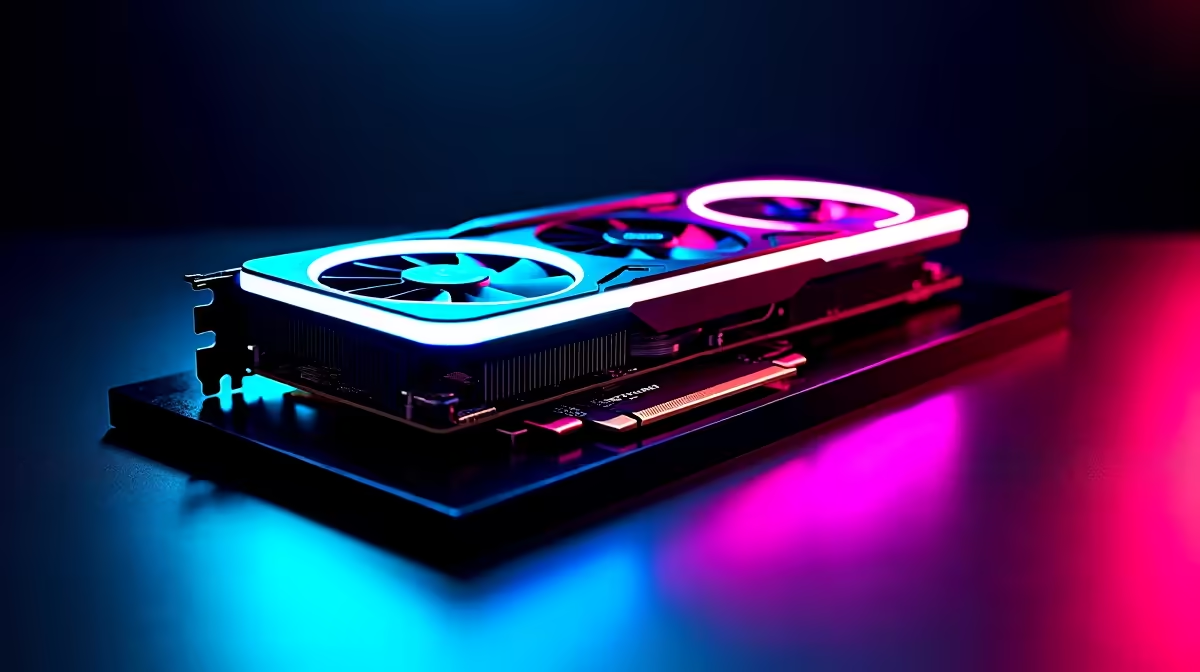
Tired of your blocky world looking... well, blocky? Minecraft with ray tracing is a breathtaking leap into photorealism, with stunning light, shadows, and reflections. But this beauty demands serious muscle, often bringing even powerful PCs to their knees. If you're dreaming of silky-smooth gameplay with all the graphical bells and whistles, you need the best GPU for Minecraft ray tracing. This guide will help you navigate the top choices for today and look ahead to 2026.
Understanding the Ray Tracing Performance Hit
Before we dive into specific cards, let's quickly cover why ray tracing is so demanding. In simple terms, it simulates the actual path of light rays in a scene, calculating how they bounce off surfaces to create incredibly realistic lighting and reflections. This is a massive computational task, far more complex than traditional rendering methods.
That's why finding the best GPU for Minecraft ray tracing isn't just about picking the most expensive card; it's about finding one with dedicated hardware (like NVIDIA's RT Cores) and software support (like DLSS or FSR) to handle the load without turning your game into a slideshow.
Top GPU Contenders for Minecraft with Ray Tracing
As we look towards 2026, the landscape is dominated by three major players. Choosing the right one depends on your budget and performance priorities.
NVIDIA: The Reigning Champion 👑
Let's be clear: for ray tracing performance, NVIDIA is currently the top dog. Their RT Cores are specifically designed to accelerate these complex calculations, and their DLSS (Deep Learning Super Sampling) technology is a masterpiece, using AI to boost frame rates with minimal impact on image quality. For anyone serious about getting the absolute best GPU for Minecraft ray tracing experience, exploring NVIDIA's GeForce lineup is the perfect starting point. The performance you get from high-end NVIDIA RTX cards is simply unmatched in graphically intense ray-traced scenes.
AMD: The Powerful Challenger
Team Red has made massive strides with its RDNA architecture. While historically trailing NVIDIA in pure ray tracing, AMD's Radeon cards offer incredible rasterization performance for your money and are constantly improving their ray tracing capabilities. Their FidelityFX™ Super Resolution (FSR) is an open-source upscaling technology that provides a significant performance boost, making them a very compelling option for a high-refresh-rate Minecraft experience.
Intel: The Ambitious Newcomer
Don't sleep on the new kid on the block. While still maturing, Intel's Arc series is showing serious promise, especially with its XeSS upscaling tech. As their drivers improve and future generations are released, Intel could become a fantastic value-for-money choice for gamers looking for a solid ray tracing experience without breaking the bank. The tech used in these cards often borrows from innovations seen in professional-grade workstation GPUs, promising a bright future.
Check Your Settings! 🔧
Before you upgrade, make sure you're using the right version of Minecraft! Ray tracing is only available on the Bedrock Edition for Windows. Also, try performance-enhancing mods like OptiFine (for Java Edition shaders) or install the latest graphics drivers—you might squeeze out a few extra frames for free!
Building a Balanced Rig for Peak Performance
A powerful graphics card is only one piece of the puzzle. To avoid bottlenecks and ensure your system runs smoothly, you need to support your new GPU with the right components. Investing in one of these premium graphics cards means the rest of your PC needs to keep up.
A modern CPU from Intel or AMD is crucial for feeding your GPU the data it needs. We also recommend at least 16GB of fast DDR4 or DDR5 RAM for a stutter-free experience.
Most importantly, don't skimp on your power supply! These high-end GPUs are thirsty for power. A weak or unreliable PSU can cause crashes and instability. Grabbing a reliable Corsair power supply with enough wattage (check the GPU's recommendation) is non-negotiable. For a clean build and easy cable management, opting for a fully modular PSU is a smart move. ✨
Finding the best GPU for Minecraft ray tracing in 2026 will mean looking for a card with excellent dedicated hardware, mature upscaling technology, and at least 12GB of VRAM to handle future textures and mods. Happy building! 🚀
Ready to Build Your Dream Machine? The world of Minecraft ray tracing is waiting. Whether you're Team Green, Red, or Blue, the perfect GPU will transform your game. Explore our massive range of graphics cards and find the perfect component to build your ultimate rig today.