Quick Answer
For Minecraft in South Africa, the best monitor balances refresh rate and resolution based on your hardware. A 1080p 144Hz monitor is the sweet spot for most players, while those with stronger rigs benefit from 1440p at high refresh rates. Minecraft''s art style means colour accuracy and response time matter more than raw pixel density.
Minecraft is deceptively demanding when you add shaders and mods, yet surprisingly light in vanilla form - which means the right monitor depends entirely on how you play. South African players also need to consider value for money given Rand pricing on imported displays. This guide breaks down every relevant specification so you can make a confident buying decision.
Resolution: What Actually Looks Better in Minecraft
Minecraft''s blocky aesthetic means that super-high resolutions deliver diminishing returns compared to a realistic game. At 1080p, the game looks clean and sharp on screens up to 27 inches. At 1440p, fine details in texture packs and shaders become noticeably crisper, and the extra screen real estate helps when managing inventory and maps. 4K is overkill for most Minecraft players unless you''re running a high-end rig with heavy shaders and want cinematic screenshots. For SA players on a budget, 1080p remains the pragmatic choice - the price difference between 1080p and 1440p monitors can be R2,000 or more, and that money may be better spent on a faster CPU or more RAM. If you''re investing in a versatile gaming monitor that you''ll use for other titles too, 1440p is worth stretching the budget.
Refresh Rate: Why It Matters More Than You''d Expect
Minecraft can run at extremely high frame rates on mid-range hardware, especially in vanilla or lightly modded form. A 144Hz monitor transforms the feel of navigating the world - movement is smoother, turning feels more responsive, and combat becomes meaningfully more precise. For players using keyboards and mice competitively in minigame servers or PvP, a 144Hz or 165Hz panel is a genuine advantage. 240Hz monitors are available but the jump from 144Hz to 240Hz is less perceptible than the jump from 60Hz to 144Hz, and the price difference in SA is substantial. 60Hz monitors are adequate for casual single-player exploration, particularly on lower-end hardware where frame rates won''t exceed 60fps anyway. The key rule: buy the highest refresh rate your GPU can consistently feed. A 240Hz monitor running at 60fps gives you no benefit.
Panel Type and Colour Quality for Minecraft
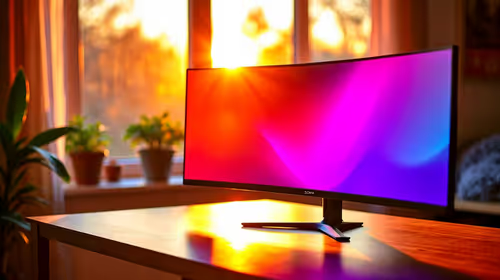
Minecraft''s vibrant biomes, sunsets, and shader effects make panel quality more important than players often realise. IPS panels offer wide viewing angles and excellent colour reproduction - ideal if you share your screen with others or stream. TN panels are the fastest in response time, historically popular for competitive play, but their colour and viewing angle limitations are a real downside for a game as visually expressive as Minecraft. VA panels split the difference with better contrast ratios, making dark caves and night environments look excellent, though ghosting can be an issue in fast-moving scenes. For most SA Minecraft players, an IPS panel at 144Hz hits the best overall balance. Fast IPS variants have narrowed the response time gap with TN panels significantly.
Screen Size and Practical Considerations for SA Gamers
Monitor size interacts with resolution - a 27-inch 1080p screen will show visible pixels up close, while the same resolution on a 24-inch screen looks sharper. The 24–27 inch range is ideal for desk setups at normal viewing distances. Larger screens (32 inch and above) work better with 1440p or 4K to maintain pixel density. SA gamers should also consider power consumption, as loadshedding makes energy-efficient displays worth noting. Monitors with lower wattage draw extend UPS runtime during outages. Adaptive sync technology (FreeSync or G-Sync Compatible) is a worthwhile feature to look for, as it eliminates screen tearing across variable frame rate scenarios - common in modded Minecraft where frame rates can swing widely.
Frequently Asked Questions
Q: Is 144Hz worth it for Minecraft in South Africa? A: Yes, if your hardware can sustain frame rates above 60fps. Minecraft is one of the few games that can push very high frame rates on mid-range hardware, making 144Hz a genuinely impactful upgrade over 60Hz displays.
Q: Does Minecraft benefit from a 1440p monitor? A: Yes, especially with shaders and high-resolution texture packs. Vanilla Minecraft shows modest improvement, but modded builds with realistic shader packs look significantly better at 1440p than 1080p.
Q: What monitor size is best for a Minecraft desk setup? A: 24 to 27 inches is the practical sweet spot for desk setups. At 24 inches, 1080p looks sharp. At 27 inches, 1440p is recommended for clean pixel density. Go larger only if your desk and viewing distance support it.
Q: Should I prioritise refresh rate or resolution on a tight SA budget? A: Refresh rate first. A 1080p 144Hz monitor will feel noticeably better to play on than a 1440p 60Hz screen, especially for any kind of PvP or fast-paced gameplay. Resolution can be upgraded later with a stronger GPU.
Ready to Find Your Perfect Match? Shop gaming monitors and PC deals at Evetech for the best Minecraft setup.