Quick Answer
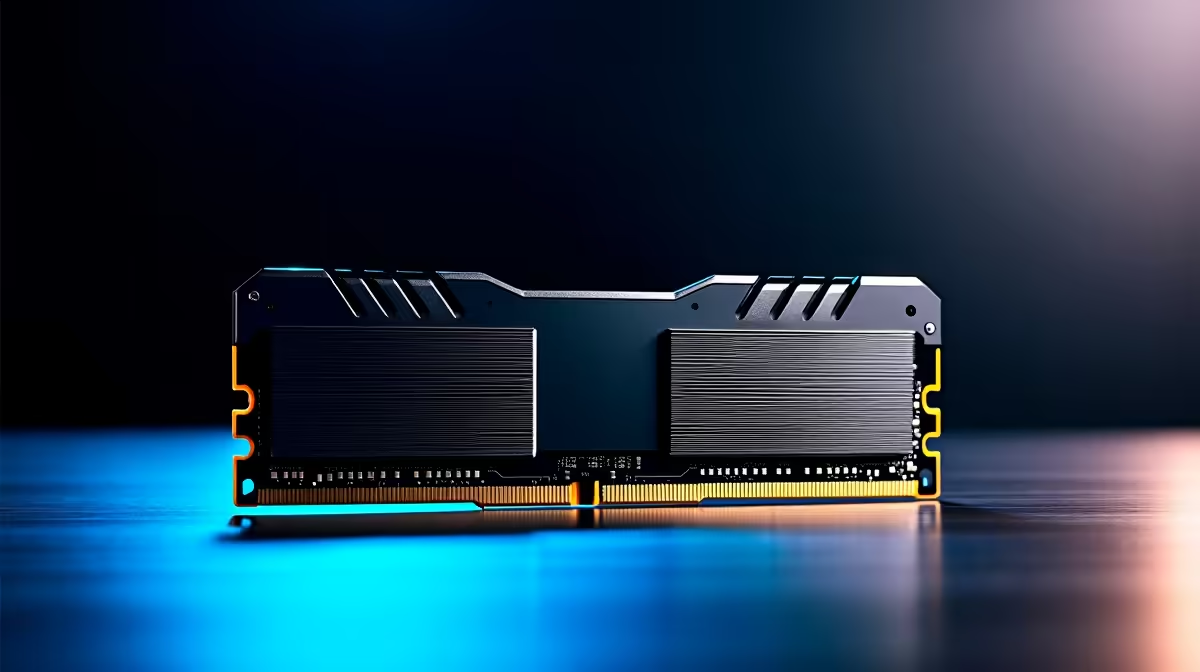
The best RAM for the Intel Core Ultra 7 265K is DDR5 running at 6000MHz with CL30 timings, which hits the sweet spot between bandwidth, latency, and compatibility on Z890 motherboards.
Why RAM Selection Matters More with the Core Ultra 7 265K
The Intel Core Ultra 7 265K is built on the Arrow Lake architecture, and unlike its Raptor Lake predecessors, it uses a tile-based design that separates the compute die from the SoC tile. This architecture change has a direct impact on how the processor interacts with memory. Arrow Lake does not use a Ring Bus interconnect - instead it relies on a fabric interface that has different latency characteristics than older Intel platforms.
In practical terms, this means the Core Ultra 7 265K is more sensitive to memory latency than raw bandwidth compared to Intel's 13th and 14th Gen chips. High-frequency kits with loose timings can actually underperform tighter-latency kits at slightly lower speeds. This is an important distinction when shopping for RAM in South Africa, where premium high-frequency kits carry significant price premiums that do not always translate to proportional performance gains on Arrow Lake.
The Core Ultra 7 265K officially supports DDR5 up to 6400MHz with XMP/EXPO profiles on Z890 motherboards. Going beyond this threshold requires overclocking headroom that varies significantly between boards and memory kits.
Frequency and Latency: Finding the Sweet Spot
For the Core Ultra 7 265K, DDR5-6000 with CL30 timings represents the optimal mainstream configuration. At this speed, memory latency sits in the 40 to 45 nanosecond range, which Arrow Lake's memory fabric handles efficiently. The jump from DDR5-6000 to DDR5-7200 or higher yields diminishing returns in gaming and productivity tasks, while the price increase can be substantial - often R800 to R1,500 more per kit in the SA market.
For productivity workloads like video editing, 3D rendering, or software compilation, bandwidth matters more than it does in gaming. If your use case is heavily workstation-oriented, DDR5-6400 CL32 or DDR5-6800 CL34 kits offer a better bandwidth-to-latency ratio that benefits memory-intensive tasks. Capacity also matters in this segment - 32GB (2 x 16GB) is the recommended minimum for the 265K, with 64GB being worthwhile if you work with large project files.
Kit Configurations and Capacity Recommendations
For gaming-focused builds, 32GB DDR5 in a dual-channel configuration is the right choice. Arrow Lake supports dual-channel memory, and single-channel operation cuts performance significantly - always pair your DIMMs in the slots recommended by your motherboard manual. Most Z890 boards want RAM in slots A2 and B2 (the second and fourth slots) rather than A1 and B1 for optimal signal integrity.
For mixed-use builds that combine gaming with content creation or software development, 64GB is increasingly practical as application memory requirements grow. The price difference between 32GB and 64GB DDR5 kits has narrowed considerably through 2025 and 2026, making 64GB a sensible investment at this platform tier. Prices in South Africa for reputable 32GB DDR5-6000 CL30 kits range from roughly R2,200 to R3,500 depending on the brand and specific timing configuration.
Compatibility and XMP/EXPO on Z890
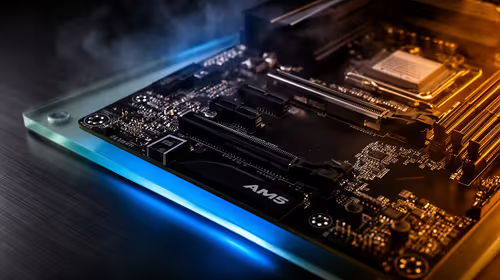
Z890 motherboards are the only platform that supports the Core Ultra 7 265K, and all Z890 boards support DDR5 exclusively - there is no DDR4 option on this platform. XMP 3.0 is the Intel memory profile standard you want to look for when purchasing RAM for this build. EXPO is AMD's equivalent standard and while some Z890 boards accept EXPO profiles, XMP 3.0 kits are the safer choice for guaranteed compatibility.
Always check your motherboard's Qualified Vendor List before purchasing RAM. Even kits that meet the right speed and timing specifications can have stability issues on specific boards if they use different ICs than those validated by the board manufacturer. The most commonly validated DDR5 IC types for Z890 in 2026 are Samsung B-die and Hynix A-die, both of which offer good overclocking headroom and reliable XMP compatibility.
Frequently Asked Questions
Q: Is DDR5-7200 worth the premium over DDR5-6000 for the Core Ultra 7 265K?
A: In most gaming and everyday use scenarios, no. The performance gap between DDR5-6000 CL30 and DDR5-7200 CL36 is typically under 3% in gaming benchmarks on Arrow Lake, while the price difference in South Africa can be R1,000 or more per kit. Only pursue higher frequencies if you have a specific workload that benefits from the added bandwidth.
Q: Can I use DDR4 with the Core Ultra 7 265K?
A: No. The Core Ultra 7 265K on Z890 is a DDR5-only platform. There is no DDR4 support on Arrow Lake motherboards.
Q: How much RAM do I need for a Core Ultra 7 265K gaming build?
A: 32GB is the recommended minimum for a gaming build in 2026. Modern games increasingly use 16GB or more of RAM under demanding conditions, and 32GB gives you comfortable headroom. If you also use your PC for content creation, 64GB is worth considering.
Q: Does dual-channel memory make a noticeable difference on the Core Ultra 7 265K?
A: Yes, significantly. Arrow Lake shows a larger performance gap between single-channel and dual-channel than most previous Intel platforms. Always install RAM in matched pairs in the correct slots as specified by your motherboard manual.
Also at Evetech: All RAM & Memory | Graphics Card Deals
Ready to Find Your Perfect Match? Shop at Evetech