Quick Answer
Seagate offers both NVMe and SATA 2TB SSDs suited to South African builds in 2026. The BarraCuda Q5 and FireCuda 530 cover the NVMe side, while the BarraCuda SATA remains a reliable choice for budget-conscious upgraders. Pricing in ZAR varies depending on the interface and read/write speeds you need.
Seagate 2TB NVMe SSDs: FireCuda and BarraCuda Q5
For SA gamers and content creators who want fast sequential reads, the Seagate FireCuda 530 2TB remains one of the top PCIe 4.0 NVMe drives available locally. It targets users with high-throughput workloads, including video editing, large game installs, and 3D rendering. Read speeds reach around 7,300 MB/s, and the drive ships with a five-year warranty, which matters for long-term ownership in a market where RMA turnarounds can take time.
The BarraCuda Q5 2TB is a more accessible PCIe Gen 3 NVMe option. It suits mid-range builds where the motherboard does not support PCIe 4.0, and it provides a meaningful jump over any SATA drive without requiring a platform upgrade. For students at UCT, Wits, or UP who are building a first gaming or productivity rig on a tighter budget, the Q5 hits a sensible price-to-performance position.
Both NVMe drives benefit from heatsinks when running in South African conditions where case airflow can be compromised during warmer months. If loadshedding is part of your reality, a quality UPS paired with any NVMe install protects against data corruption during unexpected power cuts.
Seagate 2TB SATA SSDs: BarraCuda and IronWolf
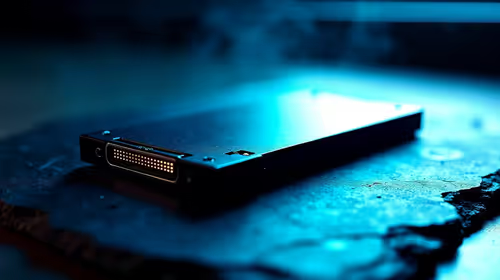
The Seagate BarraCuda 2.5-inch SATA SSD at 2TB is a staple for laptop upgrades and secondary storage in desktop builds. SATA SSDs top out around 560 MB/s read, but for storing game libraries, recorded footage, or large document archives, that speed is entirely adequate. In ZAR terms, SATA 2TB drives typically cost noticeably less than their NVMe equivalents, making them an intelligent pairing with a faster boot NVMe.
The IronWolf 110 2TB SATA SSD is aimed at NAS users and small business setups running always-on workloads. It carries extended endurance ratings and vibration resistance, which matters if you are running a home server that stays powered through load shedding recovery cycles. For a pure gaming or desktop OS drive, the standard BarraCuda SATA is the more cost-effective choice.
For laptops, a SATA 2TB swap is one of the highest-impact upgrades available without replacing the whole machine. Many older student laptops still use spinning hard drives, and a BarraCuda SATA replacement dramatically improves boot times and application loading.
How to Choose Between NVMe and SATA in 2026
The decision between NVMe and SATA in 2026 comes down to three factors: your motherboard's M.2 slot availability, your budget in ZAR, and whether your workloads are transfer-intensive. For most gamers, NVMe will reduce game load screens noticeably. For general storage or secondary drives, SATA 2TB is harder to beat on value.
If your system has two M.2 slots, a common configuration is a smaller NVMe for Windows and a 2TB SATA or second NVMe for game storage. This split keeps system costs manageable while delivering fast access to both OS and installed games.
When comparing prices locally, factor in that ZAR pricing on storage fluctuates with the rand-dollar exchange rate. Buying during a stronger rand period can save meaningful amounts on higher-end drives like the FireCuda 530.
Compatibility and Installation Notes for SA Buyers
Before ordering a Seagate 2TB SSD locally, confirm your motherboard supports the interface you are targeting. PCIe 4.0 NVMe drives work in PCIe 3.0 slots but will throttle to Gen 3 speeds. SATA M.2 drives require a SATA-keyed M.2 slot, which is not universal on newer motherboards focused on NVMe.
For desktop installs, cloning your existing drive using Seagate's included DiscWizard software makes migration straightforward. For laptop upgrades, most modern 2.5-inch bays accept standard 7mm SATA drives, though ultra-thin laptops may require an M.2 slot instead.
Once installed, enable TRIM in Windows and set your power plan to avoid aggressive sleep states, especially relevant if you are on a UPS setup during load shedding. Proper TRIM maintenance extends SSD lifespan significantly.
FAQ
Is the Seagate FireCuda 530 2TB worth the premium in South Africa?
For users doing video editing, game development, or working with large project files, yes. The FireCuda 530's PCIe 4.0 speeds provide a real workflow difference over SATA or Gen 3 NVMe. For casual gaming alone, a mid-range Gen 3 NVMe or even SATA 2TB is sufficient and more budget-friendly in ZAR.
Can I use a Seagate 2TB NVMe in a laptop?
Yes, if the laptop has an M.2 NVMe slot. Many recent student and gaming laptops include M.2 slots supporting PCIe 3.0 or 4.0. Check your model's service manual before purchasing. SATA M.2 and NVMe M.2 are not always interchangeable.
How does load shedding affect SSD lifespan?
SSDs are far less vulnerable to power cuts than HDDs, but mid-write interruptions can still cause file system corruption. A basic UPS or surge protector is recommended to allow clean shutdowns. Seagate's SSDs include firmware-level power loss protection on higher-end models.
What is the typical ZAR price range for a Seagate 2TB SSD in 2026?
Pricing shifts with the exchange rate, but as a general range, SATA 2TB options sit at a lower price point than NVMe equivalents, with the FireCuda 530 carrying the highest price among Seagate's 2TB lineup. Check current listings for the latest local pricing before buying.
Ready to Find Your Perfect Match? Browse the full SSD range available for delivery across South Africa and find the right Seagate 2TB option for your build or upgrade. Shop SSDs at Evetech