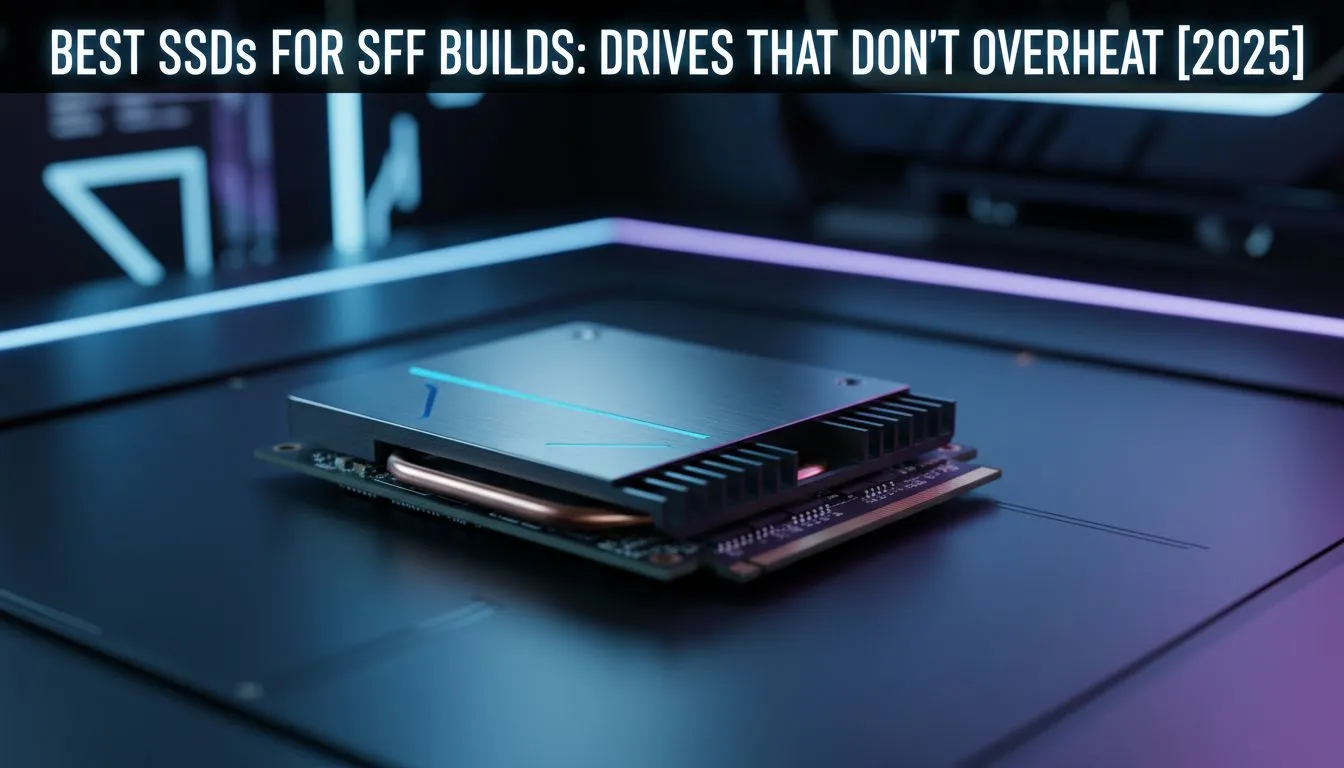
Building a Small Form Factor (SFF) PC is the ultimate flex. You get desktop power in a console-sized package that looks incredible on any desk in South Africa. But cramming all that performance into a tiny case creates a serious enemy: heat. Your lightning-fast NVMe SSD, the heart of your system's speed, can quickly become a thermal bottleneck. Choosing one of the best SSDs for SFF builds isn't just about speed… it's about staying cool under pressure.
Why Heat is the Silent Killer in Your SFF Build 🔥
In a spacious tower, your components have room to breathe. In an SFF build, they're practically cuddling. A hot-running SSD doesn't just warm itself up; it raises the ambient temperature for your CPU and GPU, too. This leads to a nasty problem called thermal throttling.
When an SSD gets too hot, its internal controller deliberately slows it down to prevent damage. Suddenly, your expensive, super-fast drive is performing worse than a budget model. You'll feel this as slower game load times, sluggish file transfers, and general system lag. It’s the last thing you want from a high-performance rig. Understanding this is key to browsing the wide world of solid-state drives for the right fit.
Key Features of the Best Low-Heat SSDs
When hunting for a drive that won't cook inside your compact case, you need to optimise for thermal efficiency, not just raw speed. Here’s what to look for when choosing the best SSDs for SFF builds.
Power Efficiency is King
The simple physics is this: less power consumed equals less heat generated. Look at the spec sheets for a drive's active power consumption, measured in watts (W). A drive that sips 3.5W under load will be significantly cooler than one that guzzles 7W. This is often more important than peak sequential read speeds, which you rarely hit in typical gaming scenarios anyway.
The Great Heatsink Debate
Many high-performance NVMe SSDs come with chunky, pre-installed heatsinks. While great for desktop towers, they are often too tall for the tight clearances in an SFF case. You're frequently better off choosing a "bare" drive and using the low-profile heatsink provided with your motherboard, which is designed to fit the space perfectly.
Measure Twice, Buy Once 🔧
Before buying an SSD with a pre-installed heatsink for your SFF build, check your case and motherboard clearance specifications online. Community forums for your specific case model are a goldmine of information, often with user-submitted photos showing what fits and what doesn’t.
Gen4 vs. Gen5: Is Faster Always Better?
PCIe 5.0 drives are incredibly fast on paper, but they are also the hottest-running consumer SSDs ever made. In a thermally constrained SFF build, a Gen5 drive is almost guaranteed to throttle without aggressive cooling, which you likely don't have space for. A top-tier, power-efficient Gen4 drive often provides more consistent, real-world performance and is a much smarter choice for a compact rig.
Top SSD Picks for a Cool & Compact Rig
Instead of a fixed list, the smartest approach is to know what kind of drive to look for. Models like the WD Blue SN580 or Crucial P5 Plus are legendary for their excellent balance of strong performance and thermal efficiency, making them ideal candidates for SFF builds. They prove you don't need the absolute fastest drive to have an exceptional experience.
When you're ready to buy, keep an eye on performance-per-watt metrics and user reviews that mention thermals. You can often find a fantastic, cool-running drive when you check out the latest SSD deals, saving you some ZAR in the process.
Creative SFF Storage Solutions 💡
Don't forget that your M.2 slots aren't your only option. To further manage heat, consider a hybrid approach.
- Boot Drive: Use a power-efficient NVMe for your OS and core applications.
- Game Library: Install your larger games on a 2.5" SATA SSD. They generate far less heat and connect via a cable, giving you more placement flexibility. There are many great SATA SSDs available that are perfect for this role.
- Archive/Media: For files you don't need instant access to, using high-speed external SSDs can offload storage completely, keeping your case interior as cool as possible.
This strategy ensures your main drive stays responsive while keeping overall system temperatures in check.
Ready to Find Your Perfect SFF Drive? Choosing the best SSD for SFF builds is about smarts, not just speed. A cooler drive means more consistent performance where it counts. Explore our massive range of storage options and find the perfect drive to complete your compact powerhouse.