Quick Answer
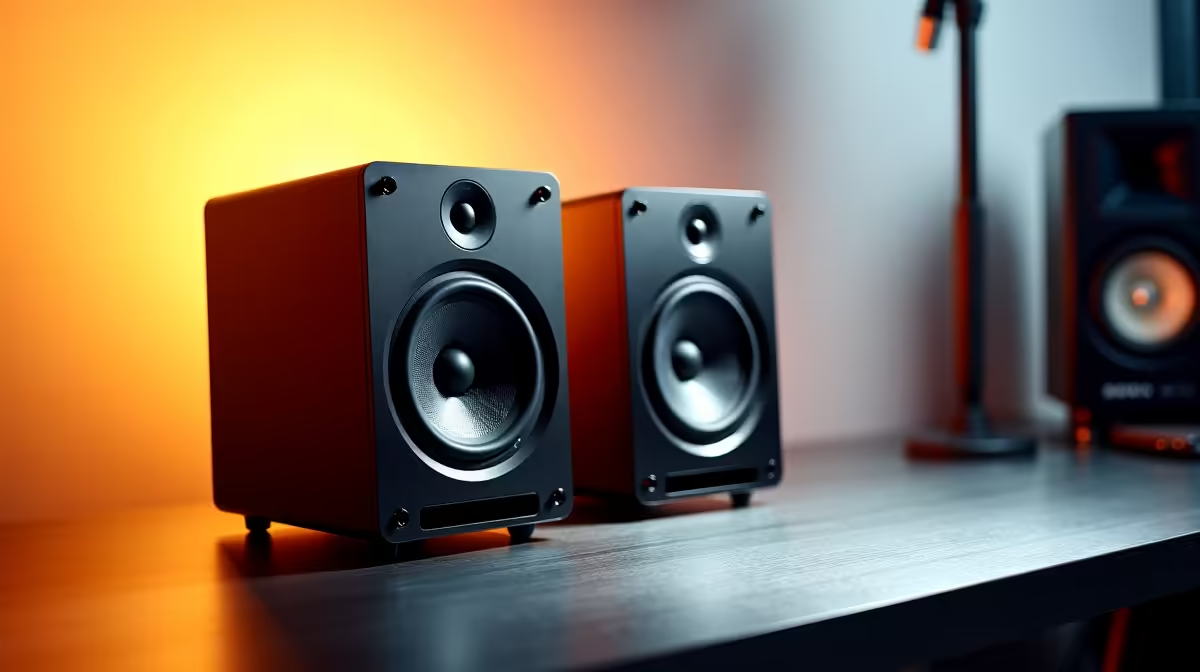
For Mac-based music production in South Africa, studio monitors in the R4,000 to R15,000 range from Yamaha, Adam Audio, and Focal deliver the flat, accurate response needed for reliable mixing and mastering. Paired with an audio interface that plays well with macOS, these options give SA producers the monitoring environment needed to compete with international releases.
What Makes a Studio Monitor Suitable for Mac Music Production
A studio monitor is not a consumer speaker designed to make music sound good. It is a tool designed to reveal what is actually in your mix, including problems. The flatter the frequency response, the more accurately you can judge how your music will translate across different listening environments, from earbuds on the Gautrain to a car stereo on the N1.
For Mac users, connectivity matters alongside sound quality. Most modern studio monitors connect via XLR or TRS balanced cables to an audio interface, which connects to the Mac via USB or Thunderbolt. The monitor itself does not need to be Mac-compatible, but your interface and DAW (Logic Pro, Ableton, Pro Tools, or GarageBand for beginners) must play well with macOS.
Room acoustics matter as much as monitor quality in a South African home studio context. If you are producing in a bedroom in Joburg or Cape Town without acoustic treatment, even R20,000 monitors will reveal the room's resonances rather than your mix. Budget for basic acoustic panels or corner bass traps alongside your monitor investment.
Top Studio Monitor Recommendations for SA Mac Producers
Yamaha HS5 and HS8: the HS series has been an industry reference for decades, and for good reason. The HS5 (5-inch woofer) suits smaller rooms and near-field monitoring, while the HS8 handles larger rooms and gives a clearer picture of low-frequency content down to around 38Hz. Both feature the signature Yamaha white woofer and a front-ported design that tolerates placement close to walls better than rear-ported alternatives. The HS5 pair sells in South Africa for approximately R8,000 to R10,000 per pair, and the HS8 pair for R13,000 to R16,000.
Adam Audio T5V and T7V: Adam's T-series monitors are the go-to entry-to-mid-range option for producers who want the ribbon tweeter sound that Adam is known for. Ribbon tweeters provide exceptional high-frequency detail without harshness, which is valuable when mixing tracks with significant high-end content such as electronic music or afrobeats production. The T5V pair sits around R6,500 to R8,500 in SA, and the T7V pair around R9,000 to R11,000.
Focal Alpha 50 Evo: Focal's Alpha Evo series brings the French studio monitor heritage into a compact and accurate package. The Alpha 50 Evo offers a wide sweet spot, a detailed midrange suited to vocal-heavy genres, and a built-in DSP for room calibration. It suits Mac producers working in Logic Pro or Ableton on genres that demand precise vocal and midrange treatment. Pricing in SA sits around R14,000 to R18,000 per pair.
KRK Rokit 5 G4 and Rokit 8 G4: KRK monitors are a popular choice for producers who work across hip-hop, electronic, and bass-forward genres. The DSP-assisted bass extension and built-in EQ in the G4 generation allow compensation for room acoustics, which is valuable in untreated SA home studios. The Rokit 5 G4 pair is available around R7,000 to R9,000.
Integrating Studio Monitors with Mac and an Audio Interface
For a Mac-based production setup, pair your studio monitors with a USB-C or Thunderbolt audio interface. The Focusrite Scarlett series and Universal Audio Volt range both have driver-free macOS compatibility, meaning Logic Pro and GarageBand recognise them immediately without additional setup.
Connect the interface's monitor outputs (left and right XLR or TRS balanced outputs) directly to the input on each studio monitor. Set your Mac's audio output to the interface in System Settings, and your DAW's output to the same device. This gives you a low-latency signal path ideal for tracking and mixing.
For load shedding resilience in SA, a UPS that keeps your Mac, audio interface, and monitors powered during a two-hour blackout window allows uninterrupted recording and mixing sessions. Many UPS units rated at 1500VA can handle a Mac Mini or MacBook, an audio interface, and a pair of 50W monitors for two to three hours at load shedding Stage 4 levels.
Passive Speakers vs Active Studio Monitors
Almost all studio monitors recommended for home and project studios are active (powered), meaning they contain their own amplifier. This simplifies setup significantly for Mac producers as there is no need for a separate power amplifier. Passive studio monitors require an external amplifier and are typically found in mastering studios with high-end custom speaker builds.
For SA producers at any stage from bedroom beatmaker to serious project studio, active monitors are the practical choice. The options listed above are all active designs.
Frequently Asked Questions
Do I need an audio interface to use studio monitors with my Mac? Yes, for the best sound quality and lowest latency. Connecting studio monitors directly to your Mac's headphone output via an adapter works technically but introduces noise, limits volume control, and bypasses the dedicated DA conversion that audio interfaces provide.
What size studio monitor is right for my room? In a standard bedroom studio of 10-15 square metres, 5-inch monitors are ideal. They have a focused sweet spot, avoid over-exciting room resonances, and produce sufficient volume for accurate near-field monitoring. Eight-inch monitors suit larger dedicated studio spaces with some acoustic treatment.
Are studio monitors also good for general music listening? Studio monitors are designed for accuracy rather than pleasantness. They reveal every imperfection in a recording, which can make casual music listening feel harsh compared to consumer speakers that apply mild EQ shaping. Most producers use their studio monitors exclusively for work and switch to consumer speakers or headphones for casual listening.
What is the best DAW for Mac music production in South Africa? Logic Pro is the dominant choice for SA producers on Mac due to its comprehensive feature set, extensive included plugin library, and one-time purchase price of approximately R500 on the App Store. Ableton Live is preferred by electronic music producers and live performers, while Pro Tools remains standard for professional recording studios and post-production facilities.
Ready to Find Your Perfect Match? Shop Evetech's monitor range and complete your Mac music production setup with the right display alongside your studio monitors.