Quick Answer
The Core i5-14600K has a capable integrated memory controller that handles DDR5 up to around 6400 MT/s and DDR4 up to around 3600 MT/s with good stability. For gaming in South Africa in 2026, DDR5-6000 CL30 is the widely recommended sweet spot - it sits at the edge of the controller''s native speed band and delivers real gaming performance gains over slower kits at a price that has become accessible locally.
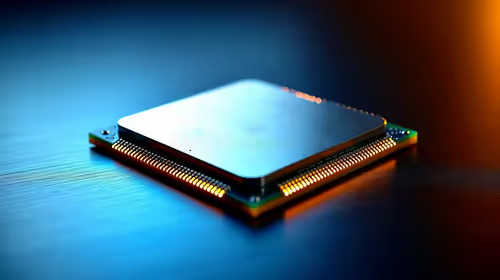
The Core i5-14600K is one of the most popular gaming CPUs in South Africa''s mid-to-high performance segment. It pairs a high-core-count layout with strong single-threaded performance, and unlike many CPUs, it genuinely responds to RAM speed tuning. Understanding the i5-14600K''s memory controller - what it prefers, where its limits are, and what actually moves the needle in gaming workloads - is worth spending time on before you buy RAM or commit to overclocking your kit.
How the i5-14600K Memory Controller Works
Intel''s Raptor Lake memory controller (used in 14th Gen) supports both DDR4 and DDR5, depending on the motherboard platform. The i5-14600K is an LGA1700 chip and pairs with Z690 or Z790 motherboards. DDR4 boards are still common in SA and represent a cost-effective build path; DDR5 boards are increasingly affordable and unlock the higher-speed tiers.
The memory controller has a Gear mode that affects how the memory and CPU fabric synchronise:
- Gear 1: CPU''s memory controller runs at 1:1 with RAM. Lower latency, better gaming performance. Achievable up to approximately DDR5-6400 on Z790 with quality DIMMs.
- Gear 2: Controller runs at 1:2. Required at very high DDR5 speeds (above approximately 6400 MT/s). Reduces latency advantage of high-speed RAM.
For gaming, staying in Gear 1 at the highest stable speed is the goal. DDR5-6000 CL30 achieves this comfortably on most Z790 boards with the i5-14600K.
DDR4 vs DDR5 for the i5-14600K in 2026
If you''re building new in 2026, DDR5 is the recommended path for the i5-14600K. DDR5 motherboard prices have normalised and DDR5 kits at 6000 MT/s are now competitively priced in South Africa. The platform also futureproofs your RAM investment if you plan to upgrade CPU down the line.
That said, if you''re upgrading an existing Z690/Z790 DDR4 system, the i5-14600K performs very well on DDR4. The practical gaming performance gap between a well-tuned DDR4-3600 CL16 kit and DDR5-6000 CL30 is measurable but not dramatic in most gaming scenarios - typically a few percentage points of average frame rate, with sub-1% lows being the more noticeable improvement on DDR5.
Best RAM Speed Recommendations for Gaming
Here are the recommended configurations by platform and budget:
DDR5 (Z690/Z790 DDR5 board):
- Best value: DDR5-6000 CL30 - sits natively in the controller''s preferred band, Gear 1 stable, widely available in SA
- Performance tier: DDR5-6400 CL32 - pushes the Gear 1 ceiling, requires a quality board and some BIOS tuning
- Avoid above 7200 MT/s for gaming - Gear 2 transition negates bandwidth gains in latency-sensitive gaming workloads
DDR4 (Z690/Z790 DDR4 board):
- Best value: DDR4-3600 CL16 or CL18 - well within the controller''s native range, excellent stability, strong latency
- Performance tier: DDR4-4000 CL16 - requires XMP/EXPO and sometimes manual subtiming tuning
- Capacity: 32 GB (2x16 GB) is the recommended starting point for gaming in 2026
Does RAM Speed Actually Matter for Gaming on the i5-14600K?
Yes - more so than on some other platforms. The i5-14600K''s gaming performance is meaningfully affected by memory latency and bandwidth because its high core count creates workloads where the CPU is frequently waiting on data. In CPU-bound gaming scenarios - high frame rate competitive titles at 1080p, large open-world games with dense NPC AI - the difference between a slow kit and a well-tuned 6000 MT/s DDR5 kit is visible in frame-time consistency and sub-1% lows.
For SA gamers on a budget, prioritise a 32 GB DDR5-6000 CL30 dual-channel kit over a 16 GB faster kit. Capacity matters more than raw speed above the 6000 MT/s threshold in most gaming workloads.
Frequently Asked Questions
Q: What is the maximum stable RAM speed for the i5-14600K? A: Most i5-14600K samples run DDR5-6000 to DDR5-6400 in Gear 1 without issue on a quality Z790 board. Higher speeds are possible but fall into Gear 2 territory where latency advantages diminish.
Q: Does enabling XMP/EXPO profiles cause instability on the i5-14600K? A: XMP/EXPO profiles are generally stable within the controller''s supported speed range. DDR5-6000 XMP profiles are broadly stable. At 6400+ MT/s, some boards and DIMMs require voltage adjustments for all-day stability.
Q: Is 32 GB of RAM necessary for gaming with the i5-14600K? A: In 2026, yes for a future-proofed build. Modern titles push past 16 GB in the background with a browser and Discord running. 32 GB dual-channel eliminates RAM as a bottleneck for at least the next several years.
Q: Should I buy RAM already validated for my specific Z790 motherboard? A: Where possible, yes. Motherboard manufacturers publish QVL (Qualified Vendor Lists) on their support pages. RAM on the QVL has been tested for compatibility at rated speeds, which reduces the chance of stability issues out of the box.
Ready to Find Your Perfect Match? Shop gaming PC deals at Evetech.