Quick Answer
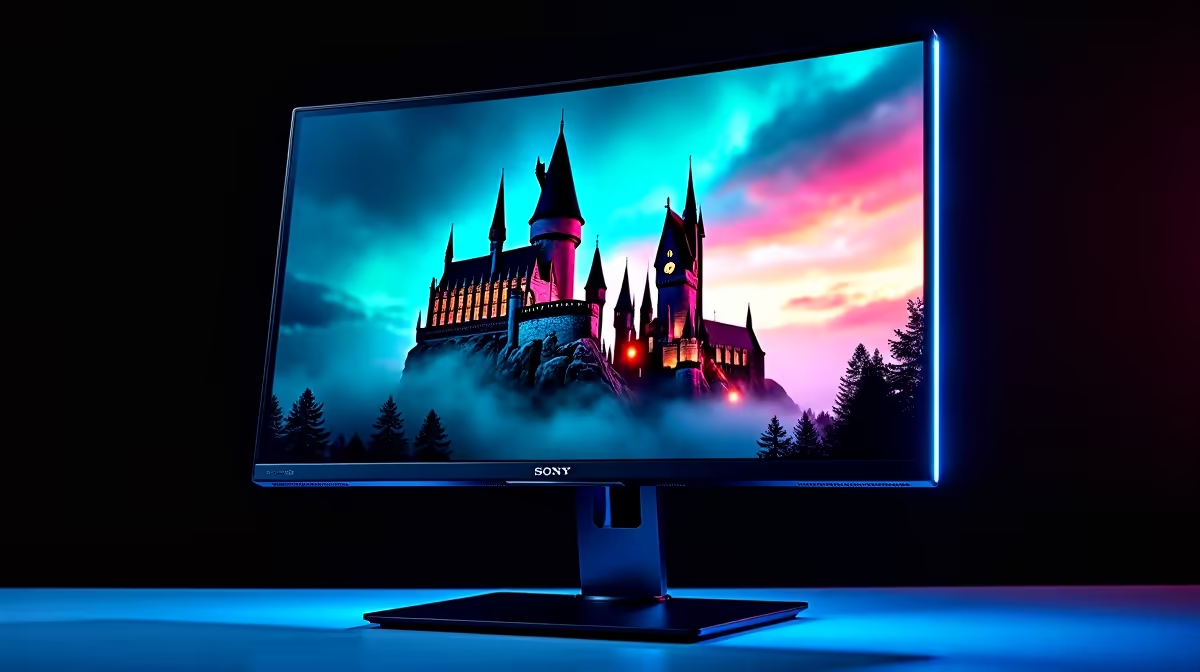
Getting the best HDR visual experience in Hogwarts Legacy requires enabling HDR in Windows display settings first, then calibrating the in-game HDR brightness slider to suit your specific monitor's peak nit output. Most players on SDR monitors should disable HDR and instead use the game's contrast and brightness controls for better results.
Understanding HDR in Hogwarts Legacy Before You Adjust Anything
Hogwarts Legacy includes a dedicated HDR mode with a brightness slider measured in nits. The value you enter should roughly match your display's peak HDR brightness capability. If you enter a value far above your display's actual capability, highlights will be clipped and the image will look blown out in bright scenes. If you enter a value too low, the image will appear dim and muddy in dark areas like the dungeons and forests.
The first requirement is a monitor or TV that actually supports HDR. True HDR requires a display rated for HDR10 at minimum, with a peak brightness of at least 400 nits. Many monitors sold in South Africa are labelled HDR-ready but only reach 200 to 300 nits, which produces a noticeably inferior HDR result compared to a proper HDR600 or HDR1000 panel. If your display falls in the budget category, you may get better-looking results with HDR disabled and manual calibration through the game's standard settings.
Before entering the game, go to Windows Settings, then Display, and enable the HDR toggle for your monitor. Windows will also offer a Windows HDR Calibration app. Run it before adjusting in-game settings. This creates a baseline that the game uses to interpret brightness signals correctly.
Setting the In-Game HDR Brightness Slider
Once you are in Hogwarts Legacy, navigate to Settings, then Display. You will see the HDR Brightness slider. A general starting point is 1,000 nits for OLED panels, 600 nits for a HDR600-rated IPS or VA monitor, and 400 nits for entry-level HDR-capable displays.
The game provides a calibration visual that shows a pattern of test images. Adjust the slider until the shadow details in dark areas are visible but not flat grey, and the bright highlights have definition rather than appearing as blank white surfaces. The Hogwarts Great Hall ceiling at night and the Forbidden Forest are good test areas once you are in gameplay, as they combine both bright torch light and deep shadow.
On most displays available in South Africa in 2026, a setting between 400 and 700 nits delivers the most natural result. Monitor specifications printed on South African retail listings will typically state peak brightness in nits under the HDR or display specs section.
Additional Visual Settings That Work Alongside HDR
HDR does not replace other visual quality settings in Hogwarts Legacy. Ray tracing in the game affects how lighting interacts with surfaces throughout Hogwarts, and this combines with HDR to produce more realistic-looking reflective floors and candle-lit rooms. For South African PC users running higher-end hardware, enabling ray tracing with HDR active produces the most immersive result, though at a significant performance cost.
If ray tracing causes frame rate drops below comfortable levels, prioritise disabling ray-traced reflections first, as they carry the highest performance cost. Global illumination and shadows via ray tracing carry moderate costs and provide strong visual improvement. Keep these enabled if your hardware can sustain playable frame rates.
For players running Hogwarts Legacy on an SDR monitor without true HDR support, disable HDR entirely and manually set brightness at roughly 50 to 55 percent and contrast at 55 percent as a baseline. Adjust brightness by moving through a dark scene until shadow detail is visible without the picture appearing overall too bright. This approach often produces a more consistent look on SDR panels than forcing HDR through a monitor that cannot handle it.
Resolving Common HDR Display Problems in Hogwarts Legacy
If your screen looks washed out in HDR mode, the slider value is too low for your display or your Windows HDR setting is misconfigured. Return to Windows Display Settings and confirm HDR is enabled at the OS level. If colours look oversaturated and highlights are blooming into white patches, reduce the nit value in-game by 100 to 200 nits and reassess.
Some South African users report that HDR in Hogwarts Legacy causes brightness to spike unexpectedly during cutscenes. This is a known behaviour related to scene-by-scene tone mapping. If this is distracting, reducing the peak brightness setting by 15 to 20 percent from your usual calibrated value tends to smooth out the transitions.
FAQ
What nit value should I set for HDR in Hogwarts Legacy?
Match the nit value to your monitor's rated peak HDR brightness. Common values are 400 nits for entry HDR displays, 600 nits for HDR600 monitors, and 1,000 nits for OLED panels. Adjust up or down using the in-game test pattern.
Should I use HDR in Hogwarts Legacy on a budget monitor?
If your monitor is rated below 400 nits or is not certified for HDR10, you will likely get better results with HDR disabled. Use the standard brightness and contrast sliders instead for a cleaner image on SDR displays.
Does Hogwarts Legacy support HDR on PC in 2026?
Yes. Hogwarts Legacy includes full HDR10 support on PC with a dedicated brightness calibration slider in the display settings menu. Windows HDR must be enabled at the OS level before the in-game option activates correctly.
Can I use HDR with a 60Hz monitor in Hogwarts Legacy?
Yes. HDR and refresh rate are independent. A 60Hz HDR monitor will display Hogwarts Legacy with HDR enabled. However, for the smoothest gameplay experience, a higher refresh rate display is preferable when hardware performance allows.
Ready to Find Your Perfect Match? Upgrade your gaming setup with hardware that brings Hogwarts Legacy to life at maximum visual quality. Shop the Best Gaming PC Deals at Evetech