Quick Answer
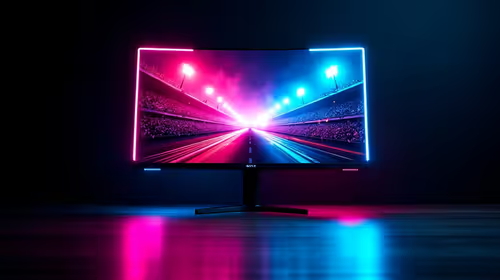
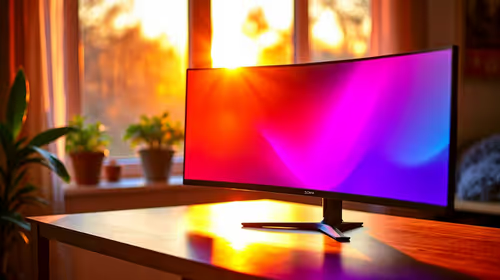
The top gaming monitors in SA for 2026 balance refresh rate, resolution, response time, and price in ZAR. Whether you are a competitive FPS player or an immersive single-player gamer, there is a monitor in the R3,500-R9,500 range that fits your setup and load-shedding-aware routine.
Why Monitor Choice Matters More Than Ever for SA Gamers
A GPU upgrade without a matching monitor upgrade is like putting a turbo engine in a car with a flat tyre. In 2026, the SA gaming monitor market has matured to the point where 1080p 144Hz is a baseline expectation, and 1440p panels with 165Hz+ refresh rates are accessible under R8,000. The right monitor transforms your gaming experience whether you are in a res LAN room, a digs setup, or a dedicated home office fighting Stage 2 schedules.
Panel technology has also shifted. IPS panels now dominate mid-range gaming monitors thanks to their wide colour gamut and near-zero colour shift at angles, while VA panels remain relevant for budget-conscious buyers who want deeper blacks for immersive titles. TN panels have largely retreated to the ultra-competitive esports niche where 0.5ms response time is non-negotiable.
The Refresh Rate Conversation: 144Hz, 165Hz, and 240Hz
Refresh rate is the number that matters most for gaming feel. At 60Hz your frames are capped at 60 per second on screen, which is noticeably choppy in fast-paced titles. At 144Hz the difference is immediately apparent to anyone who makes the switch. At 240Hz the gains become marginal for most players unless you are competing in organised esports where every millisecond counts.
For the majority of SA gamers, 144Hz to 165Hz at 1080p or 1440p represents the best value proposition in 2026. Cards like the RTX 4060 and RX 7600 can push those frame rates in popular titles without the same GPU tax you pay chasing 240Hz performance.
Loadshedding is worth factoring in here too. Running a 240Hz monitor draws more power than a 144Hz panel. If you are on a UPS to keep your rig alive during Stage 4, a 144Hz IPS monitor gives you longer battery runtime per gaming session without sacrificing the core benefit of a high-refresh display.
Response Time and Panel Sync: What SA Buyers Should Check
Response time is listed as the time it takes a pixel to change from one shade of grey to another. Marketing numbers range from 0.5ms to 5ms. IPS panels in the 1ms MPRT range are the current standard for gaming. Avoid monitors with 8ms or higher native response times as they introduce ghosting in fast movement.
Adaptive sync is the other key spec. FreeSync Premium works across a wide range of AMD and NVIDIA GPUs in SA builds, which is significant because NVIDIA supports G-Sync Compatible certification on many FreeSync panels. Confirm the monitor's sync range matches your GPU's typical output range for smooth tear-free gameplay.
Resolution: 1080p vs 1440p vs 4K in 2026
At R3,500-R5,500, 1080p 144Hz+ monitors remain the most practical choice for competitive gaming. At R5,500-R9,500, 1440p 165Hz IPS panels offer a meaningful resolution bump that shows up in game detail and desktop sharpness without the GPU overhead of 4K. 4K gaming monitors in SA sit above R10,000 and pair best with an RTX 4080 or higher, making them a next-tier upgrade for most builders.
For NSFAS-funded students buying a laptop-and-monitor combo for varsity, a 24-inch 1080p 144Hz monitor in the R3,000-R4,000 range is the practical sweet spot. It handles gaming, lecture notes, and coding without straining a limited allowance.
Screen Size: 24, 27, or 32 Inches?
Desk space in SA student accommodation is often limited. A 24-inch monitor at 1080p gives optimal pixel density and fits on smaller desks without dominating the room. A 27-inch monitor at 1440p is the sweet spot for home setups where you sit 60-80cm from the screen. A 32-inch panel at 1440p or 4K suits a full home office rig or a living room console-plus-PC hybrid setup.
Frequently Asked Questions
What is the minimum refresh rate worth buying for gaming in SA in 2026?
144Hz is the minimum worth targeting in 2026. 60Hz monitors are fine for general use but create a noticeably inferior gaming experience compared to 144Hz, especially in shooters and racing games.
Is a 1440p monitor worth buying over 1080p for competitive gaming?
For competitive gaming, 1080p at 165Hz+ gives you a frame-rate advantage over 1440p at the same GPU tier. For single-player and mixed-use gaming, 1440p at 144Hz is a better balance of visual quality and performance.
Do gaming monitors come with NSFAS-friendly pricing in SA?
NSFAS provides a R5,200 laptop allowance which does not typically stretch to a separate monitor. However, students who add part-time income or parental support often budget R3,000-R4,500 for a secondary monitor to pair with their laptop docking station.
How does loadshedding affect monitor buying decisions?
Monitors with lower wattage panels extend UPS runtime during load shedding. A 27-inch IPS gaming monitor draws roughly 25-45W, which is a manageable addition to a UPS load. Check the power draw spec before buying if UPS runtime is critical.
Ready to Find Your Perfect Match? Find the right gaming monitor for your resolution, refresh rate, and budget goals. Shop Gaming Monitors at Evetech