Quick Answer
The best motherboard for a content creator PC in South Africa prioritises PCIe bandwidth for fast NVMe storage, sufficient RAM slots for 64 GB or more, robust VRM delivery for sustained CPU performance, and reliable connectivity including USB-C and Thunderbolt where available. Matching the board to your CPU platform and budget is the starting point.
Building a content creator PC in South Africa is a different exercise from building a pure gaming rig. Where gamers prioritise frame rates, creators need sustained throughput - fast storage for large video files, stable CPU performance across long renders, and enough expandability to add capture cards, audio interfaces, and external drives. The motherboard is the foundation that enables or limits all of that. This guide walks through what to look for at different price points in the SA market.
Platform Choice: Intel vs AMD for Creator Boards
The first decision is CPU platform, because it determines your motherboard chipset options. For content creators, both Intel and AMD offer strong choices, but the priorities differ slightly.
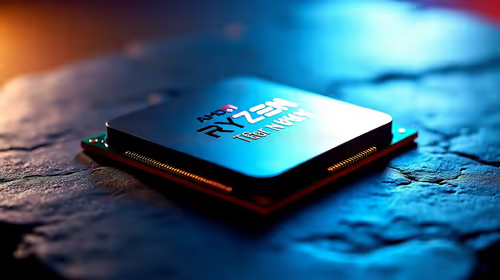
AMD''s AM5 platform (Ryzen 7000 and 9000 series) brings DDR5 memory support natively and PCIe 5.0 on both the primary GPU slot and an M.2 slot on higher-end chipsets. For creators who shoot in 4K or 6K and work with large RAW files, PCIe 5.0 NVMe storage delivers sequential read speeds that dramatically reduce ingest and cache times. The B650 chipset is the practical sweet spot - it offers PCIe 5.0 M.2 support on most models, dual M.2 slots, and solid USB connectivity at a price range roughly between R3,500 and R6,500 in SA. Stepping up to X670 or X870 adds more PCIe lanes and better overclocking headroom.
Intel''s LGA1700 and LGA1851 platforms (12th through 14th and 15th gen Core series) are also well-represented in SA retail. The Z790 chipset offers rich connectivity - Thunderbolt 4 headers on premium boards, multiple PCIe 4.0 M.2 slots, and strong memory overclocking. For creators who use Thunderbolt-connected external SSDs or high-speed docking stations, a Z790 board with onboard Thunderbolt is hard to match at the feature level. B760 boards are a more budget-conscious alternative, though they sacrifice some overclocking and lane flexibility.
VRM Quality and Sustained CPU Performance
Content creation workloads - video rendering, 3D modelling, machine learning tasks - push the CPU hard for extended periods. Unlike gaming, which is bursty, a video encode can run at full CPU utilisation for 20 to 60 minutes. This sustained load demands a motherboard with a high-quality VRM (Voltage Regulator Module) that delivers clean, stable power without thermal throttling.
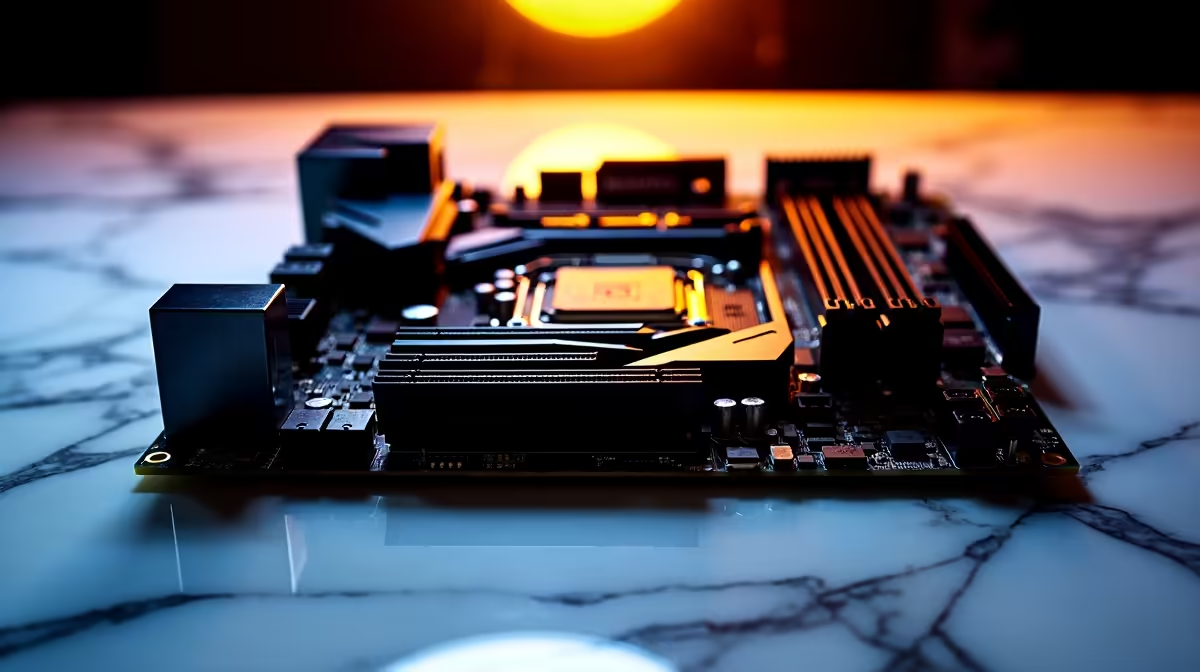
For high-core-count CPUs like the Ryzen 9 7900X, Ryzen 9 9950X, or Intel Core Ultra 9, look for boards with a 12+2 phase VRM or higher. Lower-tier boards with weak VRM stages will let the CPU throttle under sustained load, negating the performance advantage of an expensive processor. Board reviews consistently highlight VRM thermals under sustained load - this is one of the most useful data points to check before purchasing. In SA where a CPU can cost R8,000 to R20,000, protecting that investment with a capable board is a priority.
Storage and Connectivity Essentials for Creators
Content creators live and die by storage bandwidth. A motherboard for a serious creator workstation should offer at minimum two M.2 slots (three is better), with at least one supporting PCIe 4.0 x4. This allows a fast boot/OS drive plus a dedicated project/scratch drive - crucial for video editing where timeline playback performance is tied directly to scratch disk speed.
USB connectivity matters more for creators than for most users. Look for rear-panel USB 3.2 Gen 2 (10 Gbps) ports and, ideally, at least one USB-C Gen 2x2 (20 Gbps) port for fast external drive transfers. If you use a capture card internally, ensure the board has enough PCIe x4 or x16 slots to accommodate both a GPU and a capture card simultaneously without bandwidth sharing causing dropouts during live recording.
Audio creators should check if the board ships with a quality onboard audio codec (Realtek ALC4080 or equivalent) or plan for a dedicated sound card. Ethernet should be 2.5 GbE minimum for fast NAS access - many SA creators back up large project files to a local NAS.
Budget Guidance for SA Creators in 2026
At R3,500–R6,000 a B650 or B760 board covers the needs of most YouTube, streaming, and photography creators. You get multiple M.2 slots, USB-C, and solid VRM quality from reputable brands. This tier pairs well with a mid-range Ryzen 7 or Intel Core i7 processor.
At R6,000–R10,000 you move into X670, X870, or Z790 territory. These boards add more PCIe lanes, better VRM stages, higher USB port counts, and - on select models - onboard Thunderbolt 4. This tier makes sense if you''re working with a Ryzen 9 or Core Ultra 9 processor, or if your workflow relies on Thunderbolt peripherals.
Above R10,000, flagship X870E or Z890 boards offer the highest lane counts and the most expansion slots. These are appropriate for professional video production workstations, multi-GPU inference builds, or creators who need maximum future expandability.
Frequently Asked Questions
Q: Does a content creator need a Z-series or X-series board, or is a B-series enough? A: For most creators - even those editing 4K footage - a B650 or B760 board is sufficient. Upgrade to X or Z series only if you need extensive overclocking, more than two M.2 slots, or Thunderbolt connectivity.
Q: How much RAM can I run on a mid-range creator motherboard? A: Most B650 and B760 boards support up to 128 GB across four DIMM slots, which is more than enough for video editing. Aim for 64 GB DDR5 as a practical starting point for 4K workflows.
Q: Is Wi-Fi necessary on a creator motherboard? A: Not if you use wired Ethernet, which is preferable for NAS access and stable file transfers. Wi-Fi 6E is a useful bonus for flexibility but not a core requirement for a fixed workstation.
Q: What''s the most important spec to not compromise on? A: VRM quality. Cutting corners on a cheap board with a premium CPU will result in CPU throttling under sustained creative workloads, wasting the money spent on the processor.
Ready to Find Your Perfect Match? Shop content creator PC components at Evetech.