AOC's latest 31.5-inch display puts two demanding ideas on the same panel: 5120 x 2880 detail and motion clarity aimed at fast play. The AGON PRO AGP327KG is rated for 144Hz and includes NVIDIA G-SYNC Pulsar. South African buyers should separate the impressive demonstration from the practical cost of driving 5K, then compare it with the in-stock ASUS XG27JCG at R18,299.
Quick Answer
The AGP327KG is a new 31.5-inch 5K 144Hz gaming monitor with G-SYNC Pulsar. No South African price was confirmed. The most direct current Evetech comparison is a 27-inch ASUS dual-mode 5K model at R18,299, while the checked premium monitor sample ran from R7,999 to R18,299.
🖥️ What AOC has actually announced
AOC specifies a 5120 x 2880 panel running at up to 144Hz. That is far more pixel detail than QHD, but the refresh figure alone does not describe the experience. G-SYNC Pulsar combines variable refresh operation with backlight strobing to target clearer moving objects without forcing a fixed refresh relationship.
The independent Gamescom hands-on is useful because a journalist saw the display operating rather than repeating a specification table. It is not a full measurement set. There were no captured latency charts, colour results or South African launch details, so those remain open questions.
The current gaming monitor range shows how broad this category already is. The read-only catalogue sample included QHD OLED and high-refresh options as well as two 5K-related ASUS models. The closest resolution match, the XG27JCG, was R18,299 and offers a 5K 180Hz or QHD 330Hz dual-mode approach.
🎯 The GPU question comes before the panel question
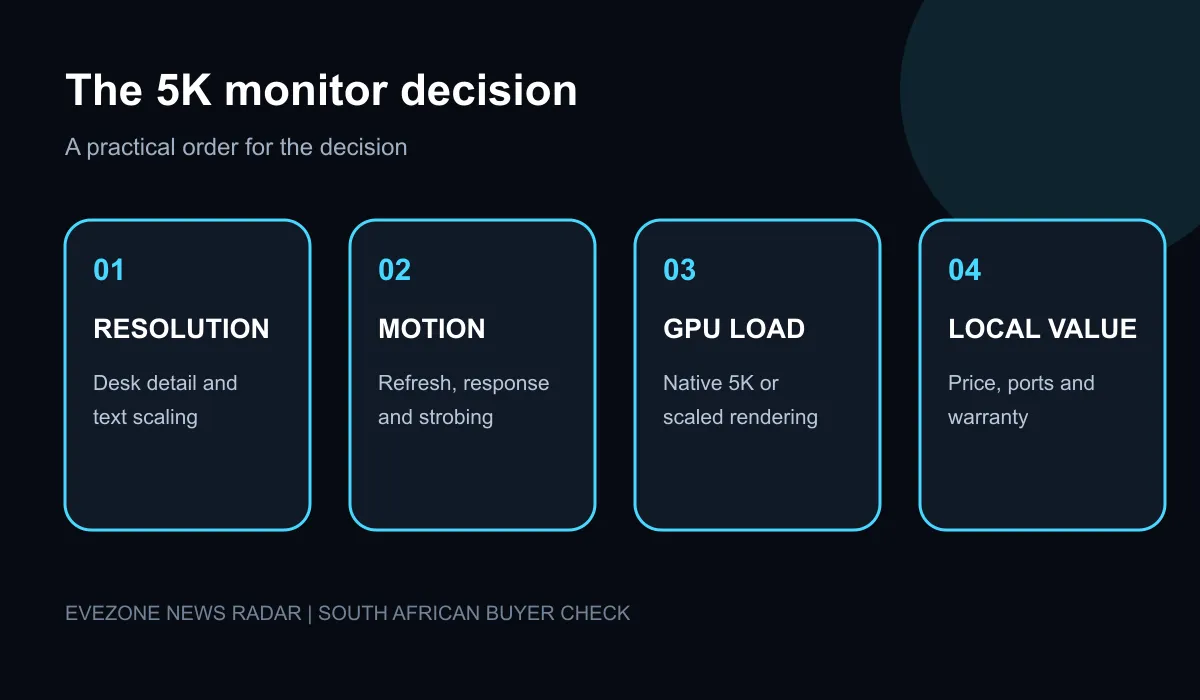
Rendering a modern game at native 5K is a large workload. A buyer who wants high frame rates may need resolution scaling, reduced effects or frame-generation support. Desktop work and detailed single-player games can benefit from the extra pixels even when competitive titles are run at a lower internal resolution.
That makes the intended game library important. A monitor can be excellent for text, creation and slower games yet still need a deliberate performance plan for demanding releases. Check whether the graphics card supports the required DisplayPort or HDMI mode and whether the chosen cable carries the full signal.
🔍 Compare motion clarity, not one headline number
Pulsar is the distinctive part of this launch. Motion clarity can be influenced by pixel response, strobe timing, brightness and frame consistency. A claimed 144Hz panel that keeps moving detail readable may feel different from a faster display with weaker motion handling, but only controlled tests can quantify that difference.
Use the current gaming monitor deals to compare panel type, resolution, adaptive sync, warranty and physical size. A 31.5-inch 5K panel also produces a different viewing density from a 27-inch model, so desk depth and text scaling deserve attention.
No local listing means there is no responsible rand-price prediction yet. Wait for confirmed ports, warranty, availability and independent measurements. The R18,299 comparator is a decision anchor, not a forecast for the AOC.
Frequently Asked Questions
What resolution and refresh rate does the AGP327KG use?
AOC specifies 5120 x 2880 at up to 144Hz on a 31.5-inch panel.
What does G-SYNC Pulsar target?
It combines variable refresh behaviour with strobing to improve perceived motion clarity on compatible systems.
Was a South African price confirmed?
No local AGP327KG price was confirmed. The current ASUS XG27JCG 5K comparator was R18,299.
Is 5K useful for every gaming PC?
No. Native 5K places a heavy load on the GPU, so game settings and scaling still matter.
What should buyers wait for next?
Wait for a confirmed local price, port specification, warranty and independent measurements before deciding.
Ready to compare the right gaming display? Match resolution and motion handling to your graphics card, favourite games and desk before choosing a panel.