Ever lost a clutch in Valorant because your enemy appeared out of nowhere? That split-second hesitation isn't just your ping... it could be your monitor. While 144Hz is solid, the jump to a 240Hz monitor is the secret weapon many South African pros use to gain that critical edge. It’s about seeing the game faster and reacting instantly, turning close fights into definite wins. Ready to see the difference? 🚀
Why 240Hz is the New Standard for Competitive Play
In the fast-paced world of esports, every millisecond counts. A standard 60Hz monitor refreshes the image 60 times per second. A 144Hz monitor more than doubles that. But a 240Hz monitor? It updates the screen a blistering 240 times per second. This isn't just a number on a box; it's a tangible performance boost.
The result is exceptionally smooth motion, drastically reduced input lag, and superior target tracking. Imagine trying to snap to an enemy strafing across your screen. On a lower refresh rate display, they might appear to stutter or blur. With the pro esports advantage of 240Hz, their movement is rendered with buttery-smooth clarity, making your aim more intuitive and precise. It's no wonder that for serious competitors, 240Hz monitors in South Africa are becoming the new baseline for performance.
Can Your Rig Actually Handle a 240Hz Monitor?
Before you jump on the 240Hz train, there's a crucial question: can your PC keep up? To truly benefit from a 240Hz display, your graphics card needs to consistently push 240 frames per second (FPS) in your favourite games. If your PC struggles to hit 100 FPS, a 240Hz monitor won't magically fix that.
For esports titles like CS2, Valorant, or Apex Legends, which are optimised for high frame rates, a modern mid-range GPU (like an NVIDIA RTX 4060 or AMD RX 7700 XT) can often do the trick, especially at 1080p resolution. For more demanding AAA titles, you'll need some serious graphical horsepower. It's all about matching your hardware to ensure you get the performance you're paying for when you explore the full range of PC monitors. ⚡
Check Your FPS First 🔧
Before upgrading, run your main competitive game with graphics settings on low and V-Sync off. Check your average FPS counter. If it's consistently pushing above 200 FPS, you're primed for a 240Hz upgrade that you will absolutely feel.
Finding the Best 240Hz Monitors in South Africa
So, you've confirmed your rig is ready and you want that competitive edge. What should you look for? The market for 240Hz monitors in South Africa is buzzing with fantastic options.
Key Features to Consider:
- Resolution: 1080p (1920x1080) is the sweet spot for competitive gaming at 240Hz, prioritising frame rate over pixel density. 1440p 240Hz models offer a sharper image but require a top-tier GPU.
- Panel Type: IPS panels deliver the best colour accuracy and viewing angles, while modern VA panels offer great contrast. Both are excellent choices for gaming today.
- Response Time: Look for a 1ms GtG (Grey-to-Grey) response time or lower to eliminate ghosting and motion blur.
- Adaptive Sync: G-Sync (NVIDIA) or FreeSync (AMD) compatibility is essential to prevent screen tearing for a flawless visual experience.
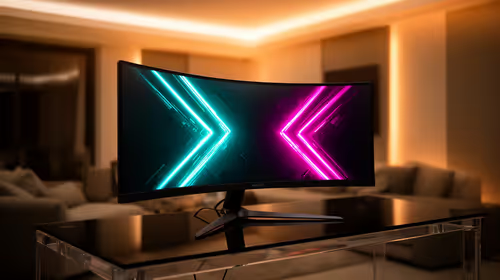
Whether you're after a flat panel for pure competitive focus or one of the immersive curved monitors for a more cinematic feel, there's a model tailored for you. Keep an eye out for Evetech's best PC monitor deals to snag a high-performance display at a great price in ZAR. ✨
Claim Your Pro Esports Advantage Today Stop letting your hardware hold you back. Experience the ultra-smooth gameplay and lightning-fast response that gives champions their edge with our range of all gaming monitors and leave lag in the dust.