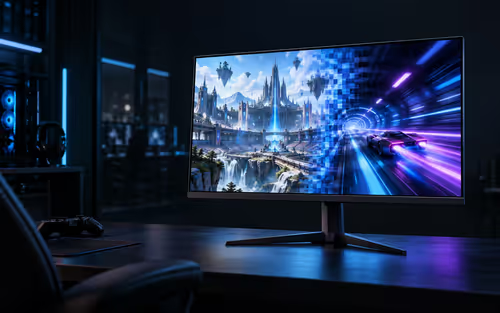
You’re lining up the perfect headshot in Valorant. It’s a 1v1 clutch situation. You peek, you click… and you’re staring at the respawn screen. Could a faster monitor have made a difference? As we head into 2026, the debate rages: 360Hz vs 500Hz. Is chasing those extra frames the key to victory, or just an expensive flex? Let’s break down whether the jump to a 500Hz monitor actually matters for South African gamers.
The Refresh Rate Race: What Do the Numbers Mean?
Before we dive into the 360Hz vs 500Hz comparison, let's get a quick refresher. A monitor's refresh rate, measured in Hertz (Hz), is how many times per second the screen can draw a new image. A 360Hz monitor updates 360 times per second. Simple enough.
This means your monitor can display up to 360 frames per second (FPS), provided your graphics card is powerful enough to produce them. The result is incredibly smooth motion and lower input lag, giving you a tangible edge in fast-paced games. But the question is, where does the benefit stop?
360Hz vs 500Hz: A Game of Milliseconds
The jump from an old 60Hz screen to 144Hz is life-changing. The jump from 144Hz to 240Hz or 360Hz is still noticeable, especially for highly competitive players. But the leap from 360Hz to 500Hz is a different beast entirely.
Let’s look at the time it takes to render a new frame:
- 360Hz: One new frame every ~2.78 milliseconds.
- 500Hz: One new frame every ~2.00 milliseconds.
That’s a difference of just 0.78 milliseconds. 찰
For 99% of gamers, even those playing at a high level, this difference is practically imperceptible. Your own human reaction time has far more variance. However, for professional esports athletes whose careers are built on micro-advantages, that tiny sliver of extra motion clarity and reduced latency could theoretically be the difference in a tournament final. For the vast majority of titles and gamers, the difference is academic, but it's a hot topic when browsing the latest PC monitors.
Optimise Your Input Lag 🔧
Beyond refresh rate, ensure you're getting the fastest response from your PC. In the NVIDIA Control Panel, set "Low Latency Mode" to "Ultra". For AMD users, enable "Radeon Anti-Lag". Also, always play in exclusive full-screen mode and disable any in-game or Windows overlays to minimise processing delays.
Can Your Rig Even Handle 500Hz Gaming?
Here’s the reality check. To get any benefit from a 500Hz monitor, you need a PC that can consistently push 500+ FPS in your chosen game. This isn't just a top-tier graphics card; you need a flagship CPU to match, as high frame rates are often CPU-bound, especially at 1080p (the standard resolution for these displays).
Running Valorant or CS2 at 500+ FPS is achievable with a high-end setup. But for more graphically demanding titles like Apex Legends or Warzone? It’s a massive challenge, even for the best hardware on the market in 2026. The extra frames from a 500Hz monitor don't matter if your PC can't deliver them.
Beyond Hertz: Finding the Real Sweet Spot
Chasing the highest refresh rate isn't always the smartest move. A great gaming experience is about the total package. For most competitive gamers in South Africa, the real value lies in the balance. There's a massive range of excellent 170Hz to 240Hz options that deliver incredible smoothness without needing a supercomputer.
Here are other critical factors to consider:
Panel, Shape, and Sync
Panel technology plays a huge role in visual quality. While older TN panels were faster, modern IPS panels now offer blistering response times with far superior colour accuracy. Then there's the shape. Do you go for the focused immersion of curved monitors or stick with tournament-standard flat screens?
And let's not forget screen tearing... a thing of the past thanks to variable refresh rate tech. Whether your GPU supports NVIDIA's G-Sync, AMD FreeSync, or the general Adaptive Sync standard, it's a must-have feature. 🚀
The Verdict: Do Extra Frames Matter in 2026?
So, should your next upgrade be a 500Hz monitor? For the overwhelming majority of gamers, the answer is no. The law of diminishing returns hits hard after 360Hz.
The 360Hz vs 500Hz debate is less about a clear winner and more about understanding your own needs. If you're a professional esports athlete with a sponsor-funded, top-of-the-line rig, the marginal gain from 500Hz might be worth it. For everyone else, your money is better invested in a well-rounded 240Hz or 360Hz monitor with a great panel, perfect resolution, and features that enhance your overall gaming experience.
Ready to Find Your Perfect Match? The 360Hz vs 500Hz debate is for the top 1%, but finding the right monitor for your rig is what truly elevates your game. From buttery-smooth gameplay to stunning visuals, the perfect screen awaits. Explore our massive range of gaming monitors and find the display that's right for you.