Quick Answer
For most South African home cinema setups, a 4K standard throw projector delivers superior image quality and flexibility, while an ultra short throw projector solves the problem of limited space and cabling in smaller rooms. If your room is 4m or longer and you can manage the cable run, a 4K standard projector wins on brightness, contrast, and price per lumen. In a compact flat, lounge, or res room where you sit closer to the wall, an ultra short throw unit is the practical choice.
How Each Projector Type Works and Why It Matters
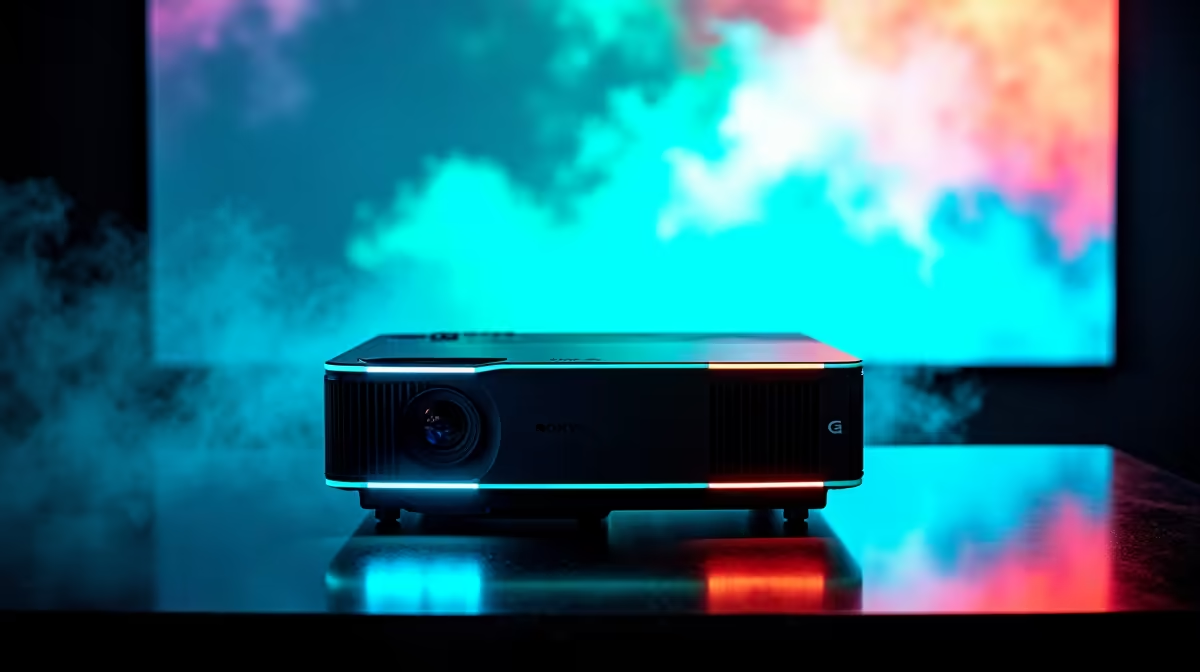
A traditional 4K projector sits on a shelf or ceiling mount at the back of the room, typically 3 to 5 metres from the screen or wall, and casts its image forward across that distance. The long throw ratio gives the lens room to produce a large, bright picture. These projectors are well-established technology: lamps, LEDs, or laser light sources are all readily available, and the optics are mature. An ultra short throw (UST) projector sits on a low cabinet or floor stand just 20 to 30 centimetres from the projection surface and uses a specialized wide-angle lens or mirror system to throw a large image at extreme angles. The benefit is obvious: no projector hanging from your ceiling, no cable running the length of your room, and no shadow problem if someone walks between the unit and the screen. The trade-off is optical complexity. UST lenses are more expensive to manufacture precisely, which is why ultra short throw units at equivalent brightness and resolution cost significantly more than standard throw projectors. A 4K UST laser projector from a reputable brand in South Africa in 2026 starts around R18,000 to R25,000. A comparable 4K standard throw laser projector with similar brightness might be R9,000 to R15,000. ## Image Quality: Contrast, Brightness, and 4K Sharpness
Brightness is measured in ANSI lumens, and this is where standard throw projectors maintain an advantage at equivalent prices. A mid-range 4K lamp or LED projector at R12,000 often delivers 3,000 to 3,500 ANSI lumens. UST projectors at the same price point may offer 2,000 to 2,500 lumens, which is sufficient in a darkened room but struggles against ambient light from a window or ceiling light. Contrast ratio is where UST laser projectors can compete very well. The laser light source in premium UST units produces deep blacks by modulating the light source directly, rather than relying on a physical iris. In a room with controlled lighting, a quality UST unit can match or exceed a lamp-based 4K standard projector on perceived contrast. For 4K sharpness, both types deliver genuine 4K (3840x2160) at the premium end of their respective ranges. However, many so-called 4K standard throw projectors in the R8,000 to R12,000 range use pixel-shifting technology to simulate 4K from a 1080p chip. True 4K imaging chips (DLP 0.47-inch or Sony SXRD/JVC D-ILA) appear mostly above R20,000 in either category. In practical viewing at 2 to 4 metres from a 100-inch screen, pixel-shifted 4K looks excellent for most content. ## Room Setup Considerations for South African Homes
South African homes present specific challenges. Many older houses and apartments were not built with home cinema in mind, meaning ceiling cable runs require chasing walls or unsightly conduit. A UST projector eliminates this by sitting on an entertainment unit alongside your soundbar and media player. Flat or townhouse living, particularly in urban Joburg, Cape Town, and Durban, often features open-plan lounges where the couch is 2 to 3 metres from the wall. A standard throw projector in this scenario may require a long extension or cable management that is impractical. UST shines here. In a dedicated home cinema room, garage conversion, or entertainment room, a ceiling-mounted standard throw 4K projector is the better long-term investment. The image geometry is more consistent over time (no objects near the projection surface to cause shadows or reflections), and servicing lamp-based units is straightforward. Loadshedding is another real factor. Both projector types draw significant power: standard throw lamp projectors typically consume 250 to 350W in lamp mode, while laser UST projectors consume 200 to 400W depending on brightness mode. A 1,000W UPS runtime calculation shows that even a high-end laser projector can run for 90 to 120 minutes on a decent 1.5kVA UPS paired with a 100Ah battery, enough to see out most Stage 2 loadshedding cycles. ## Price vs Value in the SA Market 2026
For value, a 4K standard throw projector in the R9,000 to R14,000 range from brands like BenQ, Optoma, or Epson offers the best lumens-per-rand ratio for dark room home cinema. These pair well with a 100-inch or 120-inch projection screen or a well-prepared flat white wall. UST projectors justify their premium if your room layout physically cannot accommodate a rear-mounted standard throw unit, or if you want an all-in-one lifestyle piece that includes smart TV functionality, built-in speakers, and a clean minimal aesthetic. A 4K TV at similar price points is also worth comparing: a 75-inch 4K TV at R12,000 to R18,000 delivers higher peak brightness, no lamp or maintenance costs, and more reliable performance under loadshedding (lower wattage draw, easier to run on a UPS). The projector wins on screen size at that price, delivering 100 inches or more vs a TV's 75 to 85 inches. ## Frequently Asked Questions
What screen size can I get from a standard 4K projector vs UST at 3 metres? A standard 4K projector at 3 metres throw typically produces a 90 to 110-inch image depending on the throw ratio. A UST projector at 30cm from the wall produces 80 to 120 inches depending on the model. Both can easily achieve the 100-inch sweet spot for home cinema. Do ultra short throw projectors work with a standard flat wall or do I need a special screen? UST projectors work on a flat white wall, but they benefit significantly from an ALR (ambient light rejecting) screen designed for UST use. A standard matte white screen can cause hot spots or uneven brightness with UST optics. ALR screens for UST in South Africa start around R3,000 to R6,000 for a 100-inch fixed frame version. Is 4K important for a home cinema projector or is 1080p good enough? At 100 inches or larger, 4K is noticeably sharper when sitting within 3 metres of the screen. For a more distant seating position of 4 metres or more, the difference is subtler. 4K content via streaming (Netflix, Disney+) and 4K Blu-ray takes full advantage of the resolution at large screen sizes. How do projectors hold up during South African loadshedding? Laser projectors tolerate frequent power interruptions better than lamp-based units. Lamp projectors require a cooling cycle before power is cut, and abrupt shutoffs can shorten lamp life significantly. Laser and LED projectors have no such requirement. If you use a lamp projector, pair it with a UPS that gives a safe 5-minute shutdown window.
Ready to Find Your Perfect Match? Explore display solutions at Evetech, from monitors to home cinema components, and build your ideal viewing setup.