Quick Answer
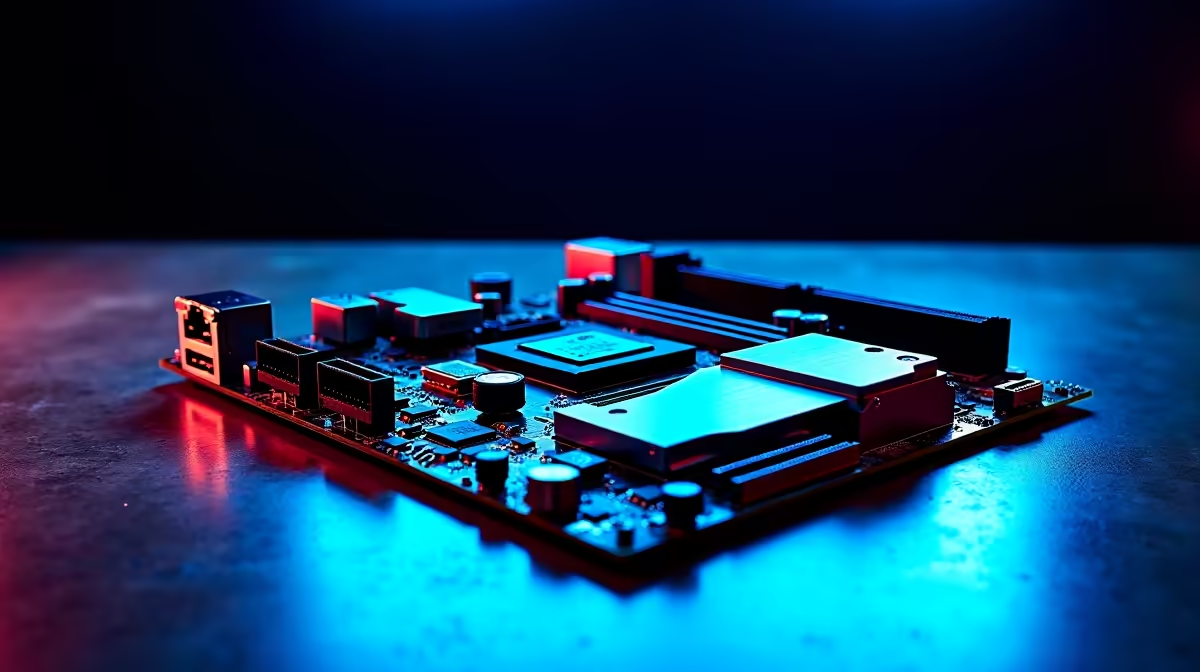
For most SA buyers in 2026, the B760 motherboard is the right choice - it supports Intel 12th, 13th, and 14th gen CPUs, provides PCIe 4.0 for storage and graphics, and costs R1,500 to R3,000 less than equivalent Z790 boards. The Z790 is only worth its premium if you specifically need CPU overclocking, extensive PCIe 5.0 lane access, or multiple M.2 drives at maximum speed. For gaming builds and standard workstations, B760 delivers equivalent real-world performance.
The B760 vs Z790 decision is one of the most common platform questions for Intel 12th to 14th gen builds in South Africa in 2026, and the marketing around chipset tiers often obscures a straightforward answer. Both chipsets use the LGA1700 socket, support the same processor range, and deliver identical gaming performance when paired with the same CPU and RAM. The difference lies in what each chipset enables beyond the baseline, and whether those additional capabilities are worth R1,500 to R3,500 extra in a South African context where every rand in the build budget matters.
What B760 Offers and Where It Fits
The B760 chipset supports the full Intel Core 12th, 13th, and 14th generation processor lineup in LGA1700 but locks CPU multiplier overclocking. This limitation is less consequential than it sounds - Intel's non-K processor variants (Core i5-12400, i5-13600, i7-13700, etc.) are not multiplier-unlocked regardless of motherboard, so the B760's overclocking restrictions only matter if you specifically purchase a K-series CPU like the Core i7-14700K.
For a Core i5-13600 or i7-13700 paired with DDR5 memory, a quality B760 board provides the full performance these processors are capable of delivering. Gaming benchmarks between B760 and Z790 systems running identical CPUs and RAM show differences within margin of error - often less than 2% FPS variance, which is meaningless in real-world play.
B760 boards typically offer two M.2 slots (PCIe 4.0 x4), adequate USB connectivity, and robust VRM designs on quality mid-range models. For most gaming builds, content creation workstations, and home office systems in SA, this is entirely sufficient.
What Z790 Adds and Who Actually Needs It
Z790 justifies its premium through several specific capabilities. First and most important: CPU multiplier overclocking on K-suffix Intel processors. If you purchase a Core i7-14700K, Core i9-14900K, or similar unlocked CPU, you need a Z790 board to access overclocking capabilities - a B760 will run the K CPU but at stock settings only, completely eliminating the reason to purchase the more expensive processor.
Z790 boards generally offer more M.2 slots (three to five on quality boards), PCIe 5.0 M.2 support for next-generation NVMe drives, additional PCIe lanes for expansion cards, and enhanced memory overclocking (XMP 3.0) profiles. For content creators running multiple NVMe drives, video professionals who use PCIe capture cards alongside GPU setups, or enthusiasts who specifically want to extract maximum performance from K-series CPUs, these features are genuinely useful.
Z790 boards also typically feature more robust VRM designs for sustained heavy CPU loads, which matters for professional workloads (3D rendering, video encoding) more than gaming. Modern Intel CPUs with efficient cores handle sustained gaming loads fine on quality B760 boards.
SA Market Pricing and Practical Build Advice
In South Africa's 2026 market, the price gap between comparable B760 and Z790 boards is R1,500 to R3,500 depending on the brand tier. At the entry level, a quality B760 board from ASUS, MSI, or Gigabyte sits in the R2,500 to R3,500 range. Equivalent Z790 boards start at R4,000 and quality mid-range Z790 options reach R7,000+.
The practical build advice for SA buyers: if your budget is R15,000 to R25,000 for a complete build, the R2,000+ saved on a B760 board versus a Z790 is better reallocated to a faster GPU, more RAM, or a larger SSD. The performance return on that GPU or RAM upgrade will always exceed the marginal real-world benefit of the Z790 platform in a gaming context.
The exception is AMD-platform consideration - while this article focuses on Intel chipsets, SA buyers should note that AMD's B650 vs X670 decision follows a very similar logic, and AMD's AM5 platform with its stronger long-term socket support may be compelling for new builds regardless of the B vs X tier choice.
Frequently Asked Questions
Q: Can I use an Intel Core i9 K-series CPU on a B760 motherboard? A: Yes, but you will not be able to overclock the CPU multiplier, eliminating the primary reason to purchase a K-series processor. If you want a K-series CPU, pair it with Z790 to access its overclocking capability.
Q: Does B760 support PCIe 5.0 for graphics cards? A: Most B760 boards provide a PCIe 5.0 x16 primary slot for the graphics card, which is where PCIe 5.0 GPU support matters. PCIe 5.0 M.2 support is more limited on B760 compared to Z790, affecting next-gen NVMe drive speeds rather than GPU performance.
Q: Is B760 or Z790 better for DDR5 memory in SA builds? A: Both support DDR5 (and DDR4 depending on the specific board variant). Z790 generally supports higher memory overclocking frequencies (above DDR5-6400) via XMP profiles, while B760 supports standard XMP 3.0 profiles up to DDR5-6000 on quality boards. For gaming, DDR5-5600 to DDR5-6000 is the performance sweet spot and both chipsets handle it.
Q: Will B760 be compatible with Intel 15th gen processors? A: Intel 15th gen (Arrow Lake) uses the LGA1851 socket and is not compatible with LGA1700 B760 boards. The LGA1700 platform (B760/Z790) supports 12th, 13th, and 14th gen Intel processors. Future-proofing arguments for LGA1700 extend across those three generations but not beyond.
Ready to Find Your Perfect Match? Find the best motherboard and PC component deals in South Africa - shop Evetech today.