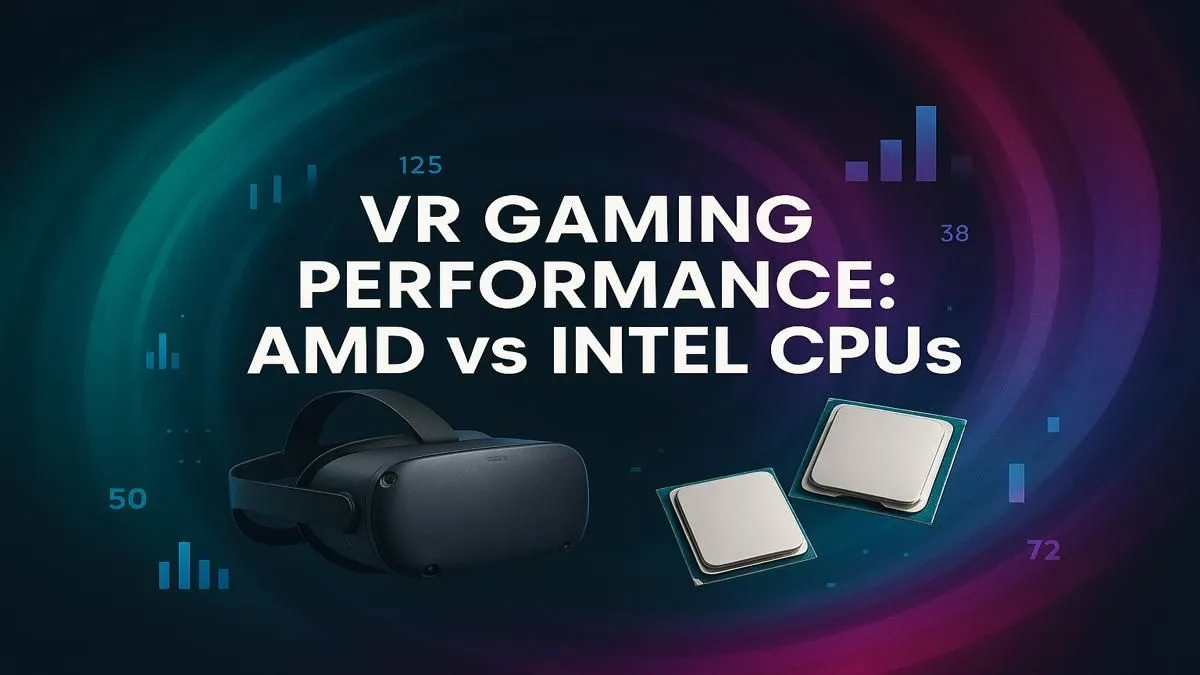
Stutter. The one word that shatters VR immersion. You’re about to land a headshot in Pavlov or nail a perfect combo in Beat Saber, and suddenly… the world judders. It’s frustrating, and often, the culprit isn’t your GPU. It’s your processor. Choosing the best CPU for VR gaming is crucial, and in South Africa, the age-old AMD vs. Intel battle has never been more intense. Let’s settle the score.
Why Your CPU is Critical for Smooth VR Gaming
While your graphics card (GPU) handles the heavy lifting of rendering those immersive worlds, the CPU is the brain of the operation. In virtual reality, its job is even more demanding. The CPU manages game logic, physics calculations, AI behaviour, and crucially, positional tracking for your headset and controllers.
If your processor can't keep up, it creates a bottleneck, failing to feed your GPU data fast enough. This results in dropped frames and inconsistent "frametimes," which cause that dreaded stutter. For VR, smoothness is everything. That’s why selecting the right central processing unit is non-negotiable for a good experience. 🔧
Key CPU Specs That Matter for VR Performance
When comparing processors, it's easy to get lost in specs. For VR gaming performance, these are the ones that truly matter.
Single-Core Speed
Many games, including VR titles, still rely heavily on the performance of a single CPU core. A higher clock speed (measured in GHz) on a single core often translates to snappier performance and higher frame rates in these scenarios. It ensures the main game thread runs without a hitch.
Core Count & Threads
While single-core speed is key, having multiple cores is essential for modern gaming. Extra cores handle background tasks—like your operating system, Discord, or streaming software—without interrupting your game. Newer VR games are also getting better at using multiple cores, making a 6 or 8-core CPU a safe bet for the future.
Cache Size (Especially L3)
Think of cache as super-fast, on-chip memory. A larger L3 cache allows the CPU to access frequently used game data instantly, reducing the time it takes to fetch it from your system's RAM. This directly lowers latency, which is a massive factor in making VR feel responsive and real.
VR Benchmarking Tip ⚡
Standard gaming benchmarks don't tell the whole story for VR. Look for reviews that specifically test 'frametimes' or '1% lows'. Consistent frametimes are more important than a high average FPS for avoiding nausea-inducing stutters. A CPU that delivers smooth, predictable frames is a VR champion.
The AMD vs Intel Showdown for the Best VR CPU
So, who takes the crown in the best CPU for VR gaming face-off? Both teams bring serious firepower to the table, but they excel in slightly different ways.
Team Blue: Intel's Performance Powerhouses
Intel has long been praised for its incredible single-core performance, making its processors a fantastic choice for gaming. With their innovative Performance-core (P-core) and Efficient-core (E-core) architecture, Intel's current CPU offerings are brilliant at balancing high-intensity gaming with background processes. For gamers who also stream or multitask, a modern Intel Core i5 or i7 provides a powerful and well-rounded foundation for a VR rig.
Team Red: AMD's 3D V-Cache Kings 🚀
AMD shook up the gaming world with its 3D V-Cache technology, featured in processors with the "X3D" suffix. By stacking a huge amount of L3 cache directly onto the chip, these CPUs drastically reduce latency and provide a significant performance boost in many games. For pure, unadulterated VR gaming performance, it's hard to argue against the raw power that AMD's powerful Ryzen CPUs, especially the X3D models, bring to the fight. They are purpose-built to eliminate stutter.
So, who wins? For a pure gaming focus where every frame counts, AMD's X3D chips often have the edge. For an excellent all-around PC that excels at VR, multitasking, and productivity, Intel remains a top-tier competitor.
Ready to Build a Stutter-Free VR Rig? The debate over the best CPU for VR gaming is fierce, but the right choice depends on your budget and goals. Don't let your processor bottleneck your immersion. Design your ultimate VR-ready PC with our builder and pair the perfect CPU with the right components today.