Ah, the late-game slog. You’ve built a sprawling empire, your rivals are plotting across the globe, and you hit "End Turn." Then… you wait. And wait. As Civilization VII looms on the horizon, the thought of those agonising turn times is enough to make any strategy fan nervous. But what if the secret to a snappier, more enjoyable "one more turn" experience isn't just your CPU, but your storage? It’s time to talk about the best SSDs for strategy games.
A lightning-fast Solid State Drive (SSD) does more than just load the game faster. Strategy titles like Civilization, Total War, or StarCraft are constantly reading and writing thousands of tiny files to track unit positions, AI decisions, and world states. A sluggish hard drive chokes on this data, leading to stuttering and those painfully long waits between turns. Upgrading is one of the most impactful improvements you can make, and our complete range of solid-state drives offers a solution for every build and budget. ⚡
Why NVMe is the Key to Shorter Turn Times
When choosing the best SSD for strategy games, the conversation quickly turns to NVMe vs. SATA. Think of a SATA SSD as a reliable delivery van on a busy city road—it gets the job done, but it's limited by traffic. An NVMe (Non-Volatile Memory Express) SSD, on the other hand, is like a freight train on its own dedicated, high-speed track.
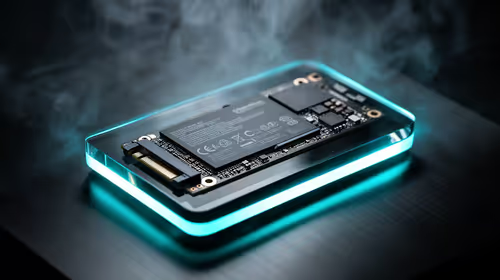
It plugs directly into your motherboard's PCIe slot, bypassing older data transfer protocols entirely. This direct line to your CPU results in dramatically lower latency and massively higher bandwidth. For a game like Civ VII, which needs to process huge amounts of AI data simultaneously, this means calculations happen faster and your next turn arrives sooner. These drives are the gold standard, and you can explore our full selection of NVMe SSDs to see the latest Gen4 and Gen5 models. Whether you're building a new rig or upgrading an old one, browsing all available SSDs will give you a clear picture of your options.
Specs That Matter for Strategy Gamers
Chasing the highest sequential read/write speed isn't the whole story for strategy games. While those big numbers are great for transferring large video files, you should pay closer attention to a spec called IOPS (Input/Output Operations Per Second).
IOPS: The Unsung Hero
High IOPS means the drive excels at handling thousands of small, random read/write requests at once. This is exactly what happens when a game's engine is simulating a complex world with countless variables. A drive with strong random read/write IOPS will feel noticeably snappier during gameplay, not just on loading screens.
You don't have to break the bank to get great performance. Keep an eye on Evetech's best SSD deals to snag a high-speed drive for a lekker price in ZAR. 🚀
Check Your Motherboard! 🔧
Before buying a top-tier Gen4 or Gen5 NVMe SSD, check your motherboard's specifications. Plugging a Gen4 drive into a Gen3 M.2 slot will work, but its speed will be limited to Gen3 levels. To get the full performance you paid for, ensure your board has a matching PCIe slot available. It’s a quick check that prevents a serious performance bottleneck!
Can You Run Strategy Games From an External SSD?
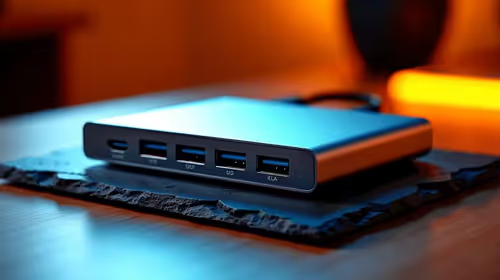
What if you're playing on a laptop with limited internal storage, or you just don't want to crack open your PC case? Good news! Modern external SSDs are faster than ever. A drive connected via Thunderbolt or USB 3.2 Gen 2x2 can deliver incredible speeds, often fast enough to rival internal SATA SSDs.
While an internal NVMe will always offer the lowest latency, a high-quality portable drive is more than capable of running your entire Steam library, including demanding strategy titles. For gamers on the go or those needing extra space without the fuss, a high-speed external SSD is a fantastic and flexible solution. ✨
Ready to End the Wait? A fast SSD is the ultimate quality-of-life upgrade for any strategy fan. Stop waiting for the AI and spend more time conquering the world. Explore our massive range of SSD specials and find the perfect drive to make your next turn instant.