You’ve just dropped some serious ZAR on a shiny new GPU, expecting glorious, high-FPS gameplay. But when you fire up Apex Legends, your frames are still stuttering and dropping. What gives? 🤔 You might be facing a classic CPU bottleneck, where your processor can’t keep up with your powerful graphics card.
Don’t stress, this is a common issue for PC builders in South Africa. This guide provides a step-by-step CPU bottleneck fix to help you diagnose and solve the problem.
What is a CPU Bottleneck, Exactly?
Think of your PC as a production line. Your CPU (Central Processing Unit) prepares the data—the game's instructions and logic—and your GPU (Graphics Processing Unit) renders that data into the beautiful images you see on screen.
A CPU bottleneck happens when your GPU is a beast, capable of rendering frames much faster than your CPU can prepare them. Your powerful graphics card ends up waiting around, which leads to stuttering, low frame rates, and a gaming experience that feels... well, pap.
How to Spot a CPU Bottleneck 🔧
Before attempting any fix, you need to confirm a bottleneck is actually your problem. The easiest method is to use monitoring software while you’re in a game.
- Get the Tools: Download a free tool like MSI Afterburner with RivaTuner Statistics Server.
- Set it Up: Configure the on-screen display to show both CPU usage (per core) and GPU usage.
- Run a Game: Play a demanding game at your usual resolution (e.g., 1080p or 1440p).
The Telltale Sign: If your GPU usage is consistently below 95-99% while one or more of your CPU cores are maxed out at 100%, you have a CPU bottleneck. This is especially common in fast-paced competitive titles at lower resolutions.
Your Step-by-Step CPU Bottleneck Fix Guide
Ready to get your performance back on track? We’ll start with the free software tweaks before moving on to hardware solutions. This approach to a CPU bottleneck fix ensures you don't spend money unless you have to.
Step 1: Software Tweaks (The Free Fixes)
These adjustments can often provide a noticeable improvement without costing you a cent.
- Lower CPU-Intensive Settings: In your game’s graphics settings, try reducing options that heavily rely on the CPU. These often include "object detail," "shadow quality," "physics," and "view distance."
- Close Background Processes: That browser with 50 tabs open? Your Discord stream? All these apps consume CPU cycles. Close everything you don’t absolutely need while gaming.
- Increase Game Resolution: This might sound counterintuitive, but running your game at a higher resolution (or using super-sampling) puts more load on your GPU. This can help balance the workload, forcing your GPU to work harder and reducing the bottleneck.
- Update Your Drivers & BIOS: Ensure your chipset drivers, graphics drivers, and motherboard BIOS are all up to date. These updates often include performance optimisations.
Free Performance Boost ⚡
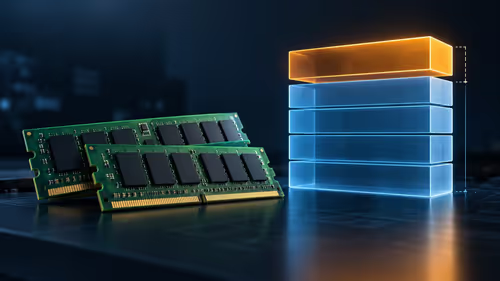
Check your motherboard's BIOS UEFI for a setting called XMP (Extreme Memory Profile) or DOCP (Direct Overclock Profile). If it's disabled, enabling it will run your RAM at its advertised speed, which can give your CPU a surprising performance lift in games. It's one of the easiest ways of solving a CPU bottleneck without opening your wallet.
Step 2: Hardware Solutions (The Real Fix)
If software tweaks don't cut it, it’s time to consider a hardware change. This is the most effective way to fix a significant CPU bottleneck.
- Overclocking: If you have an unlocked CPU (like an Intel "K" series or most AMD Ryzen chips) and good cooling, you can manually increase its clock speed. This is a more advanced fix and carries some risk, but it can squeeze extra performance out of your existing hardware.
- The Ultimate Fix... A CPU Upgrade: Sometimes, your processor is just too old or underpowered for your GPU. Upgrading is the most reliable long-term solution. A modern CPU will have more cores, higher clock speeds, and a more efficient architecture, allowing it to feed your GPU all the data it needs. When you're ready to explore your options, you can find a massive selection of CPU processors online to suit any budget.
Choosing the Right CPU Upgrade 🚀
Deciding on a new processor can be tough, but it boils down to balancing your budget and performance needs.
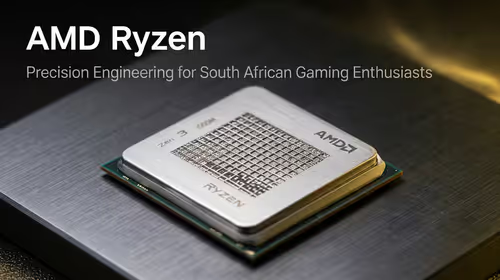
For many South African gamers, the choice is between two giants. On one side, you have the latest AMD CPU options, which often provide incredible multi-core performance and value for money, making them fantastic for both gaming and productivity.
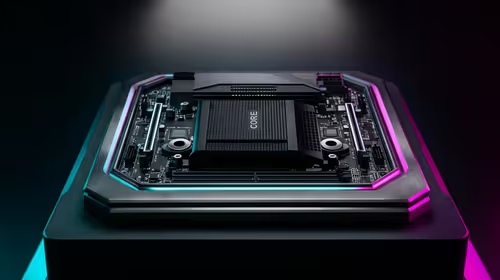
On the other hand, a powerful Intel CPU often leads the pack in raw single-core gaming speed, delivering some of the highest possible frame rates in competitive titles.
The key is to match your CPU to your GPU. Pairing a new Ryzen 7 or Core i7 with a modern RTX 40-series or RX 7000-series graphics card is a recipe for a perfectly balanced, high-performance gaming rig.
Ready to End the Stutter for Good?
A CPU bottleneck doesn't have to hold your powerful graphics card hostage. The right processor unlocks the smooth, high-FPS experience you paid for. Explore our massive range of CPU deals and find the perfect chip to unleash your PC's true power.