Just dropped some serious cash on a beastly new graphics card, only to find your frame rates in Apex Legends are... meh? It’s a classic Mzansi gamer frustration. Before you blame the GPU, the real culprit might be hiding in plain sight: a CPU bottleneck. This performance-killer happens when your processor can't keep up with your graphics card, effectively putting a speed limit on your entire rig. Let's break down what it is and how to fix it.
Understanding the CPU Bottleneck Phenomenon
Think of your PC as a production line. The CPU (Central Processing Unit) is the worker that prepares tasks (game frames), and the GPU (Graphics Processing Unit) is the artist that renders them into the beautiful visuals you see on screen.
A CPU bottleneck occurs when the worker (CPU) can't prepare tasks fast enough for the artist (GPU). Your powerful GPU ends up waiting around, twiddling its thumbs, with nothing to do. The result? Lower frame rates, stuttering, and a gaming experience that doesn't live up to your hardware's potential. This is especially common in CPU-heavy games like Cyberpunk 2077 or strategy titles like Civilization VI.
How to Spot a CPU Bottleneck in Your Rig 🔧
Suspect you have a processor bottleneck? Don't guess... test! The proof is in the performance metrics. Here’s a simple way to check:
- Fire up your game and load into a busy area.
- Open a monitoring tool. The NVIDIA or AMD overlay works, but MSI Afterburner is the gold standard. Alternatively, Windows' own Task Manager (Ctrl+Shift+Esc) can give you a quick overview under the "Performance" tab.
- Check the numbers. Play for a few minutes and watch your CPU and GPU usage percentages.
If your CPU usage is consistently high (90-100%) while your GPU usage is chilling out at a much lower percentage (e.g., 60-70%), you've found your CPU bottleneck. Your graphics card has more to give, but the CPU is holding it back.
Check Your Cores! 💡
Don't just look at overall CPU usage. Some games, especially older titles, don't use all your processor cores efficiently. You might see 50% total usage, but one or two cores are maxed out at 100%, causing a hidden CPU bottleneck. Use a tool like MSI Afterburner to monitor individual core loads and get the real story.
Practical Steps to Fix Your CPU Bottleneck
Once you've confirmed a bottleneck, you have a few options to restore balance to your PC. Let's start with the free fixes before talking hardware.
Optimise Your In-Game Settings
Before you reach for your wallet, try tweaking your game's graphics settings. Some settings hit the CPU harder than others. Lowering options like:
- Shadow Quality
- Object Detail / Draw Distance
- Physics Simulations
- Crowd or NPC Density
...can ease the load on your processor, allowing it to prepare frames more quickly and feed your hungry GPU.
Upgrade Your Processor 🚀
Sometimes, software tweaks aren't enough. If you're running an older quad-core CPU with a new RTX 40-series card, the performance gap is just too wide. Upgrading your CPU is the most effective way to fix a severe CPU bottleneck.
Choosing a new processor means deciding what's right for your motherboard and budget. Whether you're Team Blue and looking at the latest Intel CPUs, there are incredible options for every tier of gaming.
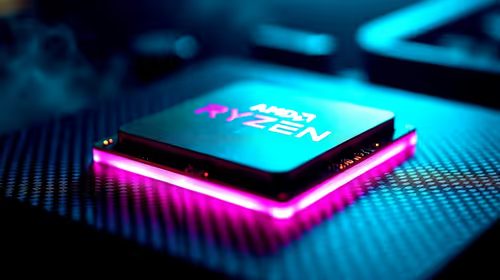
Of course, the competition is fierce, and many gamers are repping Team Red with AMD's powerful Ryzen lineup, known for excellent multi-core performance and value.
Ultimately, a new chip is the most direct way to solve this performance issue. Finding the right one is crucial, and Evetech has a massive range of CPU processors online to get your rig perfectly balanced.
Increase Your Resolution (Yes, Really!)
This sounds backwards, but it works. If you're bottlenecked at 1080p, jumping to 1440p or 4K puts more stress on the GPU. This forces the GPU to work harder, bringing its usage up and balancing the load. You might not get more frames, but you'll get a higher-fidelity image and a smoother experience by making better use of the hardware you already own. ✨
Ready to Obliterate That Bottleneck? Don't let a sluggish CPU hold your high-end GPU hostage. A balanced PC is a happy PC. Explore our massive range of powerful CPU processors and find the perfect upgrade to unlock peak performance today.